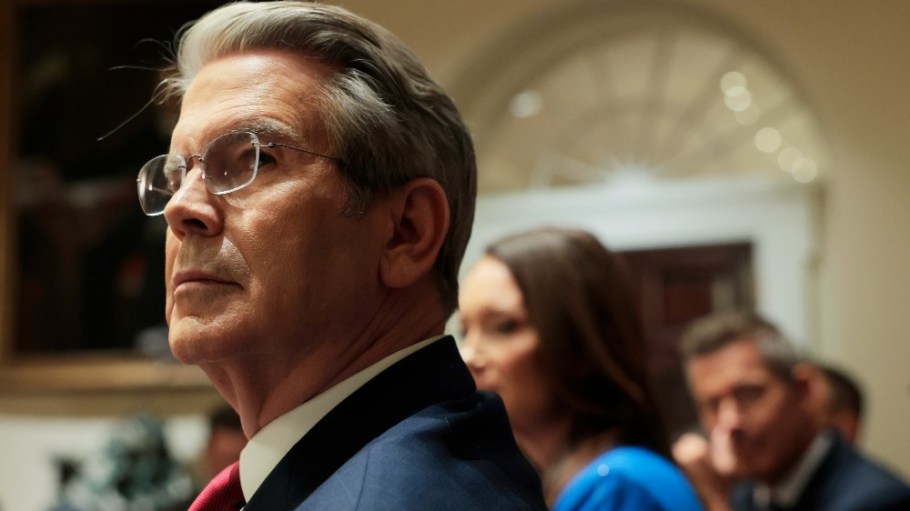
United States Treasury Secretary Scott Bessent owned that the trade tensions between the U.S. and China are unsustainable and can’t persist indefinitely. However, negotiations are likely to be a “slog.”
At a closed-door investor summit for JP Morgan in Washington on Tuesday, the nation’s premier financial policy lead said that America and China have effectively entered into a trade “embargo,” with triple-digit duties on both sides hindering the free flow of goods that consumers have become accustomed to.
Related Stories
That’s spelled bad news for Wall Street in recent weeks and sent tremors throughout the global economy, and Bessent acknowledged that the situation cannot continue to drag on, according to a report from Bloomberg that cited sources who heard the Treasury Secretary’s remarks. He told attendees at the meeting that the standoff would likely come to an end soon and that he is optimistic a deal can be reached—though those negotiations haven’t yet begun, he admitted.
Bessent said the goal isn’t to completely de-couple from China but to rebalance the trade relationship, with the U.S. bolstering its own manufacturing capabilities and capacity and taking in less from the sourcing superpower.
But while President Donald Trump seems bullish that a trade deal can be reached in the next three to four weeks, as he told reporters last Thursday, Bessent told attendees at Tuesday’s conference that if the two countries can reach a larger trade agreement in the next two to three years, that would constitute a major win.
American corporations that do business in China aren’t likely to be buoyed by Bessent’s timeline as they contend with potential price increases and shifts in sourcing due to the tariff turmoil.
Leaders from major U.S. retailers including Walmart, Home Depot, Lowe’s and Target met with President Trump on Monday to discuss their concerns about the universal baseline tariffs and reciprocal duties the administration has levied on trade partners across the globe.
Little has been reported about the discussion, though Walmart and Target both released statements calling the meeting “productive” with the former saying it appreciated the opportunity to share insights with the president and the latter saying it valued the chance to meet with retail peers to discuss a path forward on trade.
At the Bentonville, Ark.-based big box retailer’s investor meeting last week, Walmart chief financial officer John David Rainey said about two-thirds of its stock is made or grown in the U.S., while the remainder is imported from China or Mexico. Target imports about 30 percent of its product assortment from China, which now faces 145-percent duties.
While a deal with China may be on ice for the near-term, leaving many retailers exposed to tariff impacts and shoppers subject to sticker shock at retail, the U.S. is inching closer to deals with India and Japan, the White House indicated this week.
Politico reported Tuesday that officials are working on developing “memorandums of understanding” with both countries in the absence of fully fleshed-out trade deals. One official who spoke to the outlet said finalizing new trade agreements with the Asian nations could take months.
Vice President J.D. Vance traveled to India this week to meet with Prime Minister Narendra Modi, and both parties said they’d make progress in negotiating a bilateral trade framework that might help India skirt some of the tariff impacts. India is set to face 26-percent duties when the three-month deferral of Trump’s reciprocal tariff scheme wraps on July 9.
Modi was one of the first world leaders to visit Trump in Washington following his inauguration, and while the heads of state share a strong rapport, the administration does not appear eager to acquiesce to terms that don’t trend toward a rebalancing of trade between the two nations. The U.S. imported about $87.4 billion worth of goods from India last year, up 4.5 percent from 2023. Meanwhile, India took in $41.8 worth of goods from the U.S.—a trade imbalance of $45.7 billion. Trump referred to the country as a primary “abuser” of tariffs for its high duty rate of 17 percent on American-made products.
U.S. Trade Representative (USTR) Jamieson Greer on Monday confirmed that the trade agency and India’s Ministry of Commerce and Industry have finalized the Terms of Reference for negotiations on reciprocal trade.
“There is a serious lack of reciprocity in the trade relationship with India. These ongoing talks will help achieve balance and reciprocity by opening new markets for American goods and addressing unfair practices that harm American workers,” he said. “India’s constructive engagement so far has been welcomed and I look forward to creating new opportunities for workers, farmers, and entrepreneurs in both countries.”