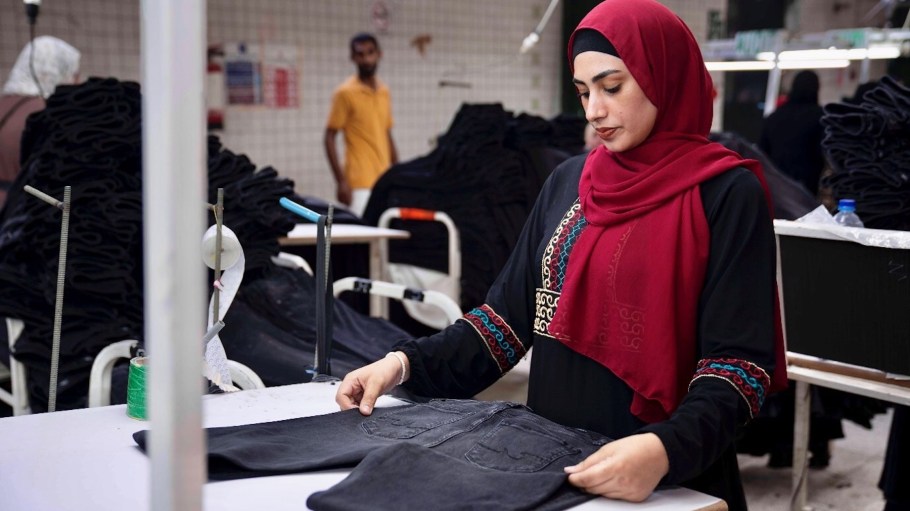
The Reimagining Industry to Support Equality (RISE) program reportedly reached 400,000 textile workers throughout the year in pursuit of improving gender equality, the sustainable, multistakeholder platform stated in its 2024 annual report.
The joint program by Gap’s Personal Advancement and Career Enhancement (PACE) program, BSR’s HERproject, CARE and the Better Work program launched in 2023 to improve the rights of female garment workers. RISE addresses gender inequality and promotes women’s economic independence through programs as well as advocating for changes in pertinent policies and procedures.
Related Stories
“In 2024, we navigated a cautious and polarized environment,” Christine Svarer, executive director of RISE, said in the report. “As we enter 2025, we do so both knowing that the operating environment will remain uncertain and holding steadfast conviction in the importance of our work.”
That work includes providing women with “comprehensive support” to increase their skills, knowledge and confidence—in turn, boosting their professional and personal development. Of those 400,000 workers reached, 65 percent were women across Bangladesh, Cambodia, China, Egypt, Guatemala, India, Pakistan and Vietnam. After attending RISE programs, these women reported that their “belief in their self-worth” increased by 49 percent. Across five countries, there was a 46-percent drop in the mindset that giving women more rights “comes at a cost” to men.
This, the collaborative initiative said, indicates that RISE is “well on its way” to reaching 1.5 million workers by the end of 2026.
“RISE now has over 30 members, including buyers and suppliers, which is crucial for achieving real improvement on the production floor,” Svarer said. “Factories that implement our programs notice real business benefits: a survey of 37 workplaces across six countries showed a 30 percent reduction in turnover rates, increased productivity and a decline in rework rates from 7.2 percent to 5.5 percent. This highlights RISE’s tangible impact, which we are continuously scaling up as we expand to new members, factories and countries.”
In 2024, RISE in Bangladesh, for example, reached 24 workplaces, 25,504 women workers, 20,330 male workers, 190 managers and 2,095 peer educators. Holistically, RISE saw 433 workplaces, 269,804 women workers, 129,814 male workers, 1,539 managers and 14,276 peer educators participate in either the peer educator and integrated models offered.
“Collaboration is and will remain at the heart of our shared success. RISE is proudly becoming a platform that unites stakeholders who work on different aspects of gender equality within and across the garment, footwear and home textile supply chain,” Svarer said.
“Centering ourselves in the realities, needs and priorities of women workers—and bringing together the perspective of women’s organizations, workers’ representative groups, suppliers, brands, buyers and many more—we are identifying new solutions to advance gender equality. Together.”
Looking ahead, RISE implemented its new strategic plan in 2024 to reach those 2026 goals. The plan—centered around the group’s mission of empowering women workers and catalyzing system changes—hinges on three interlinked strategies: behavior change, embedding gender equality into business practices, and influencing industry and public policy.

“The plan allows RISE to create opportunities and remove immediate barriers for women workers and businesses,” Svarer said. “It also sets the direction toward resolving deeper systemic issues that prevent women workers from realizing their inherent right to dignity.”
With its partners, such as Bestseller, New Balance and Ralph Lauren, RISE will focus its efforts on hitting these strategic goals over the next three years. The first goal encompasses advancing the rights of women workers in the global supply chain to ensure agency and gender equality. The second goal would see the industry recognize and prioritize gender equality across the supply chain as “critical” between sustainability and success. The third goal would ensure RISE can influence industry policymakers through the data and evidence of the organization’s work.
Also part of this three-year strategy is collaborative industry action. RISE will work with stakeholders to convene workers, unions, brands, suppliers, local organizations and governments to combine their individual and unique strengths to create “realistic solutions” to make “real progress” toward the ultimate goal of supporting an additional 1.5 million workers by 2026.
“It is important for us to have partners like RISE and Mastercard to work with on wage digitalization, because we can bring factories to the table and help ‘why digitalization matters.’ But we don’t understand what the best financial services are and how to connect those services to the workers, and how to make sure there’s a feedback loop,” The Children’s Place said in the report. “That’s the power of our collaboration.”