Avery Dennison’s latest report revealed what the digital identification provider deemed serious item-level visibility limitations.
The findings within the “Boosting Margins: The Power of Enhanced Fashion Supply Chain Visibility” report are based on a survey of 250 supply chain leaders within the fashion retail sector throughout the United Kingdom and the United States.
“Fashion brands and retailers are battling to stay in control, amid relentless supply chain uncertainty,” said Delia Glover, vice president of product, innovation and solutions development at Avery Dennison. “The pressure is mounting to cut waste, source ethically, maximize efficiency and protect profits—yet many still lack the critical visibility needed to maintain their edge.”
Related Stories
While half of those surveyed said their company has “visibility into most items,” a quarter reported “limited or no visibility” at the item level in factories and distribution centers. Furthermore, 30 percent of respondents view the supply chain as “highly problematic with regulator disruptions;” only 22 percent categorized it as “efficient and responsive.”
This indicated, according to the Levi’s collaborator, that many brands are operating in the dark—therefore leaving themselves open to waste, inefficiency, delayed shipping, lost sales and shrinkage.
“In an era of digital transformation, outdated methods persist,” Glover said. “Companies operating in the dark are leaving money on the table.”
To that end, six-out-of-ten (61 percent) of the smaller companies surveyed—those with annual revenue between $1-$9.99 million— reportedly feel they have full visibility.
“If you can trace the journey of the product, it gives you visibility. With our connected products, we now have visibility at the mill and the dye house, we’ve got visibility at the cutting room, the sewing room through to the packing process,” Liz Larkin, JD Sports’ Own brand director, said at NRF 2025, as quoted in the report. “Then right the way through to delivering to the consumer, it’s connected. And we have the ability to allow the end customer to access the story of that whole journey.”

To Avery Dennison’s surprise, larger companies were the most impacted by a lack of visibility, as four-out-of-ten (44 percent) of those with annual revenue above $1 billion reported believing they have a complete view. Full visibility was found to be most challenging for medium-sized retailers, the report found, with one-out-of-ten (11 percent) of the $250-$499 million revenue cohort saying they had achieved this feat. Only six of the 250 companies surveyed (split into six revenue categories) had “no visibility.”
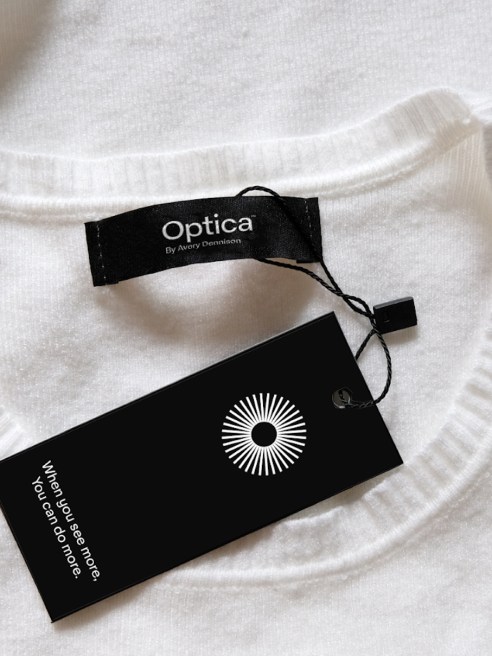
This is where Avery Dennison’s platform Optica comes into play.
The full-service portfolio of end-to-end supply chain solutions works to address the industry’s traceability troubles, as Optica combines radio frequency identification (RFID) smart labels with the Adidas-approved Atma.io connected product cloud platform, as well as some other relevant software, in-field hardware and technical support.
“Trying to operate without clear visibility into your supply chain—essentially operating in a supply chain fog—makes it impossible to track the movement of inventory and deploy data analytics to reduce waste. Technologies such as RFID item tracking help companies create a reliable data foundation,” Glover said. “This will be essential for keeping up with fast-changing sustainability regulations and improving efficiency across the board. Right now, though, many fashion brands and retailers are finding it tough and costly to deliver the level of transparency that’s becoming increasingly mission critical.”
Recording off-the-cuff changes and supply chain movements at the batch or pallet level “constrains” the precision of traceability and accountability, per the report. When the surveyed decision-makers were selecting what challenges they face, in light of a lack of item-level visibility, almost a third (30 percent) quoted last-minute changes to garment labeling; this rose to 42 percent for those in the $500-$999.99 million revenue size bracket.
The other top challenges included difficulty with identifying disruptions in real-time (26 percent), reduced agility in diverting orders to alternative suppliers or locales (25 percent), and an incapacity to meet compliance requirements on materials traceability (25 percent).
Achieving more granular data is, therefore, a “major opportunity” for the industry, per the Making Possible provider. To that end, the survey found that two-thirds (65 percent) of respondents see value in increasing collaboration with suppliers. This, Avery Dennison argued, would allow both players to connect to data sharing and visibility in the sourcing and production process.
The same amount (65 percent) reportedly think investment in better supply chain visibility tech—for example, RFID tagging—would maximize supply chain improvement. That rose to 72 percent of vice presidents, the most senior executives questioned, the NBA manufacturer said.
“The report makes clear that improving supply chain transparency and visibility isn’t just about reducing waste or minimizing profit loss, it’s also about building stronger relationships with partners and earning the trust of consumers,” Glover said. “With a portfolio of solutions like Optica, Avery Dennison helps businesses take control of their supply chain by providing item-level data transparency from source to retail. By combining innovative hardware, RFID labels and software, including our Atma.io connected product cloud—supported by in-field label printing technology, technical expertise and global coverage—brands can navigate challenges and set themselves up for lasting success.”
Avery Dennison commissioned the survey, which was conducted by Censuswide, in late 2024. Researchers polled 250 senior managers and executives at retail brands—with responsibility for supply chain management—in the UK and the U.S.