Reju is going Dutch—literally.
The Paris-based textile-to-textile recycling firm announced Tuesday that it has tapped Chemelot Industrial Park in Sittard, the Netherlands, as the site of its first industrial-scale “regeneration center.”
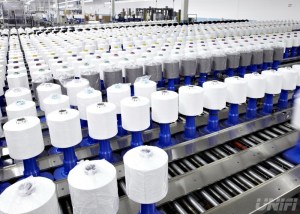
The upcoming plant, which follows the opening of Reju’s demonstration facility in Frankfurt, Germany, in October, is poised to process some 60,000 metric tons of castoff clothing a year when it kicks into gear sometime in 2027. It’s set to generate 50,000 metric tons of PET monomer from the outset, according to CEO Patrik Frisk, enough to create polyester sufficient for 300 million T-shirts.
Related Stories
Landing on Chemelot wasn’t an easy task, Frisk said. Altogether, Reju examined 47 different European sites before deciding that it was the most appropriate, not least because of the Dutch government’s ambition to create a nationwide circular economy by 2050. Logistically, it also made sense because waste can be aggregated in large quantities and rolled across the continent by rail or sea.
The park itself has huge plans of its own, including becoming Europe’s first fully climate-neutral and circular industrial cluster. This includes shifting away from fossil fuels toward greener electricity sources such as wind, solar and the more controversial biomass.
“It’s also a very unique site, because not only does Chemelot have a lot of R&D people and what have you, but there’s also a very large student body on campus there, so to speak,” Frisk said. “So they have a really interesting way of integrating business and talent from an educational perspective and research perspective on site.”
For the Netherlands, the move is a win-win in terms of what Sophie Hermans, minister of climate policy and green growth, calls the “industry of tomorrow.”
“With Reju’s decision to locate its innovative recycling plant at Chemelot, the Netherlands is achieving a first: the country’s first large-scale recycling facility where discarded textiles are turned into raw material for new and even better textiles,” she said in a statement. “This is the kind of new industry we are aiming for: sustainable, circular and future-orientated.”
Already, Reju has been inking partnerships with the likes of Nouvelles Fibres Textiles in France, Cibutex in the Netherlands and Rematrix in Italy to lay the groundwork for the pipeline it would need to collect and process textiles, which Frisk says is currently nonexistent. Where Reju will be repolymerizing its bis(2-hydroxyethyl) terephthalate—or BHET—output, however, is still TBD, though it will still be in Europe. The company isn’t outsourcing this part. Instead, its parent company, Technip Energies, will leverage the expertise of its fellow subsidiary Zimmer Polymer Technologies, which has been honing polyester production for the past seven decades.
Reju plans to announce a U.S. site in short order as well. The two so-called “megafactories” will be the first in a network of 20 or so plants that Frisk expects to span the globe by 2034, allowing the by-then-$2-billion company to seize a market share of roughly 25 percent of textile-to-textile recycled materials.
News of Reju’s location comes on the heels of rival company Circ’s pick of Saint-Avold, France, for the site of its own inaugural commercial facility, which will launch in 2028, with more to follow in North America and Asia. Last month, H&M Group-backed Syre signed a memorandum of understanding with the northern Vietnamese province of Binh Dinh for its possible first “gigascale” factory, capable of pumping out up to 250,000 metric tons of PET chips for spinning into yarn. It, too, plans to establish multiple setups worldwide to reduce the fashion industry’s reliance on both virgin polyester and its bottle-to-textile recycled alternative.
The race for the first industrial-scale textile-to-textile recycled polyester, in other words, is on, and at a time when brand budgets are growing increasingly thin because of the uncertainty over tariff turmoil and geopolitical strife. The specter of Renewcell’s bankruptcy—the result of a dearth of uptake agreements—also looms large, though the company trafficked in man-made cellulosic fiber, which makes up a far smaller fraction of fashion’s materials basket.
Frisk says, however, that Reju already has customers lined up.
“We are getting all those sorted, so more to come on that soon,” he said. “But it’s safe to say you’re not going to go and build anything today unless you have all of your upstream and downstream secured.”