The average U.S. consumer throws away nearly 82 pounds of clothes annually, leading to over 11 million tons of textile waste generated each year in America alone. And of these trashed garments, most are too complex to recycle—made with mixed material blends and full of components like zippers and buttons that existing systems can’t efficiently process just yet.
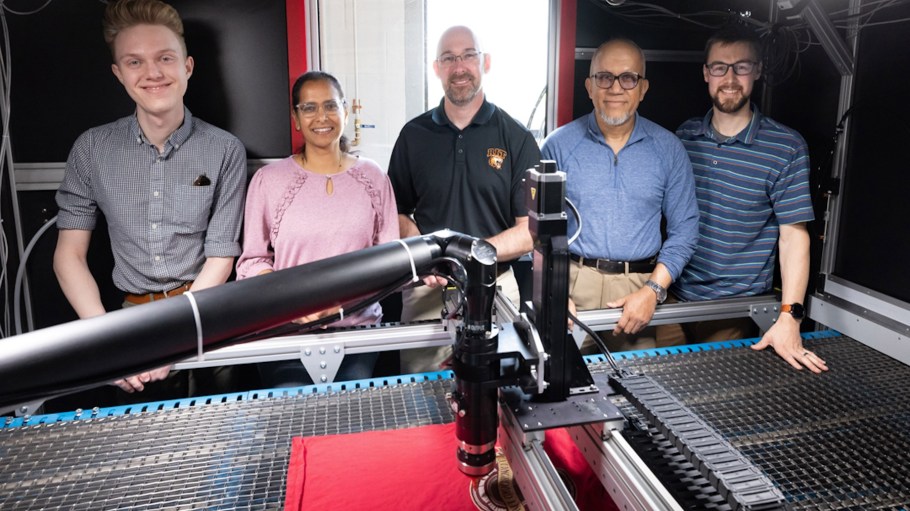
A research team at Rochester Institute of Technology’s (RIT) Golisano Institute for Sustainability (GIS) has developed an innovative automated system to tackle the global issue. Using an automated system to detect and remove these non-recyclable elements to enable higher-value material recovery, the AI-and laser-powered prototype can identify, sort and disassemble a used garment every 10 seconds.
Related Stories
“Near-infrared (NIR) camera systems work by shining specific wavelengths of light onto clothing. The light reflects off the surface and the camera measures it millimeter by millimeter to identify surface-level materials—like cotton, polyester, nylon or blends. But it can’t detect what’s beneath the surface,” said RIT’s technical program manager and lead engineer of the project, Mark Walluk. “To understand those hidden components, we manually took garments apart, examined them under a microscope and used FTIR material testing. That’s when we found things like elastic bands in cuffs—details invisible until stretched.”
Led by Walluk, the team of staff engineers includes Ryan Parsons, Nick Spears, Sri Priya Das, Ronald Holding and Christopher Piggot as well as associate research professor Abu Islam. Their process begins with a conveyor-fed imaging station, where three specialized cameras spawn a multi-dimensional map of the garment allowing for fiber composition analysis down to the millimeter. That system then leverages artificial intelligence and machine vision to recognize and remove the clothing’s non-recyclable elements, something of a “unique challenge” for the team.
“If the system has seen a certain feature before, like an elastomer cuff that stretches, it can be trained to recognize and flag it,” Walluk said. “Combining NIR surface data with AI’s ability to infer hidden materials lets us identify both visible and likely internal components. That way, we can spot recycling ‘disruptors’ inside fabrics and cut them out.”
In turn, the team developed vision-guided algorithms to identify elements (such as logos, collars or cuffs) and interpret infrared reflections for the definition of fiber type, the GIS said. That data is sent to a robotic laser cutter, which quickly cuts the needed sections without damaging any reusable fabric. The garment then moves to a robotic sorting system that drops the clean pieces into separate recycling bins. The prototype can handle a new garment in about 10 seconds.
Walluk noted the system was built with “scalability and real-world complexity” in mind, intended to be both economical and ready to replicate. And, while it’s not going to solve the world’s textile waste problem, per Walluk, it is a step in the right direction for a more circular economy.
“Today, recyclers prefer post-industrial fabrics because of their predictable material properties,” he continued. “We’re working to advance beyond that step by transforming post-consumer clothing into high-quality, reliable feedstock. This makes these materials not only viable but preferable, helping divert them from landfills.”
Key partners include Ambercycle and Goodwill of the Finger Lakes, which provided garments for testing and insights into the resale and reuse market. Nike, meanwhile, shared industry guidance throughout the project’s early stages. The project’s work began in 2023, funded through a grant of nearly $1.3 million from the Remade Institute, a public-private partnership focused on developing circular manufacturing solutions.
“Textile recycling is a critical global challenge, and we’re proud to collaborate with industry leaders to drive meaningful solutions,” said Nabil Nasr, director of GIS and CEO of the Remade Institute. “This effort not only creates significant environmental impact but also represents a major area of growth and innovation for us at GIS.”
While still in the pilot phase, the technology has attracted interest from global recyclers across the United States as well as Europe, South Asia and Latin America. The team shared plans to transition the system to its partners for further testing and potential deployment later this year.
“There’s maybe 40 different startups in the U.S. that are working on different types of recycling technologies to address this issue,” Walluk said. “We’re hoping that this technology can be leveraged to help them in their experiments and grow into a more viable commercial entities.”