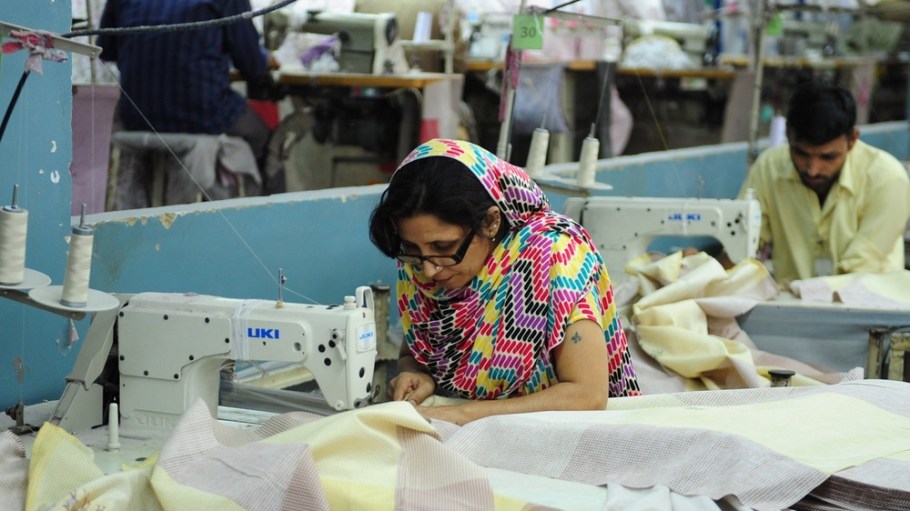
Having secured a 19 percent U.S. tariff rate and moving into the final leg of the (so far) three-year mandated period of the Pakistan Accord to improve safety in the apparel and textile supply chain, manufacturers in Pakistan told Sourcing Journal that they are “gearing up.”
Miftah Ismail, former finance minister and political economist, summed it up when he wrote on X (formerly Twitter) earlier this month: “Electricity and gas tariffs are higher than almost all developing countries, and our taxes are higher than even most developed countries. Plus, there are serious infrastructure issues in some provinces (for instance, most factories in Karachi have to buy water for millions of rupees a month) and there are law and order issues across Pakistan.”
Related Stories
He noted that Pakistan had “another opportunity” with the competitive U.S. tariff structure for the region (lower than Bangladesh and Sri Lanka’s 20 percent), but warned that “the cost of doing business in Pakistan is higher than in competing countries.”
Meanwhile, the Pakistan Accord on Health and Safety in the Textile and Garment Industry shared an update this week on the growing number of brand signatories and factory inspections—a process making the industry more export-ready, with safer factories and greater reassurance to global brands about supply chain well-being. Focused on structural, building, and fire safety, the program was launched in January 2023 with a three-year mandate, widely expected to be extended.
Collective sourcing from enlisted suppliers during this time amounts to approximately $3.5 billion. Recent signatories include Homefield Apparel, River Island Clothing Co. Limited, WinCraft, and Collars & Co.
“We continue to see strong engagement from signatories of the Pakistan Accord,” Joris Oldenziel, executive director of the International Accord told Sourcing Journal. “Our team on the ground is working closely with both brands and factories to support implementation efforts and drive meaningful safety improvements across the industry. To date, 138 brands have signed the Pakistan Accord and are sourcing from over 645 suppliers, collectively employing more than 700,000 workers.”
So far, more than 245 factories in Karachi, Lahore, and Faisalabad have been inspected for fire, electrical, and structural safety.
While the initial hesitation of factories in signing up appears to have been bridged, he observed that “tangible improvements” had been taking place. These include “installing fire safety doors, reinforcing structural columns to ensure building stability, and resolving electrical hotspots”.
Factories have been cooperative, he said, and analysts too have noted that there appears to be a shift in acceptance.
“They see that we are reasonable and don’t put unrealistic timelines, and that we are very technically focused, and after the inspections are done the factories appreciate that we check safety and help improve it. We’ve had multiple factories say that after the inspections their business has increased. It is true that brands would rather place orders in factories where safety hazards have been addressed,” he added.
Pakistan’s textile and apparel exports for fiscal year 2024–25, which ended June 30, showed a growth trend, according to the Pakistan Bureau of Statistics (PBS). Exports rose 7.39 percent to $17.88 billion from $16.65 billion the previous year. Knitwear contributed $5.01 billion, up 13.88 percent from $4.40 billion, while woven garments rose 16.07 percent to $4.13 billion. Home textile exports increased 8.41 percent to $5.66 billion from $5.2 billion.
Analysts cite several factors for the growth of Pakistan’s industry—including unrest in Bangladesh and the “China plus one” sourcing strategy—but also credit the Accord’s role in improving factory safety.
The Accord has had other benefits, particularly in giving workers a stronger voice. “In parallel, the Pakistan Accord has made significant progress through its Workplace Programs,” Oldenziel noted. “All-Employee Meetings have been held in over 70 factories, and Initial Meetings in more than 200 factories, reaching over 260,000 workers. These meetings raise awareness of health and safety risks. Additionally, information on the Worker Complaints Mechanism has been widely distributed.” Plans for the coming months include expanding the Safety Committee Training Program and holding more worker meetings.
The Accord’s boiler safety team began inspections in February this year, visually inspecting 51 boilers. Inspections include internal and external examinations, hydrostatic testing, and a follow-up functional test after remediation. Future plans involve hazard identification for materials in collaboration with the fire engineering team once the boiler program is fully operational.
Much of the learning from Bangladesh has informed Pakistan’s program and helped avoid delays. For example, the boiler safety program—added later in Bangladesh—was part of Pakistan’s initiative from the outset. “We looked carefully at the challenges in Bangladesh and modified our program to incorporate these lessons,” Oldenziel explained.
Financial planning is another focus. “In Bangladesh, big-ticket items like sprinklers and fire alarms were often delayed due to a lack of financial preparation. Now we’re working with factories to create real remediation schedules and cost estimates early in the process,” he said. The average remediation cost per factory is about $250,000—similar to Bangladesh 10 years ago—though current estimates range from $100,000 to $10 million depending on factory size.
At a meeting of Accord signatories earlier this summer in Amsterdam, Zulfiqar Shah, country director of the Pakistan Accord, reported encouraging feedback on worker safety training and government capacity building programs. Paul Rigby, Chief Safety Officer, highlighted common safety issues such as overstressed structural columns and insufficient safe exits, stressing that engagement between brands, retailers, and suppliers is crucial for faster remediation and stronger relationships.
“Accord brands don’t work from factories that are not safe—and when they know that factories are going through a remediation process, it opens up a big market—that’s a win factor,” explained Jochen Overmeyer, member of the International Accord steering committee since 2015. “If it wasn’t a win for the industry we would be long gone. This is the one success formula for the Accord that makes it work for all three parties,” he said, referring to manufacturers, the labor unions and global brands and retailers.
However, he pointed out, that this also required that all three parties have the same mindset—never an easy task.
He acknowledged it took time to get there in Pakistan, working with different provinces and a variety of manufacturers associations. While it was “much more strenuous in the beginning, sometimes confrontations between unions and brands, now we realize better that we want the same thing, and the different parties are very pragmatic about how we get it done.”
“It’s a relationship that is very concentrated in making things happen, and dealing with obstacles in a joint manner,” he said.
It’s also a winning solution for brands who often have to work at spreading their sourcing risks.
“Brands can’t afford to put all eggs in one basket. They want to avoid risk, or minimize risk instead of going to a country where the human rights situation is horrible. It’s a de-risking call. This is fine on one hand, but I don’t know how these countries will develop if you don’t give them business. You give them business and they will grow.”
The idea of expanding the Accord model beyond Bangladesh and Pakistan has been under discussion for years. “When the International Accord was renegotiated in 2023, we decided to look at other countries,” Oldenziel said. “In this case, progress in Pakistan will determine the next step—and we’re close to meeting the criteria. That means we’ll soon start exploring the next country.”
On the shortlist: India, Morocco, and Cambodia. A final decision is expected by late this year or early next year. “That’s very positive,” Oldenziel concluded.