Nvidia wants to be retailers’ right-hand man when it comes to implementing artificial intelligence.
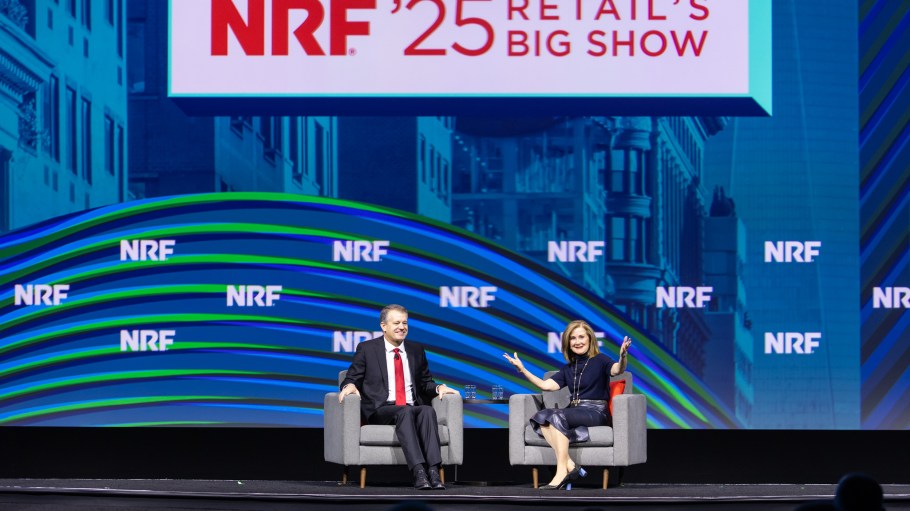
John Furner, CEO of Walmart U.S., hosted a keynote session with Azita Martin, vice president and general manager, retail & CPG at Nvidia at the National Retail Federation (NRF) conference in New York City on Sunday.
During the session, Martin explained that while the implications of last year’s buzziest technology—AI—are wide-reaching for retail, supply chains may see the highest degree of impact.
Related Stories
To upgrade retail systems with AI, Nvidia is combining its hardware—perhaps what most know it for—with acceleration software, then distributing the technology through its partners, Martin said. And in doing so, the technology company has helped brands and retailers achieve a variety of updates related to their individual goals.
L’Oreal, for instance, has used Nvidia technology to use generative AI for marketing tools. An employee might input a standard product image and use natural language to create a dynamic background with a prompt like, “Add pink-hued, reflective geometric shapes into the background of this image.” The resulting photo can then be used on the brand’s social media or marketing materials.
Walmart, on the other hand, has used AI to help amp both its customer-facing experiences and its back-end capabilities.
On the forward-facing end, the retailer has begun testing an AI-powered shopping assistant it calls Wallaby, which aims to help consumers with search and discovery using natural language terms on the Walmart site.
“[A] shopping assistant is basically taking your best and most knowledgeable sales associates and replicating that 24/7 at scale on your e-commerce site and on your mobile site,” Martin said.
Simultaneously, Walmart uses Nvidia’s technology to bolster the operations that customers don’t always think of—particularly around inventory and allocation. The company has used Nvidia’s data science acceleration libraries to enrich its forecasting functions.
“It’s enabled [Walmart] to basically ingest [a] large amount of data and be able to forecast on a weekly basis hundreds of millions of combinations of SKUs and stores, and by forecasting and running those algorithms more frequently, your forecast accuracy [improves],” Martin said. “For a company of Walmart’s scale, we know that even a 1 percent improvement in forecast accuracy represents significant [opportunity].”
Furner and Martin said they anticipate that this kind of use case will continue to see major play throughout the retail industry, particularly as retailers fixate on ensuring the right product makes it to the right location at the right time.
“Supply chain, more than anywhere in retail, in my opinion, is going to benefit the most from AI,” she said.
And Nvidia wants to make sure it’s on the precipice of making that transformation happen. The company recently launched Mega, an Omniverse blueprint that uses digital twin technology to simulate the movement and orchestration of robots, automated systems and human employees in warehouses and distribution centers.
Martin said that, as companies continue to adopt autonomous systems in their warehouses and distribution centers, testing scenarios digitally will help them ensure they receive maximum benefit from their investment in robotics, AI systems and more.
“We absolutely believe that training robots has to be done in a simulation environment, because there are hundreds of thousands of scenarios that we wouldn’t even think about in the real world that you can actually use in the simulation environment to train those robots,” she said.
Having stronger, preemptive insights into the myriad changes warehouse leaders could choose to make can enable supply chain leaders to improve throughput, fulfill orders faster and ensure that the right products get to the right customer at the right time. Furner said the technology also helps make theoretical ideas about improving operations a reality that employees can engage in and understand easily.
“The simplest way I understand digital twin [technology] is a video game. It’s an idea in your head, and it’s a reality. You create it, you simulate, you play in it. It’s always happening. We can do the same thing [for] business, and it…enables us to not have to move things around physically or put capital investments in the ground,” Furner said.
It can also save retailers money; physical testing and learning, a common approach to innovation inside major companies, often takes days, weeks or months to yield real results—and repeated tests that don’t bring forth high efficiency processes can prove expensive.
“We all understand [that] making changes in layouts is very, very capital intensive and very disruptive…and so being able to simulate different layouts and optimize operations before you actually make that capital investment and make those changes in the stores and in the distribution center, it’s really, really important,” Martin said.