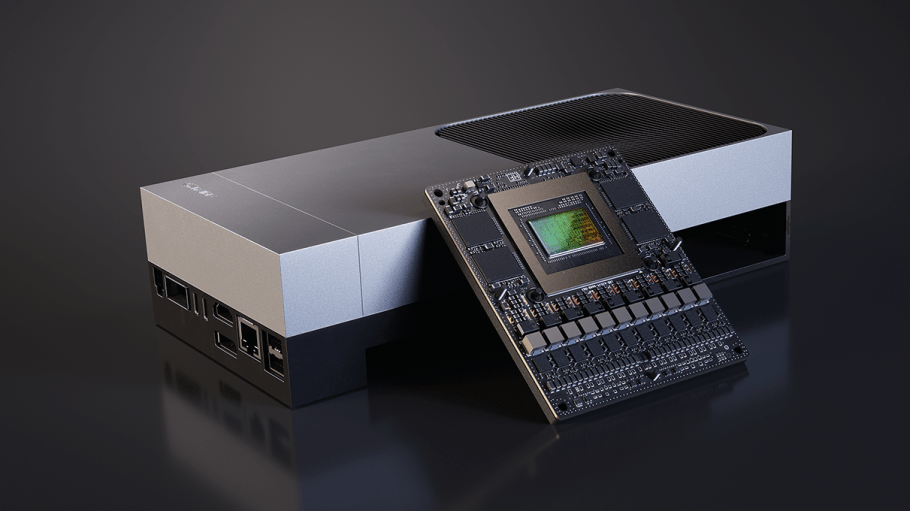
Nvidia announced Monday it has released a publicly available developer pack, called Jetson AGX Thor, that is meant to serve as a robot’s “brain.”
The pack, which it said will start at $3,499, aims to help accelerate the continued development of physical AI and robotics; physical AI allows autonomous robots, cars and other form factors to receive information, digest it and put it into action in the physical world. AI-enabled robots continue to pop up in warehouses, docks and facilities globally.
Related Stories
Jensen Huang, Nvidia’s CEO and founder, said Jetson Thor will help that trend along.
“We’ve built Jetson Thor for the millions of developers working on robotic systems that interact with and increasingly shape the physical world,” Huang said in a statement. “Jetson Thor is the ultimate supercomputer to drive the age of physical AI and general robotics.”
Robotics represents only a small portion of Nvidia’s current business—about 1 percent. But it has been working to advance physical AI, and Jetson Thor seems the latest cog in the machine.
Nvidia said Amazon Robotics, Agility Robotics and Boston Dynamics are among Jetson Thor’s early adopters. The company sees strong potential for Jetson Thor applications in logistics and retail, among other industries.
Jetson Thor runs on Nvidia’s Jetson software suite, which includes Nvidia Isaac, Nvidia Metropolis and Nvidia Holoscan; Isaac helps with motion planning and navigation, while Metropolis can analyze video to monitor retail environments or warehouse movements and Holoscan leverages sensor processing at the edge. Taken together, these applications can help robots react in real time. Jetson Thor will also be able to access major LLMs not directly created by Nvidia.
A promotional video Nvidia released touted Jetson Thor as the “ultimate platform for humanoid robotics,” a hot topic among supply chain and warehouse leaders looking to use robots to manage efficiencies. Major players, like GXO, have already started using humanoids in warehouses with partners like Agility and Apptronik, and Amazon has reportedly started testing them for delivery applications.
Experts have previously told Sourcing Journal that many humanoids today, especially those that operate on a bipedal form factor rather than as a mobile robot, still have some major shortcomings—one of which is their inability to perform multiple tasks simultaneously.
Jetson Thor is meant to ease that issue; the chip and accompanying developer kit are designed to help robotics developers enable robots to run several systems in tandem. That is to say, for instance, a robot could run a large-language model (LLM) and a vision language system simultaneously, in turn allowing it to understand external stimuli in real time and behave accordingly.
Vision language systems, which typically pair together physical hardware, like cameras, with digital systems, like computer vision models, help a robot “see” and contextualize its surroundings. LLMs, meanwhile, can help robots understand human commands and determine the best course of action. For instance, if a human tells a robot to move all items labeled “fragile” off of a pallet, the robot can use its vision systems to determine which boxes to move, then use LLM reasoning to break down the task into parts and execute accordingly.
While some robots are able to work in real time today, many are trained to handle one-off, repeated tasks and require retraining each time they need to learn something outside the bounds of that task. Enabling robots with robust AI models helps them learn, adapt and react in the moment, instead.
Jetson is replete with 7.5 times the compute of its predecessor, Jetson Orin. That extra brainpower is what allows various AI models and systems to run in parallel; today, developers often struggle to facilitate natural interactions between humans and robots, in large part because they cannot handle running multiple AI systems at once.
Tye Brady, chief technologist at Amazon Robotics, said that kind of proficiency will be critical to building robots able to meet the demands of tomorrow in many industries.
“The future of robotics in logistics depends on the ability to deploy increasingly intelligent and autonomous systems,” Brady said in a statement. “Nvidia Jetson Thor offers the computational horsepower and energy efficiency necessary to develop and scale the next generation of AI-powered robots that can operate safely and effectively in dynamic, real-world environments, transforming how we move and manage goods globally.”