Retail crime won’t stop coming.
The same day that more than 2,000 attendees gathered at the Gaylord Texan Resort in Grapevine for the June 5 kickoff of the three-day National Retail Federation Protect 2023 loss prevention conference, a suspect in New Jersey was arrested after assaulting a Neiman Marcus employee who caught him trying to steal designer clothes from the upscale department store. Paramus Police Department authorities arrested 31-year-old Jimmy Sattan in the Garden State Plaza shopping mall parking lot and charged him with robbery, resisting arrest and possession of stolen property and fake identification after he was caught with $1,148 worth of Fendi jeans, sweatpants and sweatshirts he didn’t pay for.
Related Stories
Neiman Marcus didn’t respond to a request for comment.
The incident underscores the unrelenting epidemic of crime plaguing retailers and making the topic top of mind with executives and Wall Street analysts alike.
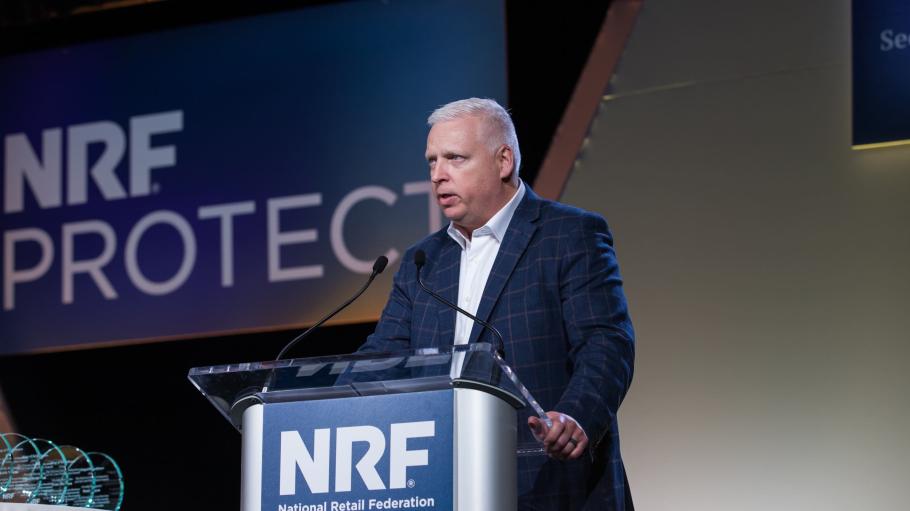
Thirty-four miles from and thirty-one days since a gunman killed nine people at an Outlet Mall in Allen, Texas, NRF Protect last week drew its largest turnout since at least 2019, as retailers, vendors, loss prevention professionals and others gathered to strategize on anti-crime tips, tactics and technologies. The three-day event is the only retail conference that brings together experts in asset protection, store safety and cyber fraud, according to NRF vice president of asset protection and retail operations David Johnston.
“What we really saw this year was a lot of collaboration and convergence between those three areas,” Johnston told Sourcing Journal. Discussions focused on how asset protection can work with cybersecurity and digital fraud, even touching on the organized retail crime elements of cybersecurity, he added.
Retail crime cost businesses $95 billion in 2022 with numbers expected to be even higher this year as merchants grapple with how to instruct staff to best handle increasingly violent shoplifting incidents.
Many retailers are taking a “hands-off policy,” Johnston said. “Particularly if they’re non-loss prevention or non-security related employees.”
With sales associates increasingly told to not obstruct thieves for the sake of safety, criminals are taking advantage, causing prices to rise and stores to close in some of the hardest-hit areas.
Technology is one way to curb the problem. NRF Protect 2023, which featured solutions from RFID tagging to AI devices tracking products and customers, illustrated how loss prevention is seeking high-tech solutions.

But Johnston doesn’t believe loss prevention is “becoming a bigger business,” rather it’s becoming a “greater need.”
“We’ve always had locks and keys; it’s just that they’ve taken different shapes and forms as retail has changed with regard to how organizations display their merchandise and what type of merchandise is being displayed,” he said.
But technology can’t be the only solution, as Walmart U.S. CEO John Furner told NRF CEO Matthew Shay at the event.
“The solution is a combination of talent, tools technology, and coalitions of industry, society and government all working together to solve this issue. There isn’t a single group, in my opinion, that can solve this on their own,” said Furner, who is also the NRF board chairman. Stakeholders must address the problem, he said, “to make sure we have communities that are vibrant, that have the right tax base, fair pricing, quality merchandise all available for people who have real needs.”
With retail shrink leaping from P&L spreadsheets onto front-page headlines, politicians, decision-makers and the public are now aware of the scope of the retail crime problem marked by increasing “violence” and “aggression” that’s “really starting to resonate with policy-markers,” said Shay.
“If this were a retail problem, retailers would have solved it by now,” Shay said. “The elements that are contributing to what we’re seeing now are elements that are outside the control of retailers.”
Furner and Shay said the following day they were headed to Capitol Hill to promote the bipartisan Combating Organized Retail Crime Act after getting the INFORM Act “across the finish line.”
“That will begin to give federal agencies, like the Department of Homeland Security, the authority to convene and collaborate and distribute resources to work with law enforcement agencies across the country,” Shay said.
Of the 232 retail professionals attending the CEO talk who participated in a flash poll, 86 percent said ORC is more of a threat to their business than it was three years ago.
On Monday, the NRF released a statement supporting the legislation. “Retailers’ foremost concern with ORC activity is the safety of retail workers and their customers,” it said. “Individuals and groups committing these crimes have used threats and acts of violence, including the use of weapons, to aid theft.”
Johnston said the tragedy of the Allen mall shooting was on the minds of attendees and served as a reminder of how vital and challenging it is to create a safe place for brick-and-mortar retail. He sensed a rallying behind the motto for the conference, “United by a shared mission,” expressing a desire for greater safety in the in-store shopping experience.
“It’s not that they haven’t had to deal with that in the past, it’s just that these things are starting to increase with, you know, a changing nation,” Johnston said. “And even though brands may compete, these groups collaborate on a regular basis and they’re truly united by that shared mission to make these things go away.”
He went on to say, “They know that if there’s a location near them that’s being impacted by [crime] then…they’re at risk as well.”
NRF Protect 2024 is scheduled for June 4-6 next year in Long Beach, Calif.
Additional reporting by Jessica Binns.