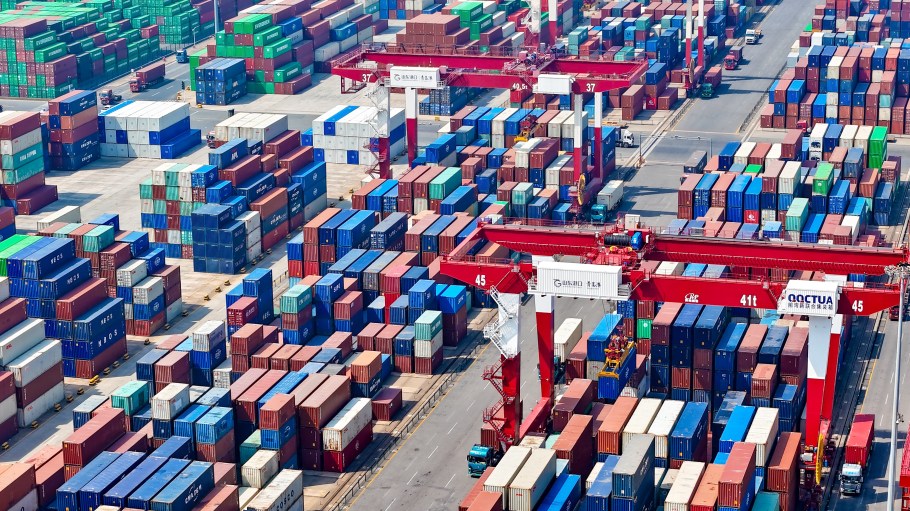
Although the Trump administration’s 90-day rollback of tariffs on Chinese imports has given retailers some breathing room to bring more product into the U.S., retailers remain largely in the dark over how to react once the Aug. 14 deadline looms.
Due to the tariff truce, duties on most goods from China are now at 30 percent, well below the 145 percent total the tariffs escalated to ahead of the détente.
“We still need clarity from the administration on what happens post-Aug. 14,” said Jonathan Gold, vice president of supply chain and customs policy at the National Retail Federation (NRF). “I don’t think they’ve figured it out yet, to be honest.”
Related Stories
In a webinar hosted by freight booking platform Freightos Monday morning, Gold noted that the question remains whether the tariffs will increase again to 145 percent if a deal is not made—which he believes is not likely. But he didn’t rule out the possibility of an 80 percent or 100 percent tariff based on President Donald Trump’s prior communications on Truth Social, as well as numbers initially touted during his election campaign.
The China deadline isn’t the only one on U.S. retailers’ minds, with the original 90-day pause of country-specific reciprocal tariffs ending on July 9.
“Right now, you’re going to see more front-loading as folks are trying to rush between those two different expiration dates. The front-loading we’ve seen to date does not include the holiday merchandise for later in the year, because the order is typically placed now or last month, and that doesn’t start coming in until late summer,” Gold said.
Gold predicts a “ramp up” in the next few months by retailers looking to get holiday merchandise into the U.S., further pulling forward the traditional August-to-October peak shipping season.
“A lot of retailers are going to try and beat that Aug. 14 date from China not knowing what’s going to happen,” Gold said. “Retailers don’t want to get caught with product, and then the tariff goes back up to 80 or 100 percent, or higher.”
During the webinar, Gold observed the similarities within the current environment on the trans-Pacific trade lane as that of during the Covid-19 pandemic. The decline in capacity due to blank sailings and vessel swaps from when carriers adapted lower demand had already begun to reverse once the 90-day rollback was initiated.
“You’re already starting to see the peak season surcharges starting to come into effect and see increases in freight rates,” said Gold. “It’s great that we got the tariff rate down, but now you’re seeing an increase in shipping costs. Again, retailers are going to pay one way or the other, and those costs are going to get passed along, unfortunately.”
Judah Levine, head of research at Freightos, noted his company has seen demand already “pick up sharply,” which could make it more difficult for businesses to secure ocean freight space in the short term. Exacerbating that concern, fewer empty containers than usual are headed to China from the U.S. due to the previous falloff in trans-Pacific volumes.
“Those volumes are rebounding alongside vessels and equipment that are now out of place and are being shifted back into place, but will take some time,” said Levine. “The quick restart could also mean a big bump in the number of vessels and container volumes that are going to arrive at U.S. ports in a few weeks. So taken together, shippers could face some difficulty securing space and some congestion and delays the next few weeks, mostly with origins in East Asia and the U.S.”
Congestion and equipment shortages would likely subside as vessels and equipment moved back into place, making them less of a long-term concern than the future of the tariffs.
While one of the major purported long-term goals of the tariffs was to incentivize reshoring or nearshoring, much of that has yet to take hold, Gold said there hasn’t any clear trend that new U.S. manufacturing activity has been spurred on.
“You’ve seen a lot of announcements from a number of companies about making investments here in the United States, but that’s going to take time before those investments actually take effect,” Gold said. “It’s limited, and all the uncertainty over the tariffs makes it very difficult for folks to make those decisions when tariffs can change at a moment’s notice.”
Gold noted that a manufacturing renaissance would still rely on imported inputs and components, which themselves are subject to tariffs.