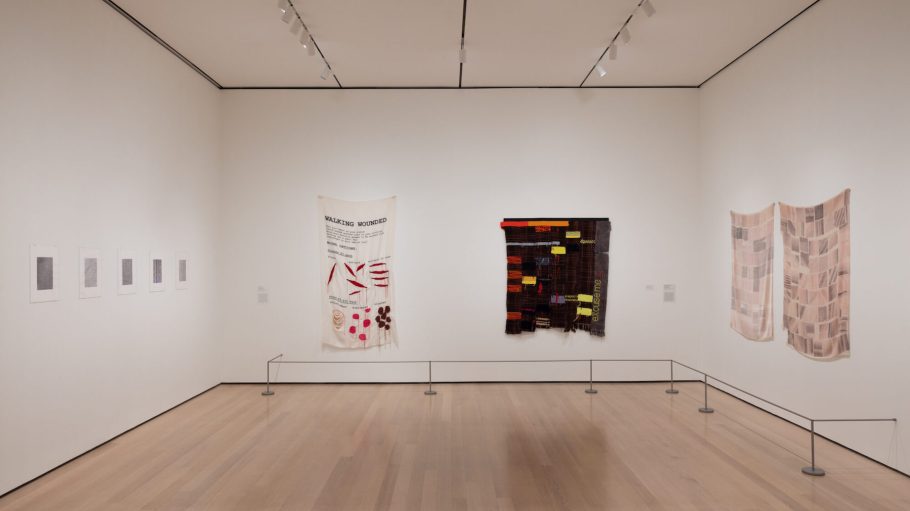
The Museum of Modern Art (MoMA) explores exploitation with its latest exhibition.
“Woven Histories: Textiles and Modern Abstraction” unfolds chronologically—beginning with the aftermath of World War I and ending with contemporary themes—to explore the “dynamic intersections” between weaving and abstraction over the past 100 years. Highlighting issues of labor and identity—inherently “intertwined” with textile production—the exhibition “challenges long-held notions of the weave as a function of textile alone,” MoMA said, with about 150 works in myriad mediums.
Related Stories
“The history of 20th-century art cannot be told without the inclusion of thread and fiber, cloth and clothing,” the exhibition’s introductory text reads, noting that the resulting retrospective will trace how fabric and fiber quietly reshaped modern art’s trajectory. “The efflorescence of textiles in today’s globalized art world speaks both to modernist abstraction’s multilayered heritage and to urgent social and political issues integral to textile production—above all, outsourced labor and sustainability.”
These various (and often overlooked) intersections are considered across seven thematic clusters, challenging the traditional hierarchy separating the “fine arts” (like painting) from the “applied arts” (like weaving). In doing so, “Woven Histories” confronts the longstanding division (in art history, granted) relegating textiles to the realm of the latter medium—one of less value. The presentation of textiles alongside pieces within the former, more respected medium, MoMa said, highlights the overlap; the “intellectual rigor, formal innovation and conceptual depth” inherent in textile practices.
Within the exhibit’s first gallery, however, is a video from the Institute 4 Labor Generosity Workers & Uniforms (ILGWU) by its curator, Carole Frances Lung. The durational (272 minutes) video, “Frau Fiber vs. the Circular Knitting Machine,” captured the labor activist’s alter ego “attempting to knit a tube sock as fast as a tube sock knitting machine,” the fiber artist told SJ.
“Think about Frau and I like Diana and Wonder Woman,” Lung said on April 20 during the exhibition’s public opening. “Frau is embodied through a uniform and activity; Frau does the action, always in a uniform that connects to the action—in this action the uniform was made from Kohler coveralls.”

The rest of labor’s thematic grouping falls mainly in the middle of the exhibition. Setting the contextually diachronic scene, the menagerie’s wall panel prefaces that one cannot talk about cloth (and clothing) without talking about how (and where) it’s made.
“Exploitative labor practices in low-wage economies currently fuel a trillion-dollar textile industry premised on racial, ethnic and wealth disparities,” reads the gallery’s didactic text. “Fast fashion— unregulated, sped-up production, marketing, and consumption cycles that create great waste and environmental degradation worldwide—has become the norm.”
Comprising a handful of pieces on the topic, the grouping addresses the non-normalcy of these normalized systems.
“Working across a range of mediums, the artists in this gallery call out the textile industry’s unrelenting quest for profit—as well as consumer complicity,” the labor gallery’s section text continued. “Others trouble a discourse that too often risks reducing labor issues to formulaic binaries: local versus global production; free versus alienated work; tradition versus innovation; manual versus mechanized modes of making.”
Also on display was Lisa Oppenheim’s use of photography and photograms to explore the history of images and materials, including those related to textile production and labor. For a 2016 dye sublimation print on aluminum, the contemporary American artist titled the composition “Mildred Benjamin, 17 years old. Right dorsal curvature. Scoliosis. Right shoulder higher than left. Shows incorrect position required to perform this kind of work.”
Consider the production of lace, MoMA continued, and the once “highly valued luxury” item’s similar historical underpinning dependent on wealth disparities and the textile industry’s unrelenting quest for profit.” When the mass production of lace replaced women laborers, the materials’ prestige was lost as well.
Oppenheim’s “Leisure Work III” photogram of vintage lace fragments underpins this laborious history. Once a luxury item made by women—some as a hobby, others for low wages—lace lost value with industrialization in the 19th century, per the piece’s label. As machine-made lace became common, a market for handcrafted vintage pieces emerged, leading to composite works such as this gelatin silver print, which Oppenheim created in 2013.
Another video—Laura Huertas Millán’s “La Libertad” from 2017—took a lens to the kaleidoscopic lives of Zapotec weavers in Oaxaca, Mexico; in turn, the 29-minute-long film “complicated binary assumptions about labor,” the exhibition said.
“Through this film, I wanted to erase these colonial frontiers and state—on the one hand —that the Navarros’ labour and mine had a horizontal dialogue,” the French artist and filmmaker told SJ. “On the other hand I wanted to engage with the weaving practice through an artisanal, and embodied filmmaking practice. One that could honor or even mimic the manual labour and intellectual dexterity of the Navarro sisters’ weaving.”
Previously on view in Washington, DC, as well as Los Angeles and Ottawa, “Woven Histories” was organized by the National Gallery of Art, in collaboration with MoMA, the Los Angeles County Museum of Art, and the National Gallery of Canada. Curated by Lynne Cooke, senior curator in the Department of Modern and Contemporary Art at the National Gallery of Art, the MoMA presentation was organized by curator Esther Adler with cultural assistant Emily Olek and collection specialist Paul Galloway. The Kate W. Cassidy Foundation made the exhibition possible, “generously funded” by The Coby Foundation, with leadership support provided by the Sandra and Tony Tamer Exhibition Fund.
“Woven Histories” is on view at MoMA through mid-September.