Bangladesh’s business community is grappling with renewed uncertainty after a series of mob attacks last week targeted at factory workers, media outlets and cultural institutions in Dhaka, heightening concerns over security and economic stability just weeks before national elections scheduled for Feb. 12.
The violence, which unfolded across industrial areas and the capital’s cultural and media districts, has rattled exporters and manufacturers already under pressure from inflation, slowing growth and weak global demand. Analysts and business leaders say the incidents risk undermining confidence at a time when political clarity is seen as essential for stabilizing the economy.
Related Stories
On the evening of Dec. 18, Dipu Chandra Das, a 27-year-old garment factory worker, was beaten, hanged from a tree and set on fire by a mob in the Square Masterbari area of Bhaluka over alleged blasphemy accusations. Das, a father of three and a member of a minority community, worked at Pioneer Knit Composite Factory. His killing triggered protests among workers and civil society groups and drew widespread condemnation.
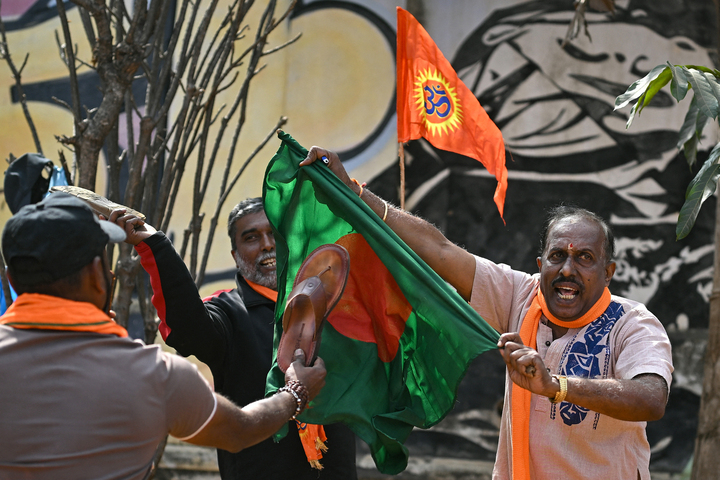
The incident also sparked diplomatic repercussions. Protests erupted in neighboring India, where demonstrators surrounded the High Commission of Bangladesh, further straining relations between the two countries at a time when economic ties are already under pressure.
That same night, mobs attacked major media organizations in Dhaka, setting fire to the offices of The Daily Star and targeting Prothom Alo. The blaze at The Daily Star trapped more than two dozen journalists on the rooftop before they were rescued. Cultural institutions, including Chhayanaut and Udichi Shilpi Goshthi, were also vandalized as groups moved through parts of the city, torching buildings and damaging property.
The physical damage to newspapers and cultural institutions—as well as the killing of a garment worker, burning of daughters of a BNP leader and other politically motivated deaths, reflect “a weak law-and-order situation in which the government appears to lack control and is not as proactive as expected,” Dr. Fahmida Khatun, executive director at the Centre for Policy Dialogue (CPD) told Sourcing Journal. “Under the interim government, law and order has remained volatile. While instability immediately after the uprising was perhaps inevitable, there was an expectation that the situation would stabilize. That has not happened.”
Khatun said the deterioration in security is complicating efforts to revive the economy after months of disruption. “GDP growth is lower than it was, inflation remains elevated, and employment generation has been slow,” she said. “Some surveys suggest poverty is rising again. Bangladesh had made significant progress in reducing poverty, but we are now seeing signs of reversal, which could worsen inequality.”
“Low investment, rising inequality and weak job creation are major challenges. No government wants to signal instability to the rest of the world. That is why these issues must be addressed without further delay,” she said
Business leaders say the violence has had an immediate psychological impact on markets and supply chains.
“We have clients and partners overseas asking us directly, ‘Is the situation stable?’” a factory owner in Savar, a suburb of Dhaka, told Sourcing Journal, speaking on condition of anonymity. “Every attack on a factory worker or a media outlet chips away at confidence in our market,” adding that buyers have begun delaying or reconsidering orders.
“Even when prices are competitive, the fear of disruption—whether political or operational—makes international brands hesitant. Inflation and rising costs also make it harder to commit to long-term contracts.”
The unrest has also exposed vulnerabilities in Bangladesh’s regional economic relationships, particularly with India, its largest export market in Asia. Tensions between the two countries have risen since the formation of Bangladesh’s interim government following the July 2024 uprising, and last week’s violence has added to the existing strain with protests in India over the killing of the Hindu garment worker. India’s Ministry of External Affairs issued a strong public condemnation of attacks on minorities in Bangladesh, framing the incidents as serious and not to be dismissed
Over the past year, India has suspended certain transshipment facilities used by Bangladeshi exporters, affecting trade flows. Visa restrictions have also tightened, limiting travel for Bangladeshis who routinely seek medical treatment in India due to proximity, shared language and access to healthcare.
“Tensions with a close neighbor inevitably affect the economy,” Khatun observed “If these frictions persist, trade and investment will suffer further.”
The climate of fear has fueled concerns that violence could continue in the run-up to the elections, with no clear indication of how quickly stability could return afterward.
“The weaponization of public anger against journalists and artists is dangerous at any time, and especially as the country prepares for elections,” said Irene Khan, the UN special rapporteur on the right to freedom of opinion and expression. “It risks having a chilling effect on media freedom, minority voices and dissent, with serious consequences for democracy.”
Despite the unrest, Bangladesh’s apparel sector—the backbone of its economy—has shown limited resilience. Apparel exports from January to November 2025 were estimated at $35.59 billion, up 2.53 percent from the same period a year earlier. The sector accounts for more than 80 percent of export earnings and employs more than four million workers, making it particularly sensitive to political volatility.
Economists caution, however, that the combination of political violence, persistent inflation, weak global demand and structural problems in the financial sector could weigh heavily on growth prospects heading into 2026.
“Political uncertainty and social instability directly affect the economic psyche,” said Dr. Zahid Hussain, former lead economist at the World Bank. “If uncertainty is reduced and public confidence improves during a peaceful transition, the economy could benefit. If not, we could see slower investment, subdued private-sector credit growth and weaker export momentum.”
Amidst the unrest, political developments have drawn intense attention, bringing hope of new systems that might yet emerge.
On Friday, Dhaka came to a standstill as Tarique Rahman, acting chairman of the Bangladesh Nationalist Party, returned after 17 years in exile.
His return comes as his mother, former prime minister Khaleda Zia, remains in critical health, and as the party seeks to reassert itself ahead of the elections. In an emotional address to supporters lining the airport and streets across the city, Rahman pledged a “plan for the people,” a message that resonated with sections of the business community seeking clarity on the country’s political direction.
“Today, standing on the soil of Bangladesh, I want to say before you all—I have a plan for the people of my country,” Rahman said.
On Monday, he continued consolidating his leadership, addressing crowds from the BNP office in Nayapaltan and calling for unity. “Let us come together to build our country step by step,” he said.
Taskin Ahmed, president of the Dhaka Chamber of Commerce and Industry, said clearer signals on the election timeline would help restore predictability for businesses. “Greater clarity will help companies plan,” he said, adding that investor appetite would ultimately depend on whether the law-and-order situation stabilizes.
The interim government, led by Nobel laureate Muhammad Yunus, has sought to reassure citizens and markets that order can be restored. But manufacturers say that alongside calls for justice over the recent violence, they are contending with mounting fiscal and structural pressures, including rising public debt and sluggish credit growth.
As Bangladesh moves closer to the polls, analysts warn that years of economic gains—from improvements in factory safety to investments in green manufacturing—could be put at risk if instability persists. Many manufacturers said they were now afraid to speak up, fearing for safety, or repercussions, but that the hope for better law and order continues to dominate.
As one manufacturer pointed out, the economy has risen on the strength of its apparel exports. “The coming weeks may prove decisive in determining whether confidence can be restored or further eroded,” he said.