More than a dozen men from Mexico’s Indigenous Zapotec community, aged between 24 and 56, were arrested by Immigration and Customs Enforcement officers during Friday’s raid of Ambiance Apparel, a manufacturer, importer and wholesaler of women’s and junior’s clothing that was swept up in a wide-ranging workplace crackdown in Los Angeles that has fueled days of clashes between law enforcement and protestors, incited the deployment of both the National Guard and the Marines and raised questions about the limits of the Trump administration’s authority in a so-called sanctuary state.
Related Stories
Distraught family members gathered outside Ambiance Apparel’s E. 15th St. office in the Fashion District on Monday to denounce what all of them described as the “kidnappings” of their 14 fathers, sons, brothers and uncles, who in many cases were the breadwinners of their households. A representative from Ambiance Apparel, reached by phone, declined to clarify conflicting accounts of whether ICE agents had warrants that allowed them to search the premises. The Department of Homeland Security similarly acknowledged a request for comment but did not respond further.
“I say ‘kidnapped’ because they were taken by force without any warnings or permits, as well as being held without any contact to the families or lawyers, and that by definition, is kidnapping,” said Carlos Gonzalez, who watched as his brother, José Paulino, was chained up like “he was some kind of dangerous animal.”
“José is human, just like you and I,” Gonzalez said. “He’s fun, he’s full of life and he’s really sweet. And the only crime that he committed was trying to live a better life and trying to get ahead and work. The whole process wasn’t just inhumane, it was illegal. This state is about being the best. This whole country boasts about being the best. But how can we claim that if we can’t uphold basic human rights and due process? Where is the sanctuary California promised us?”
Montserrat Arrazola, a college student, said she watched as her father, Jorge, and others were dragged away by officials as their relatives cried and screamed, “not knowing what to do, just like me.” She deplored ICE acting director Todd Lyons’ characterization on Friday of the arrests of “criminal illegal aliens” such as “gang members, drug traffickers and those with a history of assault, cruelty to children, domestic violence, robbery and smuggling.”
“What happened that day was not right,” Arrazola said, her voice strangled with grief. “It was not legal in this country. We all have the right to due process, and that right was denied to my father and many other workers. My father is part of this community. We demand the immediate release of all the workers detained that day. We demand that workplaces that collaborate with ICE be held accountable. We demand that the sanctuary status be respected throughout California, no matter where a person comes from or how they arrived in this country. We demand justice.”
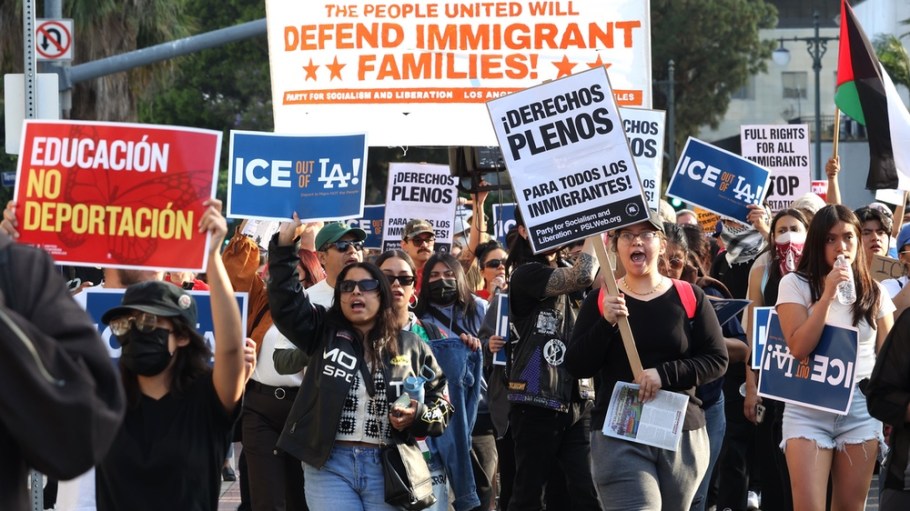
Tensions remain inflamed in Los Angeles, which seemingly overnight has become a flashpoint in the Trump administration’s ramp-up of its immigration agenda. Demonstrations have been largely peaceful, although some protestors launched water bottles, rocks, electric scooters and fireworks at passing police vehicles or set driverless Waymo cars and dumpsters on fire. Clad in tactical gear and wielding riot shields and military-style rifles, federal agents lobbed non-lethal munitions, including rubber bullets, tear gas and flash-bang grenades, to disperse crowds.
The events of the past few days have rattled the tens of thousands of people who make up the “West Coast hub” of the American apparel industry, many of whom are undocumented immigrant women from Central and South America who toil long hours for extremely low wages.
“We need to go and talk to specific employees to find out how they are. It’s going to take some time. It’s only Monday,” one manufacturing staffer, who requested anonymity to be able to speak freely. “How are we doing? Right now, we don’t know where we are, who we are or how we are. If it’s safe, we will go to work.”
The owner of a large downtown L.A. apparel factory told Sourcing Journal that the raids and subsequent upheaval were causing disruptions to productivity, but said it was too early to assess the situation or comprehend its ramifications. Several other businesses, including Reformation, Mother Denim and Saitex, either did not respond to requests for comment or declined to do so.
Others were more candid, including Alex Zar, CEO of Lalaland Production and Design, who told Sourcing Journal that the business is “operating with caution and advising our staff to carry all necessary identification and documentation to prove their residency status in case they are approached by federal authorities.”
“Although our staff members are legally residing in Los Angeles, many still fear being profiled based on their appearance or country of origin,” Zar added. “There’s a concern that being mistakenly detained could seriously disrupt their daily lives.”
The business owner, whose factory supplies major leather goods and footwear brands across the globe, said the recent ICE detention of the head of an L.A. janitorial union, as well as other labor leaders, “has understandably created a sense of fear and distraction, not only for our team members but also for their families—especially those whose legal statuses may differ.”
Sean Scott, CEO and co-founder of ComunityMade, a footwear producer that employs Fashion District natives and focuses on cultivating local talent, was disturbed and dismayed by the developments of the past 96 hours.
When asked whether the factory was experiencing interruptions to its operations, he said, “Our situation is that business is carrying on—but it is not business as usual.” Immigrants are essential to ComunityMade’s business, “so we’re concerned,” he added.
“We have fantastic teammates from Guatemala, China, Spain, Mexico, Ukraine and they’re all scared because ICE’s detentions have been sweeping, not focused on criminals or illegals,” Scott said. “Some are staying home. Families are scared, too.”
On Monday, a “big police presence” persisted in the area surrounding the company’s shop and factory headquarters, though there were no signs of protests or violence on the 500 block of Mateo Ave. Local law enforcement appeared to position itself apart from the activities of ICE or the National Guard, which swept through the city on President Trump’s orders on Sunday afternoon.
“This is our city; we’re not going anywhere. But as far as working with ICE, we don’t do that,” Officer Drake Madison of the L.A. Police Department’s public information office told Sourcing Journal. “Obviously, we’re not going to ignore a help call or something that may come out, but we’re not directly working with them [or] with the National Guard.”
Madison said that as of Monday afternoon, businesses were permitted to carry on “as usual,” noting that curfews had not been instated, as they had been in 2020 following widespread unrest across the city following the killing of George Floyd in Minnesota. He recommended that business owners refrain from trying to intervene personally in the defacement of property and avoid putting themselves or their employees in harm’s way. “Run your business, but just also look at it from a human standpoint,” he added.
One retailer in the fashion district, who asked not to be named, said foot traffic had fallen because customers are “scared to come over because of the protests.” A sales associate at another store was told that “if there’s anything happening, it’s O.K. to just close the store and leave.”
While a spokesperson for the L.A. Sheriff’s Department sought to emphasize that it “does not participate in any civil immigration enforcement activities or mass deportation sweeps,” saying in a statement that that responsibility rests solely with federal law enforcement agencies, the city’s garment workers are in a state of panic.
“There’s definitely a lot of fear and anxiety about going to work,” said Daisy Gonzalez, campaign director at the Garment Worker Center, a nonprofit that has been holding immigration clinics to provide education and resources for workers. “People are scared to take public transportation. There are a lot of unverified accounts of ICE throughout L.A. County. But, of course, people need to continue to put food on the table, pay their rent, keep a shelter over their heads.”
She fears, however, that this is only the beginning and that more families will be broken up before long.
“We should all be applying pressure on the administration to end these racist raids, to ensure that due process is something that every person in this country has access to, and to ask this administration to stop creating fear and chaos in the community,” Gonzalez added.
An ‘unprecedented power grab’
As the unrest continues to percolate on the street level, city and state officials have taken the fight to the Oval Office via the airwaves and social media, culminating in the second California lawsuit against the Trump administration in a matter of months.
Governor Gavin Newsom traded barbs with the president throughout the weekend, pushing back on the deployment of military force absent the request or permission of state and local leaders. The scuffle culminated in an apparent threat from Trump’s border czar, Tom Homan, to arrest both Newsom and Bass if they “crossed the line.” Trump cosigned the threat, saying Newsom’s arrest would be a “great thing.”
Newsom called the bluff, addressing Homan via a television interview. “Arrest me, let’s go,” he said.
On Monday, Newsom and California Attorney General Rob Bonta filed a lawsuit against the Trump administration—the second since April, when they sued the White House for what they characterized as the illegal implementation of sweeping tariffs against trade allies. The new complaint alleged that Trump “unlawfully bypassed” the governor in federalizing the state’s National Guard, overstepping his jurisdiction when local authorities had the protests under control.
“We don’t take lightly to the president abusing his authority and unlawfully mobilizing California National Guard troops,” he said in an announcement that also name-checked Defense Secretary Pete Hegseth. “Trump and Hegseth jumped from 0 to 60. Bypassing law enforcement expertise and evaluation, they threw caution to the wind and sidelined strategy in an unnecessary and inflammatory escalation that only further spurred unrest.”
The complaint alleged that Trump violated California’s sovereignty through the “unprecedented power grab.”
“One of the cornerstones of our Nation and our democracy is that our people are governed by civil, not military, rule. The Founders enshrined these principles in our Constitution—that a government should be accountable to its people, guided by the rule of law, and one of civil authority, not military rule,” Newsom posted on X on Monday. “California will be standing up for those principles in court,” he added, addressing Trump directly.
It’s unclear, however, how much this would help the 14 men, whose bonds are expected to be set between $1,500 and $5,000 per person, according to a GoFundMe that hopes to raise $150,000 to cover their families’ immediate needs, including rent, groceries, healthcare and childcare. At least one of the detainees, according to family members, have already been deported back to Mexico. Others have received no updates.
“I witnessed how they put my father in handcuffs and chained him from the waist and from his ankles,” said Yurien Contreras, whose youngest sibling is four and has autism, of Mario Romero. “It was very traumatizing. We suffered and still suffer from this traumatizing experience emotionally, mentally and physically. My father had the right to speak to a lawyer. My family and I haven’t had communication with my dad. We don’t know nothing about him.”
All 14 of the men who were detained were members of the Episcopalian Diocese of Los Angeles. They were taken on the Day of Pentecost, which is celebrated by Christians, 49 days after Easter, as a “holy disruption [of] God breaking into the evil world with the spirit of justice, the spirit of liberation and love,” said Jaime Edwards-Acton, rector at St. Stephen’s Episcopal Church. Today, the United States faces a moment that “cries out for that same spirit,” he said.
“The ICE raids in Los Angeles are nothing less than a direct attack on a working class trying to make an honest living to make ends meet for their families to put food on,” Edwards-Acton said. “The fact that ICE targeted this district, the garment district, is no coincidence. It has long been a place where immigrant labor has not only the industry but the city itself—these workers, these mothers, these fathers, these brothers and sisters‚ they are all community, and yet they were treated like criminals for the simple act of working. This is not just about immigration. What we’ve been witnessing in our communities are signs of an escalating authoritarianism.”
The broader fashion industry is paying attention to the implications that continuing raids may have on the vulnerable workforce that undergirds what remains of domestic apparel manufacturing. Much of it is already grappling with the impact of a chaotic tariff rollout on the cost of imported components and materials: buttons from China, for instance, or fabrics from Italy.
Kesi Foster, co-executive director of Partners for Dignity and Rights, a human rights advocacy group based in New York City, home to its own concentration of garment workers, called the raids “acts of cruelty that serve no other purpose than to sow chaos and fear in an attempt to divide our communities.”
“Immigrant garment workers in the United States have long shouldered the weight of systemic exploitation, including low wages, wage theft and dangerous conditions,” he said. “The administration’s targeting of manufacturing workers through ICE raids is a cruel contradiction: while claiming to want to revive American manufacturing, it punishes the very workers who sustain it.”
While Steve Lamar, CEO and executive director of the American Apparel & Footwear Association, said that the trade group abhors any violence, it also supports peaceful demonstrations in the United States and around the world as an “exercise of free speech and of the importance of civic engagement.”
“Our industry has a rich history that is interwoven with diverse immigrant communities. For generations, immigrants from Europe, Asia, Africa and Latin America have powered our industry in manufacturing, design and retail,” he said. “As we look to build a stronger, more resilient industry, we look to federal, state, county and city officials to work with local communities on a peaceful and sustainable path forward.”
Additional reporting by Rosemary Feitelberg.