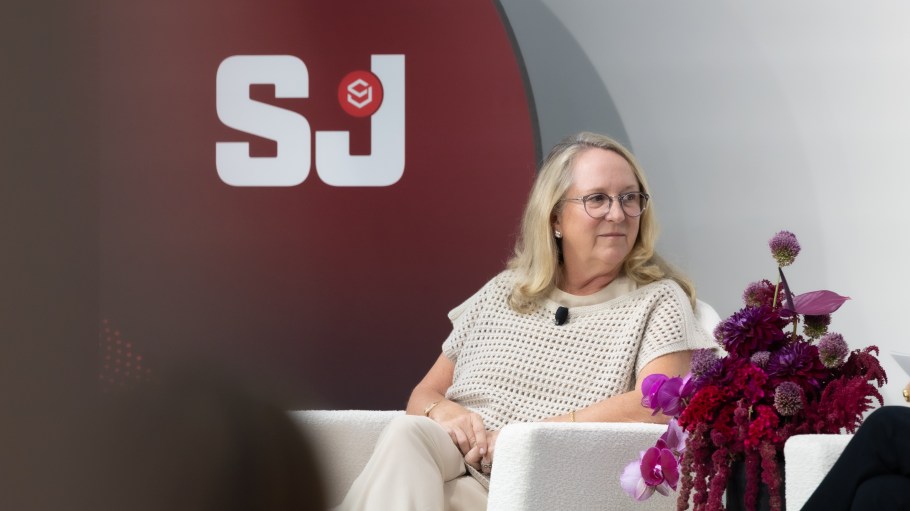
Deirdre Quinn, CEO and founder of Lafayette 148, joined Lauren Parker, director Sourcing Journal and Fairchild Studios, for a fireside chat at Sourcing Journal’s annual Fall Summit. The two discussed the ways tariffs have altered the luxury brand’s strategy and how Quinn is looking at the company’s future.
Lafayette 148 is headquartered in Brooklyn, but has its own vertically integrated factory, located in Shantou, China, where it manufactures 95 percent of its products. The other 5 percent are made in other factories; for instance, the brand’s denim is produced in Los Angeles.
Related Stories
For Quinn, having the vast majority of production in China has been tumultuous, particularly because President Donald Trump has had some fraught back-and-forth discussions with Chinese President Xi Jinping in recent months.
Today, the tariff rate on Chinese goods inbound into the U.S. stands in the low double digits. But experts expect a trade deal could be coming ahead of the end of the year, and earlier this year, Trump imposed a brief triple-digit tariff rate on Chinese goods.
For Quinn, that uncertainty has been difficult to move through. She said the triple-digit tariffs were “jump out the window bad,” but noted that her team has been working diligently to deliver quality products, with reasonable margins at a price point that makes sense for consumers.
“It’s not a lot of fun to be 95 percent made in China right now, but I’m still an optimist, so I just continue to think of creative ways to…look around the world, find potential solutions,” Quinn said.
But China isn’t the only area of the world that faces the threat of higher tariffs; other Southeast Asian sourcing strongholds have also seen high tariff rates and threats from the Trump administration. Quinn said most sourcing locations have some degree of risk when it comes to expense—and that’s not new. Lafayette 148 used to split its production among factories in a number of countries, but ultimately decided that having its own factory was the best solution.
“I used to travel extensively for manufacturing—to 70 countries—and it was never cheap enough,” Quinn said. “The decision to be vertical was a great idea 30 years ago. Today, I still stand behind what we are, but I’m definitely looking around the world and questioning, ‘Can it get worse?’”
Despite the tariff uncertainty on Chinese goods, Quinn said Lafayette 148 has not made a move to exit China or shift its sourcing yet. She said the factory has myriad capabilities that Lafayette would have to find new suppliers for, if it chose to go that direction.
“A lot of advice is, ‘Just move your production.’ It took us 30 years to build that factory. We would have to replace it with 30 little factories,” Quinn said.
She also said that the workers Lafayette’s factory employs have played a part in her decisioning around sourcing—and particularly around trying to move the factory elsewhere, even though she acknowledged there are other factories that produce Lafayette-quality output.
“I have mouths to feed on the other side of the world that have relied on our company for 30 years, and so it’s a tough choice,” she said.
Quinn said that some of the specialized capabilities inside Lafayette’s factory would be difficult to replicate out of China. What’s more, because the brand focuses on luxury goods, it has specific quality standards customers have come to expect.
For that reason, Quinn said, the brand has chosen not to trade down on its materials or fabrics. While that sometimes means the cost has to be passed on to the consumer, she said the alternative could have strong negative impacts on the company’s bottom line.
“We’re competing with Europeans. We’re very much a luxury brand. If you start to cut corners, your customers are smart. They’re going to know. And I can’t compete with the top brands in the world if I start telling design what to do and how to make it less expensive,” she said.
She said as collections come together, she studies Lafayette’s competitors, which she said helps the brand keep an edge. As she’s observed market patterns, she’s seen that keeping quality at the fore of Lafayette’s value proposition just makes business sense; she told Parker that rather than decreasing quality, the brand is increasing the fidelity of what its garments are made of.
“If anything, we’re going higher. Before every costing meeting, the first thing I do is go out to the stores and study my competition. It’s really important to do; you have to focus on who you are, what zone you’re at and watch your competitors carefully.”
In recent months, Lafayette 148 made the decision to pass some of the costs associated with tariffs down to its consumers, starting with its fall collection—at least for U.S. consumers. Quinn said the brand evaluates product prices by location now that tariffs have set in; for instance, customers at Lafayette 148’s stores in China pay lower prices than U.S. consumers.
“Why should they have to pay our tariffs?” she quipped.
In the U.S., Quinn knew that the brand couldn’t pass all its costs down to the consumer, but also knew the brand couldn’t, as she called it, “squeeze the factory”—or ask suppliers to absorb some of the costs onslaught by higher duty rates.
“That’s like eating before your children in our case,” she said. “You can’t do that to the factory, then the quality suffers, or they don’t want to do business with you, because nobody wants to lose money,” she explained.
Still, she had to reduce the number of people the company employs as a cost-cutting measure on the company’s side.
Despite the mitigation strategies Lafayette has started to employ, Quinn knows the macroeconomic situation, and the tariff rates, are a moving target—and part of her reality. She mentioned that tariffs during the first Trump administration impacted the business, but said this time around, the situation has been more unpredictable.
That’s changed how she evaluates her business on the whole.
“Tariffs [are] my third biggest expense in the company, and it certainly wasn’t that before,” she said. “You have to be faster than you ever were now, because you can’t take anything for granted. So being nimble and being quick and…dealing with cash flow, they’re equal problems.”
Still, for all the headaches tariffs can cause, Quinn knows it’s another piece of working in an already difficult business. That in mind, she said she’s focused on making quality pieces for her consumers; maintaining relationships with vendors; securing the best cost she can and preserving the longevity of the brand.
“If you don’t find a problem, you don’t have a job. I learned that a long time ago in my career, so I really take problems as opportunities to figure it out—get your teams together, stay resilient, stay focused,” she said.