Mattel had Barbie. Sanrio had Hello Kitty. Ty had Beanie Babies.
Pop Mart has Labubu.
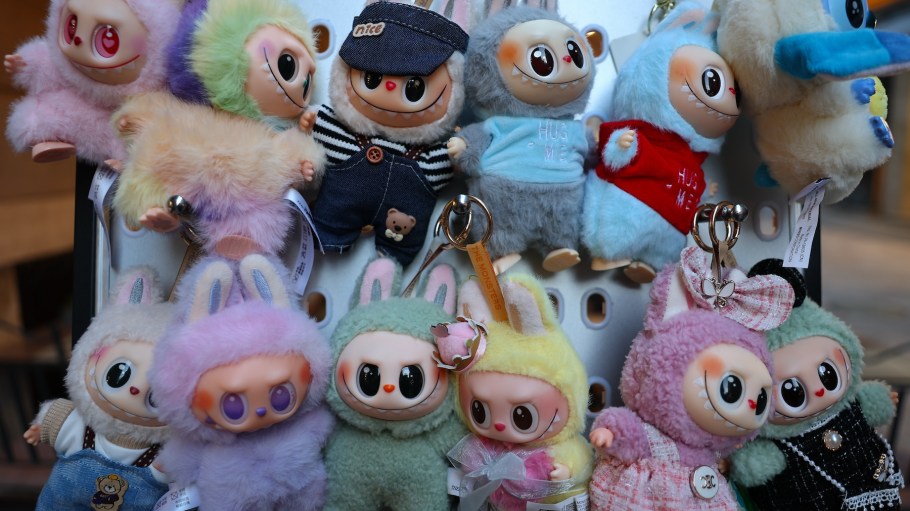
The Beijing-based collectible toy company has found its breakout success in its “The Monsters” characters, most notably Labubu, a mischievous, serrated-toothed elf from illustrator Kasing Lung’s storybook universe. In the first half of 2025, Pop Mart’s combination of collectible blind-box toys and an eye toward strategic international expansion sent its sales skyrocketing—particularly among U.S. Gen Z consumers.
Related Stories
Now, the company is on track to blow past its $2.78 billion revenue goal for 2025 to reach a whopping $4.18 billion, the company reported during an earnings announcement Tuesday.
A little added context for the uninitiated: As a Hong Kong-born artist raised in the Netherlands, Lung was heavily inspired by Nordic folklore and in 2015, he populated his picture books with “magical characters both good and evil known as The Monsters,” Pop Mart’s website prefaces.
“Among them, the most prominent one was Labubu, a small monster with high, pointed ears and serrated teeth,” it said. “Despite a mischievous look, Labubu is kind-hearted and always wants to help, but often accidentally achieves the opposite.”
In 2019, Lung entered into an exclusive agreement with Pop Mart to establish The Monsters as a proprietary intellectual property (IP) for the toymaker.
Soon, it was off to the races. The University of Hong Kong Business School reported that K-pop girl-group Blackpink’s Lisa, a Thai national, posted the devilish doll on Instagram, which caught the attention of a Thai princess; Labubu even became Thailand’s official tourism ambassador. In May, multi-hyphenate mogul Rihanna stepped out with one of the toys clipped to her Louis Vuitton bag, and rumblings about the little monster grew into a cacophony.
“We originally hoped to become China’s Disney; now we hope to become the world’s Pop Mart,” the company’s founder and CEO, Wang Ning, said in an interview with state broadcaster China Central Television on last month.
“We are committed to building a new generation of world-class consumer brands, advancing our corporatization and internationalization strategy unwaveringly,” the company said in its earnings announcement.
Considering Pop Mart was named as one of Time magazine’s most 100 influential companies of 2025, the journey is decidedly underway.
The 15-year-old plush toymaker’s revenue surged 204.4 percent during the first half of this year, reaching roughly $1.93 billion (13.88 billion yuan). That compares with 62 percent growth ($638.1 million) in the first half of 2024.
While that growth was felt across all regions, it turns out that stateside Gen Z shoppers have really Big Energy surrounding blind boxes.

The Americas reported spending $215.23 million on the bag charms—an impressive increase of 1,142.3 percent—contributing 16.3 percent of total revenue. Starting in September, sales of Labubu could surpass 10 million units every single day, Ning told Chinese media outlet Global Times last month.
“Our rapid growth stems from being an open and inclusive intellectual property platform that has attracted many outstanding artists and designers. We manage these IPs systematically,” Ning told People’s Daily in July. “The charm of the cultural industry lies in its demand for strong soft power, which can’t be rationally calculated, which means you can’t just recreate a Labubu with money.”
Rational calculations about the product’s appeal are indeed elusive. Labubu ascended to global prominence on whimsy and vibes, and much internet discourse centers on questions like, “Is this for kids?” But the appeal affects buyers of all ages, and now, markets. Ning estimated that North American sales might surpass Southeast Asia’s this year—seemingly indicating the rapid expansion and higher margins in the Western world.
But Labubu’s global domination has come with some of the same challenges that have befallen other much-hyped viral products.
Pop Mart hauled 7‑Eleven and eight of its California franchises into U.S. District Court for the Central District of California with a July 18 complaint asserting that fake dolls (now known colloquially as “Lafufus”) were being sold in their stores—underscoring how the niche toy-turned-cultural touch-point has complex copyright and counterfeit concerns, not unlike luxury or ultra-fast fashion.
In addition to capitalizing falsely on the product’s IP, the dupe market doesn’t comply with product safety standards. U.S. Consumer Product Safety Commission (CPSC) issued a warning on Aug. 18 due to the choking hazards posed by lookalike Labubus.
“These fake Labubu dolls are dangerous, illegal, and have no place in American homes,” said CPSC acting chairman Peter Feldman. “No parent should have to wonder if a toy will stop their child from breathing. Protect your children and buy only from reputable sellers.”
A similar warning was issued on Aug. 13 by the Chartered Trading Standards in the United Kingdom.
Regardless, Pop Mart is determined to see the product’s stratospheric rise continue. “Labubu ascended to global IP prominence through its distinctive artistic appeal, emerging as one of the world’s most sought-after IPs in the first half of 2025,” the company said. “We remain committed to refining operations, launching superior designs, and unlocking the value of IPs, propelling Labubu toward enduring global IP stature.”
Pop Mart has attributed its international success to stepping up the expansion and differentiating its channel positioning, using a three-pronged, strategic approach.
The first—an IP-first product development approach—means that each plush or collectible is developed around distinct characters with narrative depth, leveraging rotocast plush techniques and design innovation.
The second, omnichannel expansion, covers aggressive growth in both digital platforms and physical retail—including immersive flagship stores and automated vending machines—supporting international sales while deepening brand touchpoints.
Last but not least, global cultural resonance sees the company emphasizing storytelling and artist collaboration to cultivate emotional engagement, generating viral moments and international recognition.
Pop Mart is tackling omnichannel robustly, showing that the juggernaut isn’t just dominating in the digital realm. The company’s Americas retail stores (net gain of 31 locations) and automated retail vending machines increased 744.3 percent to $117.25 million. Meanwhile, Americas wholesale revenue reached $13.35 million—up 413.5 percent from last year’s $2.6 million.
Online channels still accounted for 58.6 percent of the total revenue generated in the region, unsurprisingly, soaring nearly 2,000 percent to $184.64 million. Pop Mart’s official website was up a staggering 2,984.2 percent to $123.38 million, making up 39.2 percent of the region’s total revenue. TikTok saw significant gains as well as, increasing by 2,032.9 percent to $43.84 million, representing 13.9 percent. Other online channels in the Americas grew by 514.6 percent to $17.39 million.
“We continued to advance the development and optimization of our brand’s official website and closely followed the trend of live-streaming e-commerce,” the company said. “With a focus on user needs, we enhanced the user experience to deepen brand influence.”
Regardless of region, Pop Mart’s core business is its IP operation ecosystem, according to the interim results announcement.
Pop Mart’s registered artists’ IPs—other proprietary products like “Molly” or the more philosophical “CryBaby”—collectively accounted for 88.1 percent of revenue. Of that baker’s dozen assortment, The Monsters IP accounted for 34.7 percent—roughly $670 million. For context, Labubu-related sales hit $418 million last year.
“At the product level, we kept introducing new products, enriching product offerings and enhancing product design capability,” the Cayman Islands incorporated company said.
Looking ahead, Pop Mart plans to continue optimizing R&D efforts—such as deploying the global supply chain and locking-in more suitable manufacturing partners—to meet market demand without compromising supply. The company is equally “committed to refining operations, launching superior designs and unlocking the value of IPs, propelling Labubu toward enduring global IP stature.”