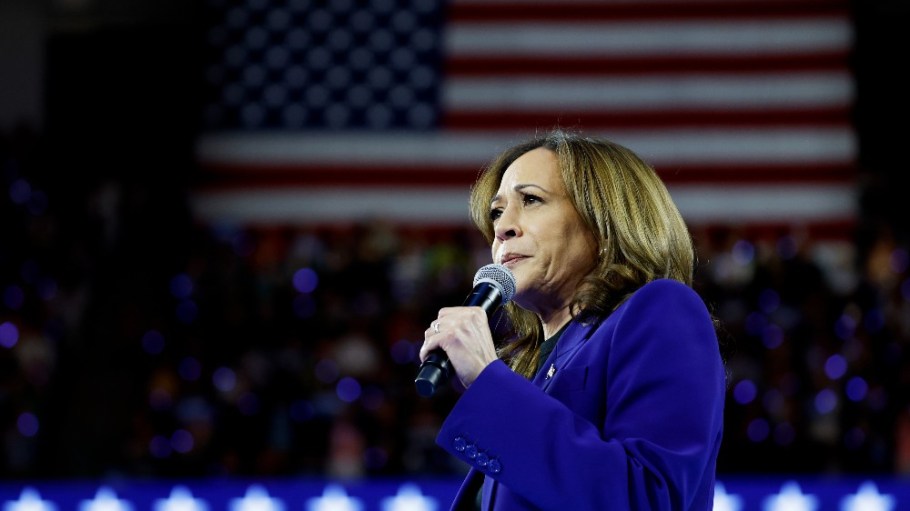
On the fourth and final night of the Democratic National Convention, Vice President Kamala Harris accepted her party’s nomination for the presidency.
The United Center in Chicago swelled with such boisterous applause and affirmation that one might never guess that Harris’ campaign came together in the space of a month. “But I’m no stranger to unlikely journeys,” she said.
When she took the stage, the VP broke away from the stump speech she’s delivered so adeptly in recent weeks, speaking instead to her early days in Oakland, Calif. and the struggles of a mother raising a family mostly on her own. She underscored the importance of community in shaping her life, of learning to seize opportunity instead of waiting for permission or a leg up, and of fighting against injustice on behalf of those who can’t do so on their own.
Related Stories
“My entire career, I have only had one client: The People,” Harris said, referencing her legacy as a prosecutor and as Attorney General of California. “I know there are people of various political views watching tonight, and I want you to know: I promise to be a president for all Americans. You can always trust me to put country above party and self.”
Despite the ready abundance of memes and merch and the steady stream of campaign donations, before Thursday, Harris had yet to speak cogently on her plans for a new administration and how she might tackle the issues weighing heavy on the minds of Americans.
But with a focus on the middle class and the kitchen-table issues dominating conversations in households across the country, Harris has begun to craft a new brand of populism—and patriotism.
Doubling down on her framework for an “Opportunity Economy,” which she unveiled last week, Harris told the DNC audience she envisions a country “where everyone has a chance to compete and a chance to succeed, whether you live in a rural area, small town, or big city.”
“As president, I will bring together labor and workers, small business owners and entrepreneurs and American companies to create jobs, grow our economy and lower the cost of everyday needs,” she said. Harris said her administration would provide access to capital for small business owners and founders, end the housing shortage and safeguard Social Security and Medicare.
She then contrasted those objectives with those of her opponent. “He doesn’t actually fight for the middle class; instead, he fights for himself and his billionaire friends,” she said. “He will give them another round of tax breaks, that will add $5 trillion to the national debt.”
Former President Donald Trump has said he plans to renew his 2017 Tax Cuts and Jobs Act if elected, and provide further tax cuts for wealthy individuals and corporations. Harris’ economic agenda includes a plan to raise the corporate income tax rate from 21 percent to 28 percent—a proposal championed by President Joe Biden—and a pledge not to raise taxes on those earning less than $400,000.
Harris also again took aim at Trump’s polarizing plan to implement a universal tariff system on goods from other countries. The Republican nominee has proposed a 10-percent, across-the-board tax on all imports, as well as expanding duties on China-made goods up to 60 percent.
“He intends to enact what, in effect, is a national sales tax—call it a ‘Trump Tax’—that would raise prices on middle-class families by almost $4,000 a year,” Harris said.
The Peterson Institute for International Economics and the Center for American Progress estimate that a universal baseline tariff could cost the typical household between $1,500 and $1,700 annually on necessities sourced from across the globe.
“Instead of a Trump tax hike, we will pass a middle-class tax cut that will benefit more than 100 million Americans,” the nominee added. Those cuts would be made in part by resurrecting and enhancing some of the elements of the 2021 American Rescue Plan, like the Child Tax Credit and the Earned Income Tax Credit.
While the speech focused heavily on issues at home, Harris also succinctly alluded to her philosophy for advancing the country’s standing abroad.
“I will make sure that we lead the world into the future on space and Artificial Intelligence— that America, not China, wins the competition for the 21st century, and that we strengthen, not abdicate, our global leadership,” she said.
She also positioned herself staunchly opposite the Trump-Vance ticket in her desire to protect alliances and relationships that have been shaped and solidified over the course of the past four years. “I will stand strong with Ukraine and our NATO allies,” she said, underscoring the importance of cooperation with Europe.
Harris then called forcefully for an end to the war in Gaza, saying, “now is the time to get a hostage deal and ceasefire done.”
“President Biden and I are working to end this war such that Israel is secure, the hostages are released, the suffering in Gaza ends and the Palestinian people can realize their right to dignity, security, freedom and self-determination,” she added. On a Wednesday call with Israeli Prime Minister Benjamin Netanyahu, Biden urged the leader to ratify a treaty swiftly.
“As President, I will never waver in defense of America’s security and ideals, because in the enduring struggle between democracy and tyranny, I know where I stand—and where the United States of America belongs,” Harris said.
The presidential hopeful ended her address by positioning the Democratic party as a standard-bearer for a new kind of patriotism—one rooted in optimism for the future.
“Our opponents in this race are out there every day denigrating America, talking about how terrible everything is,” she said. “Well, my mother had another lesson she used to teach: never let anyone tell you who you are. You show them who you are.”
“America, let us show each other—and the world—who we are and what we stand for: freedom, opportunity, compassion, dignity, fairness and endless possibilities.”