Industry groups are celebrating a dog toy company’s loss in front of the Supreme Court as a victory for trademark rights.
In a unanimous decision, the U.S. Supreme Court ruled last week that the Ninth Court of Appeals erred in declaring a dog toy parodying Jack Daniel’s protected by the First Amendment. The decision instead clarified that a mark used as a source identifier is not protected as free speech—even if that work was intended as parody.
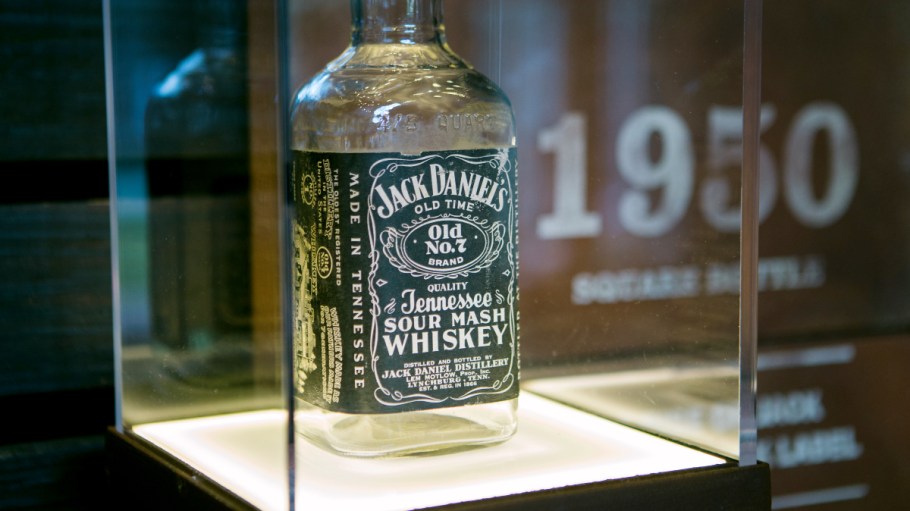
The case revolved around a fecal-themed “Bad Spaniels” dog toy that VIP Products LLC defended as a Jack Daniel’s parody. The toy, which remains available for purchase online, features several details mirroring Jack Daniel’s own, including a label that replaces the text “Old No. 7 Brand Tennessee Sour Mash Whiskey” with “The Old No. 2 On Your Tennessee Carpet.”
Related Stories
VIP added the Bad Spaniels toy to its “Silly Squeakers” line—other products include Dos Perros, Smella Arpaw and Doggie Walker—in 2014. VIP did not apply to register the Bad Spaniels name, but in its complaint claimed it owned and used the “Bad Spaniels’ trademark and trade dress.” Jack Daniel’s soon sent VIP a letter demanding it stop selling the product, to which VIP responded by seeking a declaratory judgement that it neither infringed nor diluted the whiskey brand’s trademarks.
VIP argued that its product was protected under the Rogers test, a legal benchmark based on the 1989 Supreme Court case Rogers v. Grimaldi that requires an infringement claim be dismissed if the complainant can’t prove either that the challenged use “has no artistic relevance to the underlying work” or it “explicitly misleads as to the source or the content of the work.” It also contended that its product was a parody and as such made “fair use” of Jack Daniel’s trademarks.
The district court that heard the case rejected both contentions for the same reason—that VIP used the parodied Jack Daniel’s features to identify the source of its own products. The case proceeded to trial, where Jack Daniel’s won. The Ninth Court of Appeals reversed the decision, however, ruling that the Bad Spaniels toy was subject to the Rogers test because it is an “expressive work.” When the case returned to trial, VIP won.
The Supreme Court’s decision will return the case once more to the district court, which will have to decide whether the Bad Spaniels marks are likely to cause confusion with Jack Daniel’s marks.
The American Apparel & Footwear Association (AAFA), Footwear Distributors & Retailers of America (FDRA), Council of Fashion Designers of America, Inc. (CFDA) and the Accessories Council praised the decision, which they said “will protect American intellectual property on behalf of brands, workers, consumers, and the American economy.”
“The court’s decision gives certainty to American brands that investments in new designs and innovation are not lost by allowing others to pilfer the intellectual property of another,” AAFA president and CEO Steven Lamar said in a statement. “We should not glorify or justify any type of counterfeiting or trademark infringement; it is illicit and those standing by the sidelines are complicit.”
The AAFA, FDRA, CFDA and Accessories Council together filed an amicus brief supporting Jack Daniel’s Properties, Inc. in January. Levi Strauss & Co. and Nike, Inc. both filed their own amicus briefs supporting the whiskey seller as well.
The decision promises to have an immediate impact on at least one fashion company: Vans, Inc. The VF label found itself pursuing a similar case against MSCHF last spring. At issue were a line of Old Skool-inspired sneakers that the Brooklyn-based provocateur claimed parodied the classic Vans style. In December, the Second Court of Appeals stayed the dispute pending the Supreme Court’s decision in Jack Daniel’s Properties Inc. v. VIP Products LLC.