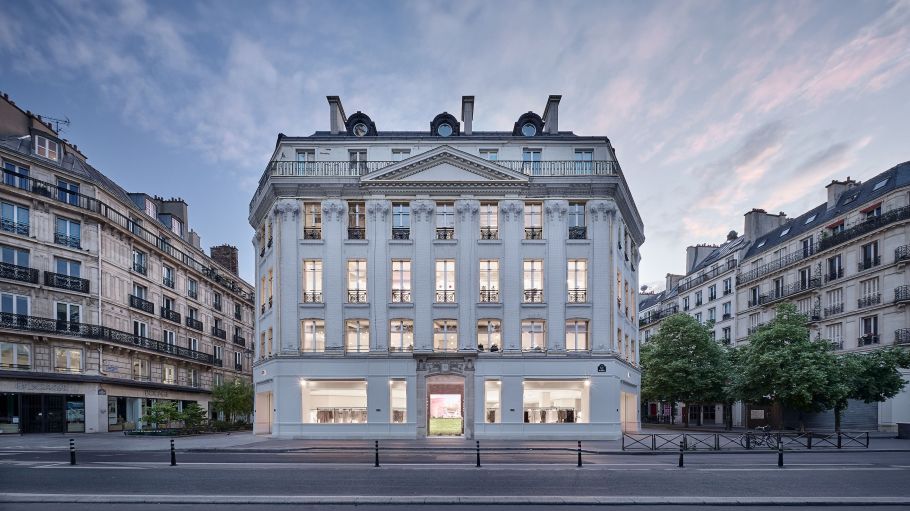
Is Zara luxury now?
While global headwinds continue to rock retail, Zara parent company Inditex continues to chart steady sales growth as it elevates its flagship brand and ups its high-street game.
Revenues gained 8.4 percent in constant currency in the third quarter to 9.8 billion euros, even amidst currency fluctuations, tariffs, and global economic uncertainty.
The strong results beat analysts’ expectations, which had anticipated sales growth at between 7 and 8 percent at constant currency. The numbers sent the stock bounding 8.5 percent in midday trading.
Related Stories
“Our high levels of diversification have underlined the resilience,” said chief executive officer Óscar García Maceiras, touting the company’s broad business model, omnichannel integration, and focus on differentiating and elevating each brand. “Good execution of the model has permitted us to generate both an excellent gross margin and also to exhibit discipline, cost control,” he added in a conference call following the release of the results.
The consistent upscaling of the brands under non-executive chair Marta Ortega Pérez has driven customer loyalty. In addition to Zara, Inditex also operates he Massimo Dutti, Bershka, Pull&Bear, Stradivarius, and Oysho brands, as well as Zara Home.
“Inditex have released a strong 3Q release that reinforces the quality of the business and will make investors question whether the right peer group for this company is luxury rather than retail in our view,” Deutsche Bank analyst Adam Cochrane said in a note following the release.
Gross profit in the third quarter jumped 6.2 percent to 6.1 billion euros, with gross margin reaching 62.2 percent. That puts Inditex in a strong position at a time when many other retailers are squeezed and seeing margins shrink.
The profit jump came from tight cost controls, including sourcing in U.S. dollars, creating logistics efficiencies with its new distribution facilities and nearshoring.
Chief financial officer Andrés Sánchez emphasized that, despite challenging currency fluctuations, the company’s strong numbers came from growth – not cuts such as layoffs or slashing budgets. On the flip side, operating expenses rose just 3 percent, well below the pace of sales growth.
Boding well for the holiday season, the company reported that early fourth quarter sales are tracking up 10.6 percent at constant currency in the month of November, driven by the fall collections.
The company also broke out the first three weeks of November, which rang up at 9 percent growth at constant currency, before any Black Friday frenzy, to better indicate the company’s overall health, said head of investor relations Gorka García-Tapia. Those numbers indicate accelerating momentum going into the last stretch of the year.
The company ended the third quarter with 11.3 billion euros of cash on hand, and continues to invest in its logistics upgrades, including its new distribution center in Zaragoza, with a 1.8 billion euro spend across 2024 and 2025 on streamlining projects.
“Zaragoza logistics center is just at the beginning of its ramp up and will capture future growth,” said García Maceiras. These investments are intended to strengthen Inditex’s ability to meet global demand, particularly in markets with growth potential such as the U.S.
In October, the company inaugurated a 2.1 million-square-foot Zara design and operations hub in its hometown of Arteixo, Spain, and continues to invest in the rollout of soft-tag RFID technology to improve stock accuracy and facilitate speedy self-checkout for customers.
That tech has been a hit with customers. García-Tapia said that self-checkout transactions have reached 90 percent of sales in “the larger flagship stores that really drive a lot of traffic.”
The company is now rolling out RFID tech to its Bershka and Pull & Bear brands.
While Zara’s fast-fashion competitors such as H&M have been hit by pressure from low-cost, ultra-fast fashion players Shein and Temu, García-Tapia sidestepped questions about coming European regulations aimed at ending the bloc’s de facto de minimis exemption with new parcel taxes and fees.
García-Tapia highlighted how data-driven operations allow the company to react in real time to trends and adjusting its in-season product offering to allow for more full-price sales of trendy, fashion-forward items, not competing on cost.
Speaking about the use of AI in its operations, he added that its early days, but they are using it to improve search for its website as well as to streamline back-office tasks such as reading contracts.
In the first nine months of the year, the company opened new stores in 39 markets including Bershka’s debut in Copenhagen and Oysho’s second German outpost in Berlin.
Flagship Zara openings and refurbishments included Osaka, Barcelona, and Rome. The Osaka flagship is a high-concept architectural design spanning 22,000-square-feet across four floors, with a café on the top floor. The pre-existing Zara store will become a standalone Zara Man store, as the company builds out that brand.
In the U.S., Zara expanded to its 26th state, with an opening in Charlotte, N.C. Tariffs have not put a damper on Inditex’s American expansion plans.
“We see that growth is in our hands, not dependent on the performance of the broader market,” said García Maceiras.
Zara’s Boston flagship will reopen this week after an extensive revamp. In 2026, Zara will open a flagship in San Francisco and revamp its Fifth Avenue flagship in New York City.
And it’s not just Zara. García Maceiras said he sees opportunity with its younger-skewing Bershka brand, which will debut in the U.S. with two stores in Miami in 2026.
Differentiation across brands is an increasingly important core strategy. “We continue generating a very broad range of fashion propositions for each of our differentiated concepts,” said García Maceiras.
Its loungewear brand Oysho, which pivoted into athleisure and sportswear while building communities around its workout wear, has been the strongest performer outside of Zara, and opened in Amsterdam and Berlin this year. More countries are in the pipeline for 2026.
Trendy twenties-focused brand Stradivarius opened its first stores in Austria and the Netherlands this year.
Looking at the first nine months of the year, gross profit reached 16.8 billion euros, with a gross margin of 59.7 percent, underscoring the consistent execution of its global business model.
The company is staying ahead of economic headwinds with its newly-appointed international advisory board. Stacked with leading economists, business leaders, and policy experts, the group held its first meeting on Nov. 27. The board’s role is to advise Inditex’s own board of directors on geopolitics, international economics, and global strategic issues.
It is chaired by former Italian prime minister Enrico Letta, joined by Taeho Bark, president of the Lee & Ko Global Commerce Institute; British diplomat Simon Fraser; Rafael Gil-Tienda, Oliver Wyman’s chair for Asia-Pacific; Anne Lange, former Cisco director of innovation; Enrique Lores, current chief executive officer of HP; and economist Marcos Troyjo of Columbia University and INSEAD.