Gender equality is the low-hanging fruit of corporate social responsibility—an easy win for marketing campaigns or ESG reports. A new assessment of how 2,000 of the world’s most influential companies handle diversity and inclusion amid mounting political headwinds, however, suggests that many public-facing policies remain untethered to operational reality.
That say-do gap is starkly evident in findings from the World Benchmarking Alliance, a Dutch nonprofit, which found that while 71 percent of businesses—including boldface names like Amazon, H&M Group, Kering, Nike, Puma and Zara owner Inditex—explicitly forbid violence and harassment in the workplace, only 3 percent offer survivor-centered support, creating an “illusion of safety.”
Related Stories
Maternity policies demonstrate similar precarity. More than two-thirds of companies don’t clearly disclose leave duration, and among those that do, fewer than 5 percent meet international standards for duration, pay and global applicability. Even worse, not one company requires its suppliers to offer workers paid carer time-off.
Advancing the oft-touted “just transition”—the move from high-carbon economies to more sustainable ones while ensuring benefits and risks are fairly shared—exposes another blind spot. Only 7 percent of firms meaningfully engage with workers. Fewer than 1 percent recognize women as a distinct stakeholder group in the transition dialogue, with sex-disaggregated data on layoffs and transition impacts in short supply, and gender-responsive action in reskilling or job creation scarcer still.
The findings reveal an essential truth: gender equality will not advance through corporate action alone, said Namit Agarwal, who leads WBA’s social transformation work. Although commitments have largely remained intact despite brewing backlash—from the Trump administration and a rightward shift in European governance—businesses haven’t meaningfully progressed on translating them into “action on a large scale, which is not surprising given the backdrop of everything that we are observing at the moment,” he told Sourcing Journal.
On average, the WBA-indexed businesses received close to 19 out of 100 points on gender equality, up four points from 2024’s benchmark. Still, more than one in 10 firms scored zero, and only eight companies cleared the halfway mark. In a word, Agarwal said, progress has been “marginal,” though efforts can vary by geography, sector or whether a company focuses on direct operations or the supply chain. Overall, however, gender equality is a systemic issue that requires coordinated action beyond the boardroom.
“It’s not easy for one company or a few companies to be able to take that leadership and change things, especially when it comes to supply chains, unless there are other players and the government and their competitors and peers who also take similar action,” he said.
External pressure from civil society organizations and investors can also spur change, Agarwal said. Shareholder resolutions and public campaigns have created inflection points that compel corporations to tackle issues head-on. That dynamic may also explain why the apparel sector continues to outperform industries such as food and agriculture, accounting for most of the benchmark’s modest gains.
“On the one hand, these companies are more under scrutiny in the public narrative, and on the other, there is a lot of guidance and hand-holding support also available for those companies,” he said. Puma, in particular, stands out as one of the benchmark’s stronger performers for being among the few businesses tracking women’s representation in its supply chain. Similarly, H&M Group is the rare corporation that collects data on women’s leadership across its suppliers.
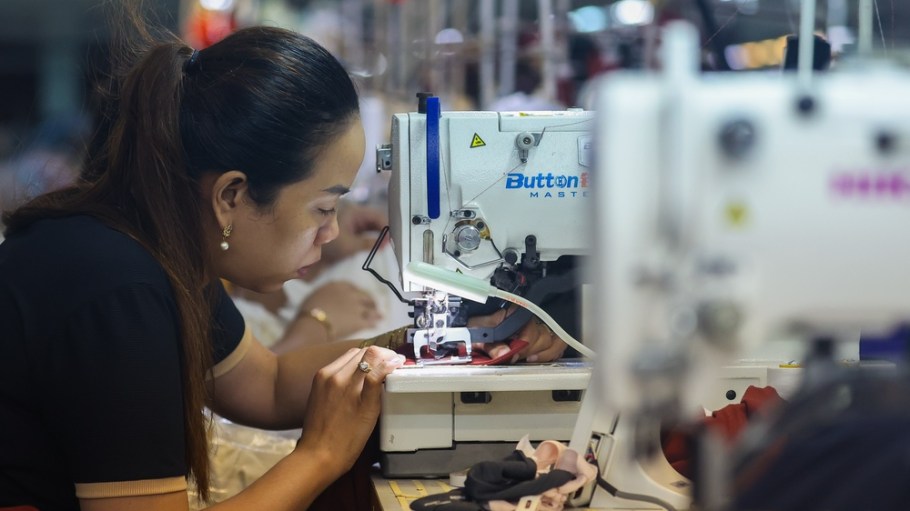
There are still potential pitfalls. Instead of merely setting supplier expectations in their codes of conduct, brands need to collaborate with factories to put those standards into practice, Agarwal said. Fashion firms also fall short by failing to view the just transition through a gendered lens, an oversight made more glaring given that 80 percent of garment workers are women who face lower pay and higher risks of exploitation. Men earn 30 percent more for similar work in Bangladesh, for instance, and 64.5 percent more in Pakistan. Another 2018 study in Indonesia by the Solidarity Center found that 71 percent of garment workers experienced verbal harassment or unwanted touching because oftheir sex—a figure that rose to 87 percent in Cambodia.
“If companies don’t necessarily understand how some of these approaches impact their women workers, then they’re essentially blind to the actions and the strategies they are designing,” he added. One example is heat stress driven by climate breakdown. If businesses don’t grasp how extreme temperatures affect women workers both on the production floor and at home, they can’t adequately respond to those challenges. This undermines workforce health, supply chain stability and other hallmarks of corporate resilience.
Legislation, such as the European Union’s now-scaled-back corporate sustainability due diligence directive, is often seen as a panacea, but it too has its limits. While regulation can “raise the bar,” Agarwal said, enforcement will remain a “bit of patchwork” and little more than a “paper promise” unless it’s harmonized across regions. Evaluating broader corporate practices, therefore, is key to ensuring that “building blocks” such as effective grievance mechanisms, relevant data collection and disclosure to monitor disparities and, above all, active worker engagement are in place.
Also crucial: Not viewing gender equality in a silo, but as part of a larger ecosystem.
“In our work at WBA, we’ll be making sure that companies are not looking at gender in an isolated way, but applying a gender lens across their climate and major transitions as well,” Agarwal said. “It’s an example of how they can take the next step.”