
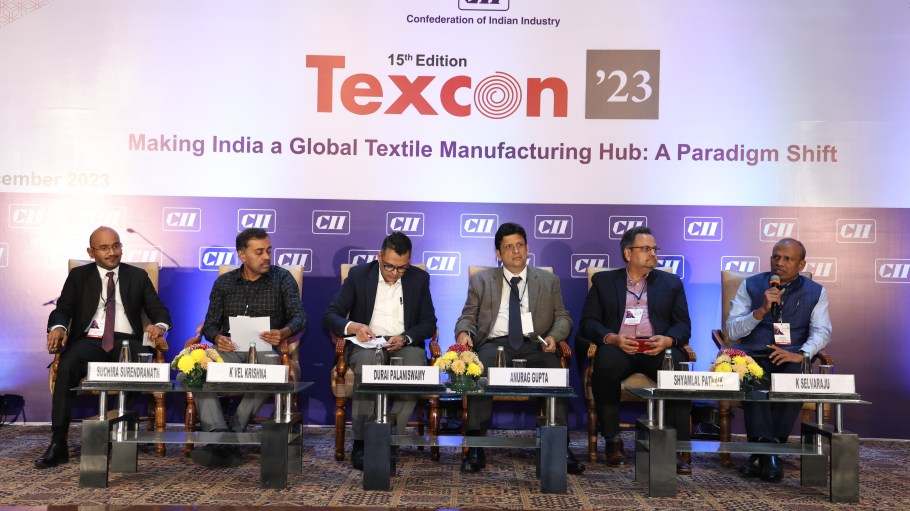
Summed up in three words, the message from Texcon ’23 was clear: “Now or Never.”
Organized by the Confederation of Indian Industry, a business association, at The Ashok in New Delhi last week, the event titled: “Making India a Global Textile Manufacturing Hub: A Paradigm Shift,” had a clear sense of urgency to meet the challenges head on—without the frustration or sense of defeat that recent numbers stimulate.
While the panelists from across the industry agreed that there was no quick fix, they were also in agreement that “more” was needed. More collaboration, more help from the government, more scaling up of factories, more innovation.
Related Stories
Perhaps the way forward is to scoot ahead—not in a plain, incremental kind of a way—but rather using sustainability as the lever to a bypass stagnation.
Actions are being taken towards traceability, for example the governmental initiative Kasturi Cotton, shown for the first time to a global audience on Dec. 2, the first day of the 81st plenary meeting of the International Cotton Advisory Committee (ICAC) in Mumbai. The global cotton industry was witness to the introduction, made by union textiles minister Piyush Goyal who inaugurated the four-day meeting at the Jio World Convention Centre.
The cotton even has a brand ambassador—actor Pankaj Tripathi—and, as the minister announced, will have 10 textile testing laboratories, organized by the textile ministry and the Bureau of Indian Standards within two weeks, with an investment of $6 million to $7 million.
All the ginners in the country have been empowered to produce the Kasturi Cotton brand as per stipulated protocol, which will have a minimum length of 29 mm. and will be blockchain enabled for complete traceability.
The Indian textile industry is working towards achieving sales of $250 billion by 2030, including $100 billion in exports.
Discussions about these targets was rife at Texcon.
“We have to have an India-first approach and work collaboratively and only then will we be successful,” said H.K Agarwal, co-chairman CII National Committee on Textiles & Apparel and managing director at Grasim Industries Ltd.
“Manufacturing is a low-hanging fruit, and we see the promise in it—a lot of changes have already happened, some policies have changed, including those of subsidies,” said Shubra Agarwal, trade advisor, ministry of textiles. “The government has not denied or left you, we have just changed the way we think,” she told the top industry hierarchy present. “Instead of subsidy-based programs we are thinking production-based.”
“It’s where the industry walks with courage. My role should be that I don’t hamper the walk,” she said.
Examples of clusters that have been successful came up repeatedly, including Tirupur in Southern India which accounts for more than a fourth of Indian apparel exports, and Surat in Gujarat. There was also a focus on bigger, successful companies like Aditya Birla, Arvind Ltd. and other leaders like Shahi Ltd. and Gokaldas Exports Ltd.
As Sivaramakrishnan Ganapathi, vice chairman and managing director Gokaldas Exports pointed out, more than 65 percent of global demand is polyester and blends. “We’re not participating in that as an export source—we need support, technology and know how—we can learn. If we can process cotton, we can process synthetics, too. The focus is squarely on the industry.”
Kulin Lalbhai, executive director, Arvind, agreed on the point, suggesting that man-made fiber needs much more focused attention and there is a “big gap in India in that part of the value chain.”
The gaps clearly need attention.
In the first seven months of this financial year, which began April 1, India’s textile and apparel exports were down 14.58 percent from April to October 2023 at $19.35 billion, with a 11.37 percent decline for textiles and 0.41 decline for apparel, against 2022 figures.
However, October 2023 hit a positive note, with growth of 10.44 percent for apparel and textiles, with 24.29 percent growth for textile exports and a decline of 8.08 percent for apparel, over 2022 figures.
Gautam Nair managing director at Matrix Clothing, put it simply: “It reminds me of the debacle of the England team —someone said that they have a fantastic team—too bad they have to play on the cricket field. On paper, we have the capability, and the vertical integration—but we have to go and do it now. The future is bright, and the industry should not get too despondent that the numbers are stagnating—we have to look at the future.”
The conversations on the sidelines indicated that the industry is still hoping for the China-plus-one spillover, with more global brands and buyers looking to mitigate risks of production by investing in other countries.
Comparisons with strong manufacturing and sourcing destinations in Asia were inevitable; examples from Bangladesh, Vietnam, Indonesia and Sri Lanka abounded. The focused training that Sri Lankan managers have, the foreign investment in companies as in Vietnam, the scaling up and policy support of Bangladesh.
The analytics and soul searching were mixed with the belief that the strengths that India has to offer, along with a high youth quotient, was a prescription for success.
As Suchira Surendranath, director of strategy and investment at Brandix India Apparel City, said in a session: “The first question of where do you move to build capacity has a simple answer—India. We have geopolitical stability, the vertical integration and the availability of raw materials and labor.”
Separately, an earlier function organized by the Apparel Export Promotion Council (AEPC) on Dec. 8 in New Delhi, saw industry heads agree to a target of $40 billion in apparel exports by 2030. In fact, “40 by 30” quickly became the mantra of the event.
Rohit Kansal, additional secretary, Ministry of Textiles, made it clear that the PM Mitra Park initiative addressed many of the issues flagged by the industry such as scale, investment and infrastructure.
“The size of the PM Mitra Park is at least 1,000 acres each which are to be vertically integrated,” he said.
Naren Goenka, chairman of AEPC, added in other strengths. ”We have an abundance of raw material with the biggest raw material base after China. Because of this, we can cater to a shorter lead time as we don’t need to import anything as our product has 98 percent Indian inputs,” adding that this strength of raw materials ensured that “‘we are the least affected by price volatility and currency fluctuations or any recessionary or inflationary changes globally.”
With the several meetings of industry heads over the last three weeks, including ICAC, Texcon and AEPC, the way ahead appears to be continued engagement. And the platform for that is right around the corner.
Bharat Tex 2024, which will be held in New Delhi from Feb. 26-29, is being described by the government as the “world’s largest textile exposition,” with more than 10,000 exhibitors across segments including handlooms and technical textiles.


