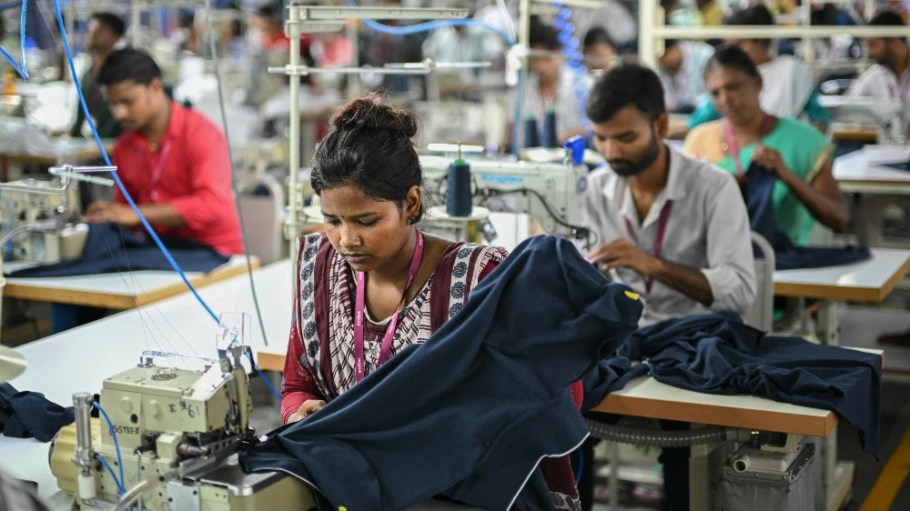
Rolling out a simplified new labor code to replace the decades-old colonial one, the Indian government revealed and implemented on Friday a plan to consolidate 29 archaic regulations into four streamlined codes.
The plan is facing a series of complex reactions. Over the weekend, trade union workers and labor groups began protesting, calling the new codes a way of “pushing labor back into the colonial age.”
On Wednesday, in a coordinated protest across the country, workers responded to a call by a coalition of 10 major trade unions demanding a withdrawal of the codes, which they said were crafted to woo foreign investors while short-changing workers. They said many were “taken by a fire of rage” over provisions that now allow companies with fewer than 300 workers to shut down without lengthy processing times, raising the previous threshold from 100 workers.
Related Stories
Industry analysts cautioned that the situation could fuel tension between manufacturers and labor in the short run, even though many agreed the codes were “pivotal” and “long overdue,” and noted that the protests were largely aligned with opposition political parties.
There was also a sense that economic reform was essential to keep India on its growth trajectory, particularly as the country faces a 50 percent U.S. tariff imposed by President Donald Trump. Neighboring countries such as Bangladesh and Sri Lanka face a 20 percent reciprocal tariff.
Opinions across the board remain deeply divided. The Southern India Mills’ Association (SIMA) said that employee well-being and rights are now “more strongly safeguarded.”
Durai Palanisamy, chairman of SIMA, told Sourcing Journal that it was a “bold and transformational reform.” The codes will rationalize the 29 existing laws, strengthen worker protection, ease business compliance, and help India meet social accountability standards required for trade deals with the European Union and the U.S. with the “one license, one registration, one return” regime-boosting ease of doing business, Palanisamy said.
“The Government of India’s introduction of the Industrial Relations Code (2020), Code on Social Security (2020), Occupational Safety, Health, and Working Conditions (OSHWC) Code (2020), and Code of Wages (2019) brings the 29 labor laws into four streamlined codes,” he added.
The prime minister and the Labor Ministry are unequivocal in their hopes for the updated labor code.
Prime Minister Narendra Modi wrote on X: “Our government has given effect to the Four Labour Codes. It is one of the most comprehensive and progressive labour-oriented reforms since Independence. It greatly empowers our workers. It also significantly simplifies compliance and promotes ‘Ease of Doing Business.’”
Calling it a “historic decision,” the Labor Ministry said the implementation of the four Labor Codes addressed a long-pending need to move beyond colonial-era structures and align with modern global trends.
“While most major economies have updated and consolidated their labour regulations in recent decades, India continued to operate under fragmented, complex, and in several parts outdated provisions spread across 29 Central labour laws. These restrictive frameworks struggled to keep pace with changing economic realities and evolving forms of employment, creating uncertainty and increasing compliance burdens for both workers and industry,” the Ministry said.
The labor code was approved by Parliament five years ago in 2020 after extensive debate involving states, manufacturers across sectors and labor unions. The labor-intensive textile and apparel sector had been pushing for reforms to help navigate tough regulatory frameworks and shifting geopolitical pressures.
Prashant Agarwal, co-founder and joint managing director of consulting firm Wazir Advisors, told Sourcing Journal that there was no doubt it was “a great step forward,” even though it carried wide-ranging impacts.
Agarwal said the potential positive outcomes include increased formalization and workforce stability, expanded social-security access, greater flexibility for small factories and simplified compliance, including single registration and single returns to reduce burdens for manufacturers operating multiple units or job-work networks.
Potential negative impacts include higher labor costs, restrictions on contract labor, compliance burdens for micro-units and higher retrenchment costs, he said.
He added that the next six to 18 months might bring greater consolidation toward mid-sized compliant units and the development of seasonal staffing models aligned with retrenchment provisions.
“Among the areas of impact over the next few months will be rising outsourcing to smaller unregistered units to avoid compliance costs, increased automation in cutting and finishing to manage costs, a need for factories to review workforce classification and contracts to align with new worker/employee definitions, and restructuring wage components to manage statutory cost increases, along with increased investment by companies in human-resources documentation and payroll digitization,” he said.
Women can now legally work night shifts, firms have greater leeway to extend working hours and migrant workers’ rights are expected to be more clearly protected. The textile and apparel industries employ a large percentage of migrant workers who move between states for factory work.
Manufacturers have also raised concerns about added financial pressure from the new laws, particularly on small and medium-sized companies.
“We believe the new labor laws will have limited impact on larger companies in the sector, as they are already highly compliant with global labor standards due to customer requirements,” said Pratik Tholiya, senior vice president, Institutional Equity Research at Systematix Group, a Mumbai-based financial services firm.
For smaller companies, he said, simpler compliance is a benefit, but new cost and administrative burdens—including restructuring salary frameworks, ensuring social-security coverage and adhering to overtime and working-hours rules—could create challenges. For larger, already-compliant firms, the changes formalize existing practices rather than forcing dramatic shifts.
“The new laws are more consequential for smaller companies, mainly because they combine many laws into one, reducing excess paperwork. Single registration, single license and single return simplify compliance and ease of doing business. They also allow night shifts, improving productivity. They make Indian companies more acceptable to global customers, and random mass leave by workers now becomes punishable if not approved by unions,” he said.
Several small manufacturers said they feared they would bear the brunt of the changes—with overtime costs rising, mandatory employment letters for all workers, compulsory medical check-ups for workers above age 40 and more.
“The revision of labor codes has been long awaited and there is no doubt that it is the need of the hour,” said Raja Shanmugham, former president of the Tirupur Exporters Association, while noting that many points in the new labor code are already in practice among exporting companies because of global social-compliance requirements.
One new mandate requires health check-ups for workers aged 40 and above. “This should be the responsibility of ESI hospitals, which were created specifically to serve the health-care needs of laborers, rather than being placed on employers,” he said.
He added that while industry is a crucial engine of employment, manufacturers also need pro-industry policies that consider cumulative tax records and past compliance histories, providing some protection from legal consequences in case of inadvertent default.
While analysts point out that many worker unions protesting the codes are affiliated with opposition parties, union leaders argue that the issues they oppose concern fundamental rights—particularly the conditions for forming unions or calling strikes.
“According to the new labor code, workers can no longer strike because they must inform management before going on strike. They will inform the labor department, then negotiations will begin. When negotiating, strike is considered an offence,” said K.R. Jayaram, joint secretary of the Garment and Textile Workers’ Union (GATWU) in Bengaluru.
“These codes are not in favor of workers, but rather create bonded labor. They try to show social welfare, but it is a lie,” he said. “The new rules offer social-security and minimum-wage benefits—these have already been implemented in Karnataka for years—and the new rules allow companies to hire and fire workers more easily. While they allow women to work night shifts, what about the safety of women returning home? The Industrial Relations Code now mandates that factories with over 300 workers seek prior government permission to close or lay off workers. Earlier the threshold was 100. There are many factories with fewer than 300 workers, and inspections for them have reduced. How can this be pro-worker? These laws are only good for management,” he added.
He added that although the central government has passed the codes, the Karnataka state government has yet to implement them. “Once they issue this, we come under the new act. We don’t want them to do it,” he said.
As unions plan to intensify protests, insisting their rights are at stake, analysts warn that the larger economic agenda to keep economic growth on track, including the $36 billion textile and apparel export industry could face mounting pressure if the standoff deepens.