Nearly a week after contract talks between dockworkers at Canadian West Coast ports and their maritime employers broke down, negotiations resumed on Saturday.
Supported by federal mediators, the British Columbia Maritime Employers Association (BCMEA), which represents 49 ocean carriers and port terminals, met with the International Longshore and Warehouse Union (ILWU) Canada, offering a new contract proposal designed to address the union’s demands to expand its jurisdiction on port maintenance work.
Related Stories
But not before more cargo ships turned south to avoid the embattled region.
According to Mirko Woitzik, global director, intelligence solutions at Everstream Analytics, the Port of Vancouver handled 25 percent fewer incoming vessels in the week prior to the July 1 strike.
Last Friday, Woitzik said U.S. ports were “likely” to see additional ships diverting away from the Canadian gateways. This could potentially cause knock-on congestion in the U.S. West Coast ports of Seattle, Los Angeles, Long Beach and Oakland.
However, the U.S. West Coast chapter of the ILWU and International Longshoremen’s Association (ILA), which is the comparable union for East Coast and Gulf Coast port dockworkers, said their members would not work any of the diverted ships.
Such diversions are the first of what could be widespread rerouting, delaying planned ship arrivals and straining supply chains to kick off peak season when back-to-school inventory and holiday merchandise are shipped to North America.
The Canadian Manufacturers & Exporters (CM&E) said the strike is disrupting $500 million Canadian dollars, or $375 million, in daily trade. Retailers across North America could see considerable inventory delays—the Railway Association of Canada estimates it will take three to five days for every day the strike lasts for supply chains to recover.
As of Monday, ship-position data from EeSea showed eight vessels waiting at anchor off Vancouver, with eight more sailing toward the port and five idling off Prince Rupert.
Four container vessels bound for Vancouver changed their port rotations to call at Seattle first, before returning back to Vancouver: the OOCL San Francisco; CMA CGM Medea; Yantian and Hyundai Faith. Two other ships, the MSC Sara Elena and Ever Safety, left Canadian ports for the U.S. West Coast, and will not return.
ILWU Canada boss accuses BCMEA of ‘misleading’ wage leaks
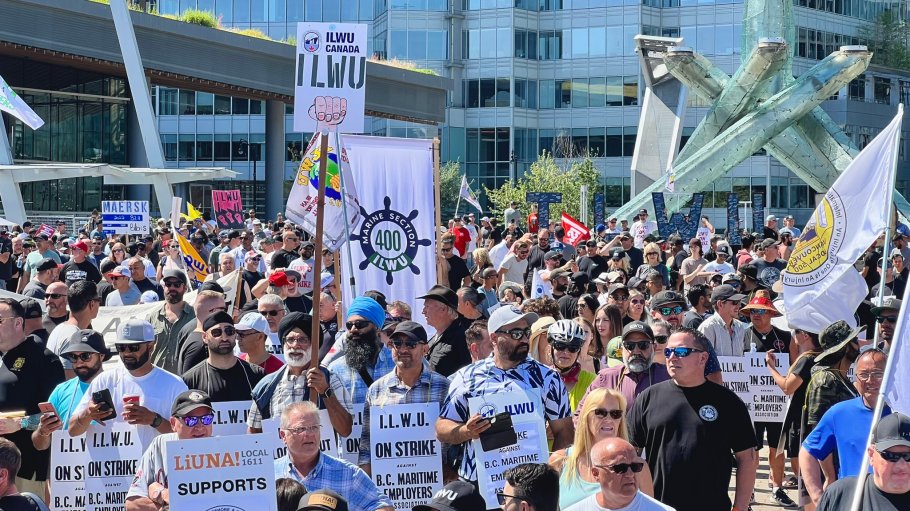
The diversions came as hundreds of people gathered at the Port of Vancouver Sunday for a rally to support the more than 7,400 workers on their second week of the strike.
The union wants higher wages, a one-time payment to tackle rising costs and better retirement pay, according to The Financial Post. In total, the union has reportedly asked for a 21.8 percent increase in pay over two years, which includes a one-time payment of $8,000 and a $10,000 increase in retirement pay.
The BCMEA has proposed a pay increase of 14.7 per cent over four years, the outlet reported. Its proposal doesn’t include a one-time payment, but increases retirement pay by $12,500.
The median salary for unionized port workers in B.C. last year was $136,000.
Last Thursday, ILWU Canada president Rob Ashton accused the BCMEA of “funding a dirty-tricks media campaign” by reporting of the wage numbers, claiming the association used anonymous sources to “selectively leak misleading information” to the press.
For example, Ashton said a waterfront worker can spend many years waiting on call to get one-off shifts at very short notice.
“Their income is sporadic, and the unpredictability of shifts makes it hard to supplement it with other jobs,” he wrote. “Even once they have more secure employment, many waterfront workers don’t receive a shift for days or even weeks at a time. Most are dispatched on a day-to-day basis, and can’t count on regular hours or shifts.”
Ashton said those earning pay rates at the high-end of the scale work night shifts six or seven days a week.
“Our members’ families are facing spiraling food bills, housing costs and interest rates,” Ashton said.
The BCMEA’s most recent proposal on Saturday included additional language for ILWU Canada to perform new work outside of the union’s jurisdiction. The union is frustrated over the use of outsourced contract work for non-union workers, which they say erodes its jurisdiction over regular maintenance.
The employers also proposed assembling an independent committee to better define which tasks fall within the maintenance category and to improve training and recruitment of ILWU workers.
On Sunday, Alberta Premier Danielle Smith called on Canada’s Prime Minister Justin Trudeau to recall Parliament and federally intervene in the B.C. port strike. This comes after Alberta’s transportation minister Devin Dreeshen also urged federal intervention.