Against a backdrop of political tension, tariff threats and cross-border instability, GFT 2025 opened this week in Bangkok with a bold message from Southeast Asia’s apparel industry: innovation will not pause.
From advanced smart textiles to resilient sourcing strategies, the region’s manufacturers are pushing forward—despite an increasingly volatile landscape.
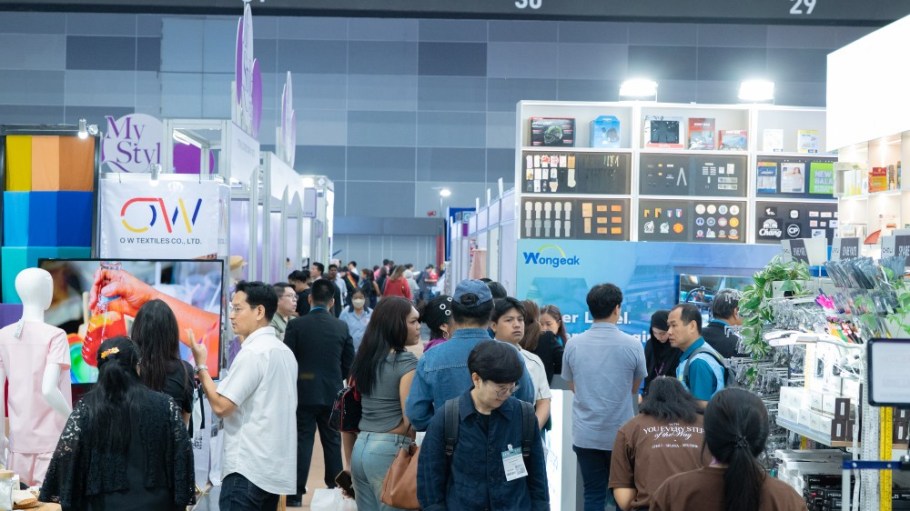
The four-day event, which is ASEAN’s largest textile and garment machinery exhibition, runs from July 23-26 at Bangkok’s opulent convention center, BITEC. With expansive national pavilions from China and Taiwan, more than 100 international exhibitors from Japan, India, Vietnam and beyond, and an expected 10,000 business attendees, the event became a focal point for new ideas, resilient sourcing strategies and cross-border collaboration. The tone of the first three days was markedly forward-looking, with speakers and stallholders focusing on AI, sustainability, smart textiles, and functional fabrics as the way ahead.
Related Stories
It was also a large meeting ground for the industry, bringing in retailers, brand owners, entrepreneurs, association members and decision makers. Activity levels at booths were high, and delegates were seen in rapid-fire meetings, exchanging contacts and drawing up plans.
Gone were the murmurs of decline or “sunset sector” fatigue. Instead, there was a surge of energy, with second- and third-generation entrepreneurs talking about scaling up and future growth. Family businesses remained a key presence, even as the floor was also dotted with new entrants and digital-first startups.
Woraporn Thamcharoen, managing director of RX Tradex, which organizes the event, noted, “The Thai textile and garment industry is constantly evolving. While manufacturing has moved to neighboring countries, new entrepreneurs, particularly medium and small-sized businesses, continue to enter the industry with creativity and designs that add value to products.”

Among the newcomers was Vorada Arayakeerati, co-founder of Piggy Monster, who launched her cotton-focused brand two years ago, at just 20 years old. “There are a lot of opportunities in this business,” she told Sourcing Journal, describing how her team—mostly her peers fresh out of college—started with a modest 10,000 baht (approximately $310) investment and were now overwhelmed by the interest at their stall. “We’ve grown a lot in just two years,” she said. The growth was apparent as the company stall was flooded with inquiries.
Speakers from the Thailand Textile Institute (THTI) and the Thai Garment Manufacturers Association (TGMA) highlighted the industry’s continuing role in Thailand.
“The textile and garment industry remains a vital pillar of Thailand’s economy, playing a significant role in employment and value creation,” said Dr. Chanchai Sirikasemlert, executive director of THTI. “In the first five months of this year, export value reached $2.55 billion, marking a 0.2-percent increase despite trade pressures from key partners such as Japan, China, and Vietnam. Entrepreneurs must now accelerate their transition toward the ‘twin transition’ of sustainability and digital technology—utilizing social media to build customer networks and incorporating tech into production.”
That energy for transformation was echoed across the floor.
Chaiyot Rungcharoenchai, managing director of Perma Corporation Co., Ltd., who has been a key voice in pushing the sector forward told Sourcing Journal, “There is a lot of potential for new ideas, especially for smart textiles that integrate technology. Functional textiles are important—they offer antibacterial, fire-resistant, and temperature-controlling properties. The key is to meet the needs of individualized lifestyles.”
It was clear that his focus on non-toxic and skin friendly products was catching the interest of visitors, as animated conversations about the possibilities of functional materials caught a lot of attention.
Technology and customization were prominent themes.
Kriangkrai Wangwijit, managing director of SKT Embroidery Co., Ltd., noted that while embroidery remains popular, digital printing has gained ground rapidly. “Digital printing allows special designs and customer needs to be customized quickly,” he said. “Technology is no longer reserved for large corporations—small-scale manufacturers can now access high-quality production and export opportunities. Those who fail to adapt from traditional methods may fall behind competitors who use technology to boost speed, lower costs, and better meet market demands.”
But amidst the energy and innovation, uncertainty lingered over international trade. The looming U.S. tariff threat—still reportedly set at 36 percent for Thailand, according to President Donald Trump’s most recent announcement—was the subject of much concern behind the scenes. While the topic didn’t dominate the formal sessions, it was a frequent topic among exhibitors and procurement delegates over coffee and on the sidelines.
“We are waiting for the announcement,” said Seksan Wongjiratikarn, managing director of Wongeak Industry, his tone emphasizing the singularity of this wait, and clearly voicing concerns that were resounding. “We believe the tariffs on Thailand should be much lower than 36 percent. We hope they will be closer to 18 percent. If not, it would require major adjustments.” He acknowledged the impact could be “significant,” potentially reshaping sourcing strategies overnight.
Despite the anxiety, however, he said that business would continue, albeit with some evolution. “I have seen substantial changes in this industry over the past few decades. But many of us have found a way to adapt. I have two factories in Vietnam, which help us balance our business across different segments.”
Thai government officials are also preparing for potential scenarios. On Thursday, Finance Minister Pichai Chunhavajira addressed the economic stimulus committee and announced plans to allocate 42 billion baht or $1.29 billion from a stimulus package to cushion the blow of any new U.S. tariff measures. The fund, if deployed, is expected to support manufacturing industries, logistics players, and export-focused small and medium companies.
Quieter was the concern over Thailand’s increasingly tense border standoff with Cambodia. On Thursday, the situation escalated with reports of nearly a dozen deaths on the Thai side and multiple artillery rounds reportedly fired by Cambodian forces in contested border areas. Over the past month, rising tensions have led to temporary closures of trading points, disrupted transport routes, and increased the sourcing pressures for many in the industry.
“Thailand’s textile and apparel industry maintains deep links with Cambodia—particularly in labor supply and material sourcing. In Sa Kaeo province, thousands of Cambodian workers are employed in Thai-owned factories, many of them commuting daily or living in worker dormitories. A number of these facilities also rely on raw materials and semi-processed inputs from Cambodia. Thailand functions as a value-add hub—handling cutting, printing, and finishing for key exports to Japan, the EU, and the U.S.,” explained one local manufacturer who requested anonymity. “Any serious disruption to the labor flow or transport routes would cause delays, cancellations, and potential loss of trust from overseas buyers.”
Nonetheless, the tone at GFT remained quietly resilient. More decisively spoken aloud was the consensus that the industry must keep pushing forward—adapting to risks, diversifying operations and staying open to new partnerships. Many businesses on the ground reflected the mix of caution and confidence.
Dr. Sirikasemlert of THTI captured the sentiment: “In this dynamic industry, only active players who keep improving—getting in touch with new innovations and ideas—will survive. Thai players are creative. This industry is a mix of art and science. GFT is where that mix comes to life—where creative people meet business partners who can make their designs real.”