Acne Studios’ pink paper shopping bag. Sugarfina’s Rosé All Day Bears candy. The Wing’s (now defunct) Flatiron space. Glossier. The millennial pink paradox of yore all but flattened the generation’s collective creative endeavors into pastel minimalism, a recent whitepaper from Future Snoops proposed.
It begs the question: Is a specific bratty shade destined for the same homogenized, algorithmic fate?
Some generative AI models and their “corporate rave” prophecies suggest a definitive answer. But, when “predictability replaces possibility,” the trend forecaster formerly known as Fashion Snoops said, it’s something of a “crisis of creativity.”
Related Stories
In other words: the consequences of relying on demographic-driven models of consumer segmentation saw the industry accidentally box-in its buying power, according to data (both aggregated and authored) from Future Snoops. In turn, consumer purchasing patterns became pigeonholed. Juxtaposed against today’s global market—rife with trade risks and economic uncertainties alongside capricious consumer demand—the future starts looking flushed like cheeks instead of checks.
But there are worse crises, per the futures intelligence agency.
The resulting “Creative Unflattening: Breaking Free from the Age of Average” report saw the Hobby Lobby ally “urge” brands to take the instability as an innovation opportunity.
“We thought the data-driven decisions would eliminate risk and guarantee success,” Hallie Spradlin, Future Snoops’ director of visionary, said of the space’s once “seductive” premise during last Thursday’s presentation. “Instead, we created a feedback loop of mediocrity.”
The flipside? Future Snoops reframed risk avoidance, for one, as risk intelligence, which begins when one stops asking how to prevent failure and starts asking how to “take the kinds of risks that redefine the future,” per the report.
There are two more of these “critical mindset shifts” within the report. The consulting agency suggested triggering the “creative paralysis to creative confidence” shift with a reframe, such as embracing the scientific method instead of a mathematical equation. The “from measuring the past to defining new value” reframe, meanwhile, advocated balancing historical data with its cultural value and emotional impact, too.
“The irony is clear,” said Spradlin. “In trying to make creativity safe for business, we’ve made business unsafe for creativity.”
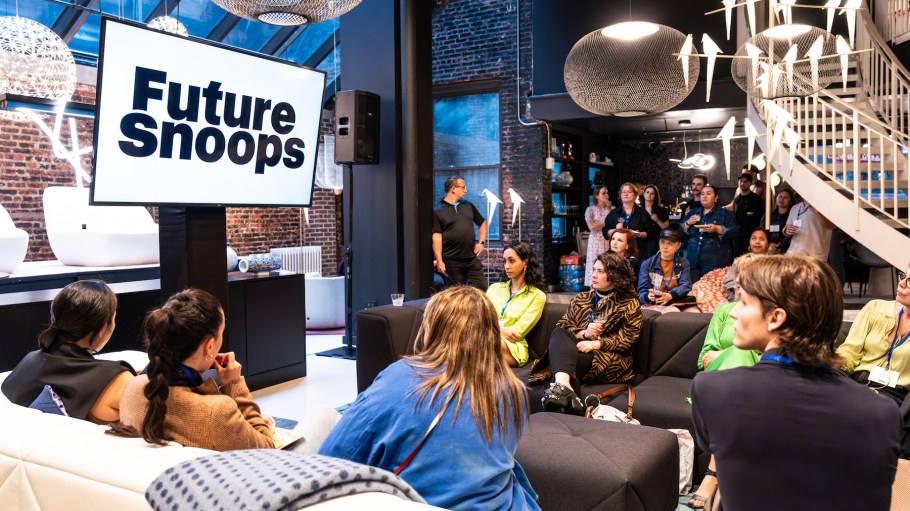
Underscoring that irony was the corresponding “evening of creative awakening.” The celebration was hosted in partnership with Dutch furniture firm Moooi—and held at the Amsterdam-headquartered company’s showroom in midtown Manhattan—on May 15 for an evening of “presentation and provocation.”
“Simply put, the ‘Creative Unflattening’ is our call to break free from the two-dimensional sameness that’s really taken over design across the globe,” Jenna Guarascio, Future Snoops’ head of content and innovation, said. “It’s about pushing back against a world where algorithms, best practices and risk aversion have created a sea of sameness.”
While yes, the trend’s advertised outcomes and styles are something of a cognitively biased earworm, the internationally-based team wanted to instead highlight the business problem, per Guarascio. When every capsule collection starts visually and/or looks the same, she continued, aesthetics and authenticity are lost. In turn, the “meaningful differentiation that makes customers care” is lost, too.
“The paper in this presentation today isn’t about nostalgia for some bygone creative era,” Guarascio said. “It’s a practical framework for standing out in a flat marketplace, where the greatest risk is playing it safe.”
Within this “unflattened” framework are three sections: retail’s “pervasive” age-of-average problem, as the market has been “optimized into oblivion;” the solution (aka reframing and resetting); and the perceived future—one that’s (theoretically) favored by the bold.
“We’ve gotten to the point where we actually have to ask ourselves, when was the last time an algorithm recommended something that had genuinely surprised and delighted you?” said Ania Sommerauer, Future Snoops’ vice president of content strategy. “The future of retail isn’t about getting better at selling—it’s about getting better at seeing.”
Granted, the escape-from-ennui doesn’t downright ditch data, Guarascio specified; retail’s return-to-relevance needs it. And some other stuff, too.
“The escape route isn’t about abandoning data; it’s about adding dimension to it,” she said. “If we approached our creative challenges from a completely different dimension [is] exactly what the ‘Creative Unflattening’ is all about.”