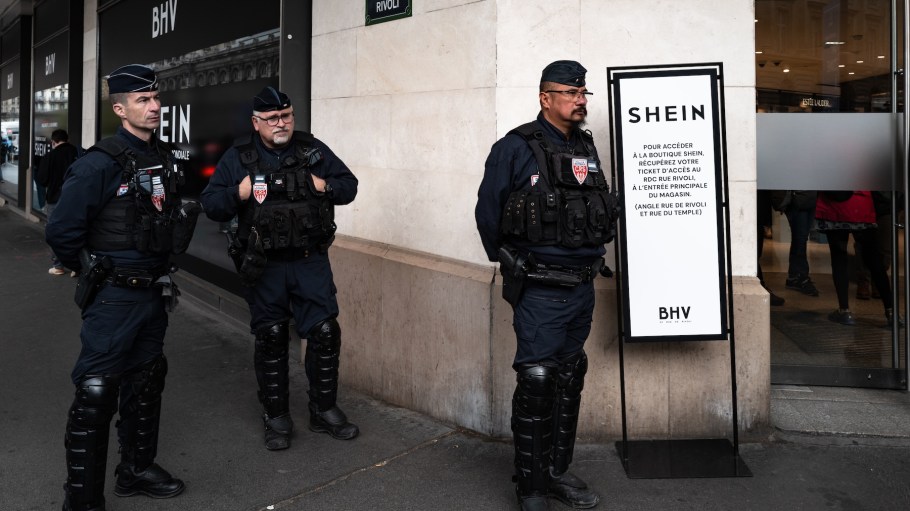
French customs has inspected more than 320,000 Shein parcels at the Paris Charles de Gaulle Airport, confirming a report by Le Parisien News. The “XXL operation” found a 25 percent non-compliance rate among the Singapore-headquartered firm’s non-textile goods—including illegal cosmetics, unsafe toys and counterfeit items—after earlier allegations involving child-like dolls and restricted weapons triggered the sweep.
Over 500,000 items were checked at Roissy Airport, per the Customs Directorate, “under the watchful eye the Ministers of Public Accounts and Trade as well as numerous cameras,” the French newspaper reported. The results are now fueling calls for EU sanctions as the Chinese ultra-fast fashion giant pivots to physical retail in Paris.
Related Stories
French authorities have now scaled back their own alarm: what was once an 80 percent non-compliance rate has settled closer to a quarter of non-textile goods.
“While the textile products inspected revealed few non-conformities, this result can be explained by the change in Shein’s commercial policy; they had closed their marketplace a few days before the customs operation and were only selling products from their own brand,” the Customs Directorate, France’s national customs administration responsible for border control, told Le Parisien News.
Conducted the day after Shein froze its marketplace amid outrage over “pedophilic” dolls, the inspection fed a government push to suspend the platform—a move the Paris Judicial Court rejected on Dec. 19 as “disproportionate,” since the illicit items had been withdrawn, according to Reuters and local court filings.
Taking prior precedents into account, a 2022 operation found that 96 percent of goods in similar parcel flows were non-compliant or counterfeit, according to a parliamentary report in December.
The filing represents the most coordinated action yet from French industry groups, who said Shein’s pricing and product-safety practices are distorting competition. The case targets Shein’s Ireland-based subsidiary, Infinite Styles Service Co., placing the matter within the jurisdiction of French courts, which could, potentially, seek provisional measures while the complaint proceeds.
The fight is happening against a backdrop of exploding import volumes and looming taxes aimed at slowing the flow.
Small-parcel imports into France jumped nearly 355 percent—from 170 million in 2022 to 773 million in 2024—with 97 percent originating from China, according to a report by the country’s National Agency for Foreign Trade Statistics and the General Directorate of Customs. Plus, European countries are set to impose a 3-euro ($3.52) levy on small parcels from July 1, 2026. In France, that levy could reach as much as 5 euros—about $5.87—depending on the outcome of the Parliament’s finance bill.
French retailers have been vocal about the need for a level playing field, arguing that it is skewed by Shein’s business practices. Earlier this year, French industry groups ramped up pressure on Shein following the launch of its first brick-and-mortar store in France.
In mid-November, a coalition of thousands of French retailers initiated legal proceedings against Shein after accusing it of unfair competition. The 12 federations and 100 large brands are demanding up to 3 billion euros—the equivalent of $3.5 billion—in economic compensation from the company for luring away customers through what they say are false promotions and substandard merchandise. The claim sought not just damages but a legal precedent that would force global e-commerce platforms operating in Europe to play by the same standards as domestic retailers. The coalition collectively represents over 60 corporate entities, with names like Monoprix, Promod and Pesson publicly backing the effort.
The case hinges on structure: because Shein sells its own branded goods, it falls directly under French consumer-protection and competition law. Marketplace-only platforms (like Temu or Alibaba) sit outside the scope of this particular suit. The move landed as French customs continues to tighten scrutiny on Shein shipments and as lawmakers weigh new levers—including the Digital Services Act and Digital Markets Act—to rein in online platforms.
If France succeeds, similar actions could follow in other EU member states. Officials have not said when decisions are expected. Shein did not respond to Sourcing Journal’s request for comment, but previously stated it’s cooperating with authorities and launched an internal review of its European operations.