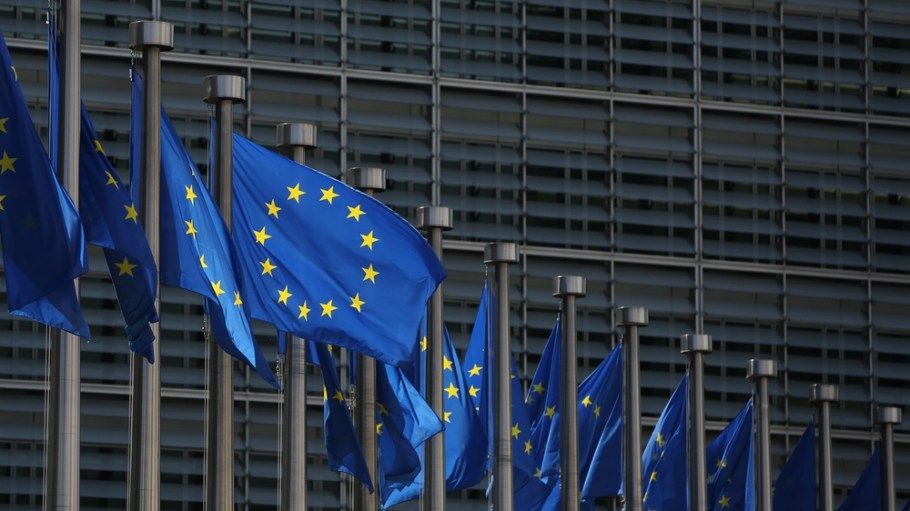
The European Union’s ombudswoman has found a number of what she called “procedural shortcomings” in the way the European Commission prepared several legislative proposals that it deemed pressing, including the so-called “omnibus” bill designed to streamline sustainability laws meant to hold big businesses accountable for their social and environmental impacts.
By skipping over parts of its “better regulation” rules for “evidence-based, transparent and inclusive” lawmaking in its pursuit of “simplifying“ the corporate sustainability due diligence directive, the corporate sustainability reporting directive and others, Teresa Anjinho said Wednesday, the European Commission has committed what amounts to “maladministration.” This includes failing either to fully justify to the public the urgency of the proposals or to document the reasons for deviating from its own internal guidance on preparing new initiatives and managing existing laws.
Related Stories
“The Commission must be able to respond urgently to different situations, particularly in the current geopolitical context,” she said in a statement. “However, it needs to ensure that accountability and transparency continue to be part of its legislative processes and that its actions are clearly explained to citizens.”
Anjinho also faulted the European Commission for leaving its departments with fewer than 24 hours over a weekend to consult on Omnibus I, as the sustainability simplification agenda is officially—and ominously—referred to. She said that the EU’s executive arm must ensure a “predictable, consistent and non-arbitrary” application of the better regulation rules even if it’s racing the clock.
“In the future, a better balance needs to be struck between having an agile administration and guaranteeing minimum procedural standards for lawmaking,” said the ombudswoman, who evaluates complaints about flawed administration by EU institutions. “Certain principles of good lawmaking cannot be compromised even for the sake of urgency.”
The European Commission has denied any wrongdoing, maintaining that it made its decisions based on “solid” evidence and with input from wide-ranging consultations.
“The Commission’s internal rules ensure that decisions taken under accelerated conditions remain supported by proportionate analysis and transparent justification,” said Arianna Podesta, a spokesperson for the European Commission. “The Commission will use the ombudswoman’s recommendations to make these procedures even clearer and more predictable for future accelerated work.”
Even so, the omnibus has come under fire by civil society organizations and several business groups, not only for fueling what critics describe as a deregulation agenda by an increasingly right-leaning Europe, but also for rushing through the process—at least, inasmuch as legislative procedures in the EU can be rushed.
The CSDDD, after a particularly grueling will-it-or-won’t-it series of postponed votes and last-gasp protestations by Germany, France, and Italy, entered into force in July 2024 with significant compromises to pro-business interests. It would only be five months later that the European Commission would broach the idea of an omnibus package that it said would cut bureaucratic red tape and reduce administrative burdens. By February, it had tabled a wishlist of amendments.
The European Council, made up of the 27 member nations’ heads of state, put forward its more aggressive position in July. European Parliament lawmakers, after a resolution by its legal affairs committee briefly failed to drum up a majority, came to an accord in November that sought to loosen requirements still further. Trilogue negotiations on a final, unified text are currently underway.
While it’s unclear if the ombudswoman’s remarks will carry more weight than a light rap across the knuckles, a group of non-profit organizations, including the European Coalition for Corporate Justice, Anti-Slavery International, Clean Clothes Campaign, ClientEarth and Friends of the Earth Europe, welcomed on Thursday Anjinho’s findings, even hailing them a “major milestone for transparency, democracy, human and environmental rights.”
The European Commission, they said in a joint statement, must end the “use of undemocratic processes” to roll back critical environmental and human rights protections, notably through other omnibus bills. The groups had filed several complaints with the ombudswoman’s office, including one in April that accused the European Commission of “sidestepping from broad consultations to favor closed-door meetings dominated by oil and gas industry interests.”
“The Commission failed to meet the standards of transparency, evidence, and consultation that EU lawmaking requires,” the organizations said. “Adopting a law based on such a flawed basis would raise serious doubt about its legal soundness.”
The consortium said that policymakers must now conduct a full impact assessment to make sure that any political agreement is “grounded in evidence and in line with EU climate goals.” The world’s largest single market has set a target of more than halving its greenhouse gas emissions by 2030, with carbon neutrality planned by 2050. Whether businesses will still be required to have Paris Agreement-aligned climate transition plans as part of the CSDDD or have them but not be required to execute them depends on the outcome of the omnibus talks.
“If this cannot be secured, the Commission should withdraw its proposal,” the organizations said. “This applies not only to the first omnibus but also to all other proposed or planned packages.”