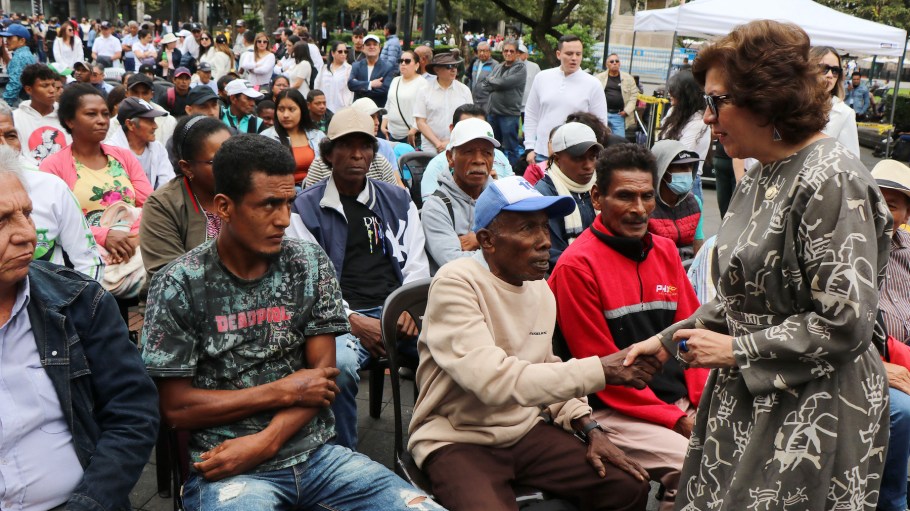
Ecuadorian government officials issued a public apology on May 31 to a group of the 300 “abacaleros” workers subjected to slave-like conditions for nearly six decades at the Japanese-owned abaca plantation, Furukawa Plantaciones.
The textile company violated “national and international regulations that affected, in essence, human dignity,” Labor Minister Ivonne Nuñez said. “The state, through the various ministries, as the sentence explains, turned a deaf ear.”
Nuñez spoke at a ceremony with other government ministers in Quito as former Furukawa workers chanted slogans such as “reparations, reparations” and “modern slavery, never again,” the Agence France-Presse (AFP) reported. The apology, held near the presidential palace, was mandated as a reparation measure in a previous ruling; when Ecuador’s Constitutional Court determined that, between 1963 and 2019, the Japanese textile company’s abacaleros were forced to live and work in conditions akin to modern slavery.
Related Stories
Per that ruling, Furukawa workers lived in unsanitary and overcrowded camps; some were denied proper medical attention for work-related injuries; accidents were common due to a lack of safety training.
“Ecuador will strive to build a state that guarantees the human rights of workers,” Nuñez said.
In January 2021, the Ecuadorian courts recognized—for the first time—that the conditions of Furukawa Plantaciones workers constituted a violation of the right to equality, non-discrimination, the prohibition of slavery by serfdom (servidumbre de la gleba), the right to health, housing, education and identity.
“The judgment established the responsibility of both the Ecuadorian State and Furukawa Plantaciones and ordered them to implement several clearly stipulated reparation measures,” nonprofit organization Front Line Defenders said in a joint statement released October 2023. On appeal, the Provincial Court of Justice of the Santo Domingo de los Tsáchilas region confirmed the company’s liability but exonerated the Ecuadorian State from liability, per the statement. It did not revoke the reparation measures in favor of the workers.
“The irresponsibility of the Furukawa company and the Ecuadorian government and the lack of comprehensive reparation has exacerbated the risk situation of the abacaleros, who continue to demand recognition of their rights, despite living in highly vulnerable conditions,” the signatories penned.
Last December, Ecuador’s Constitutional Court ordered Furukawa to award each victim with $120,000—a total of around $41 million. The court also ordered Furukawa to make a public apology, though the AFP reported the firm has not complied with either order. According to the international news agency, Furukawa said it does not have the money to pay the damages ordered by the tribunal and called them disproportionate.
Furukawa didn’t answer SJ’s attempts to confirm.
Furukawa did, however, announce the acquisition of its own shares. On June 2, an autogenerated news desk out of Japan reported that Furukawa purchased 484,700 common shares for approximately $0.00.91 billion (1.03 billion Japanese yen) between May 1-30.
“This move is part of a broader strategy approved by the board of directors to acquire up to 7 million shares, aiming to strengthen the company’s market position and potentially increase shareholder value,” TipRanks reported.
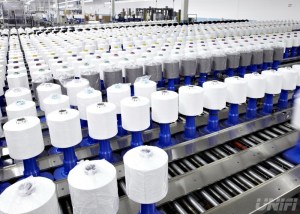
For context, Furukawa established its Santo Domingo de Los Tsáchilas plant in 1963 to cultivate and produce abaca. Also known as Manila hemp, abaca is native to the Philippines—some 10,000 miles from western Ecuador—with its fiber sourced from the banana-lookalike’s leafstalks. These outer sheaths are stripped into fine strands and woven into the resulting durable fiber.
As far as natural fibers go, abaca is considered one of the strongest for high tensile strength—which means its woven applications abound. The paper-making and rope producers benefit from its resistance to saltwater damage, while the medical industry uses the fiber for supplies like surgical masks and disposable aseptic products as well as orthopedic joint replacements and fracture-healing implants. Other industries prefer abaca over synthetic options for reinforcing polymers. Mercedes Benz, for example, has used a mixture of polypropylene thermoplastic and abaca yarn in automobile body parts; abaca fiber uses an estimated 60 percent less energy than what’s needed for fiberglass production.
Ecuador was considered an ideal growing area for abaca due to its established banana industry. It’s the largest exporter of bananas (valued at $4.51 billion in 2023) and one of the few countries outside of the Philippines producing quantities of fluctuating scale (historically 12,000 to 8,000 metric tons) of abaca.
As of 2021, Furukawa’s plantations for abaca spanned nearly 23,000 hectares across three provinces, the AFP reported, including Santo Domingo as well as Los Ríos and Esmeraldas.
Ecuador’s Fiscalia General del Estado (FGE)—helmed by former attorney-general Diana Salazar Méndez at the time—reported similar findings.
The office responsible for “initiating and continuing legal processes regarding offenses subject to public prosecution,” per Reuters, found that Furukawa has approximately 32 haciendas in the provinces of Santo Domingo, Los Ríos and Esmeraldas. However, since the Ombudsman’s Office submitted the Human Rights Verification Report, several camps have been abandoned or destroyed.
“Based on the Human Rights Verification Report related to the company Furukawa Plantaciones CA of Ecuador—which the Ombudsman’s Office submitted to the State Attorney General’s Office on March 21, 2019—a preliminary investigation was initiated for the alleged crime of forced labor or other forms of labor exploitation.” The FGE said, noting that the case entails human trafficking for the purpose of labor exploitation.
Méndez was appointed as Ecuador’s ambassador to Argentina—through executive Decree No. 634, as signed by president Daniel Noboa—10 days before the country’s public apology was issued.
“Both trials are a unique opportunity for Ecuador to do justice to the victims,” a group of UN experts said last April. “Furukawa Plantaciones must be held accountable for the human rights abuses committed, and adequate, effective and prompt reparation must be granted to the victims. Human rights defenders must be protected instead of being intimidated.”
Back in February 2023, Judge Susana Sotomayor partially accepted the request of the State Attorney General’s Office and called three senior employees—one as direct perpetrator and two as co-perpetrators—to trial, accused of child and adolescent labor violations as well. This was in addition to the legal entity Furukawa Plantaciones CA del Ecuador—the indirect perpetrator—for its participation in the crime of human trafficking for labor exploitation.
The suit marked the nation’s first-ever indictment of a company and its executives for practicing modern slavery—something Sotomayor stressed the significance of, according to an Iranian media outlet.
“‘I ask myself: what was the involvement of the public institutions before the beginning of the criminal process?’ asked Sotomayor, stating that the country’s government is supposed to protect its citizens,” the Tasnim News Agency reported.
Sotomayor reviewed over 100 pieces of evidence, as provided by prosecutor María Susana Rodríguez, to support the request.
That evidence included the report submitted by the Ombudsman’s Office to the State Attorney General’s Office, which stated that the workers endured “undignified, precarious, and inhumane living, housing and working conditions” that would constitute serfdom, a contemporary form of slavery.
“Added to this were statements from alleged victims, mostly of African descent and illiterate, who were not provided with work equipment, clothing, or safety equipment to carry out their work,” the FGE reported. “The corresponding companies also verified the lack of basic services such as water, sewage, or electricity in the work camps.”
Despite these significant court victories acknowledging that severe violations did occur, the enforcement of justice and reparation for victims remains delayed—compounded by alleged company obstruction and inconsistent state responsibility.
Last week, the Office of the United Nations High Commissioner for Human Rights (OHCHR) office for South America issued a public statement on the case’s latest developments.
“The Furukawa case is a painful example of social exclusion and racism in Ecuador, with a State that failed in its duty to protect, oversee, and punish business practices that violate human dignity,” the human rights group said. “It also calls us to reflect on how the current economic model perpetuates racism and structural discrimination, marginalizing large sectors of society and affecting the exercise of their basic rights.”