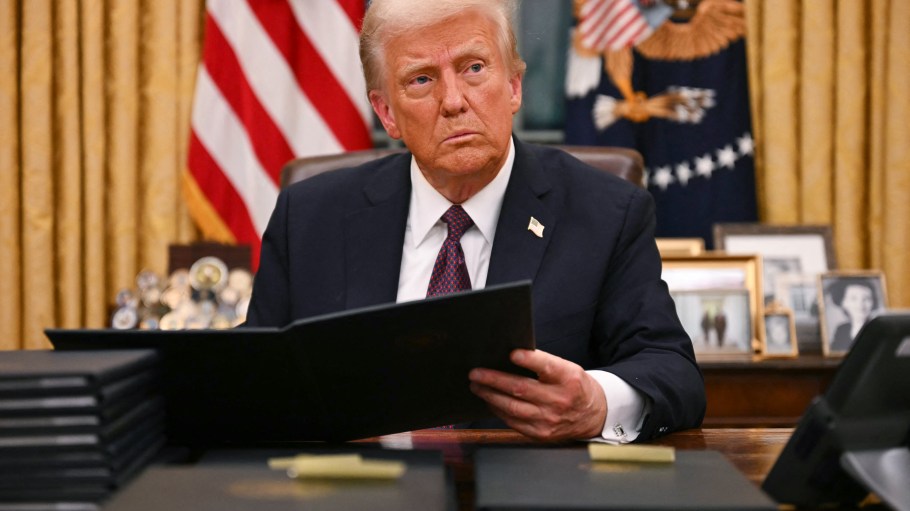
While not all of President Donald Trump’s “day one” promises came to fruition, the country’s new leader did revoke a slew of executive orders from the outgoing administration, including one poised to impact artificial intelligence’s further development.
Trump on Monday fulfilled a campaign promise to rescind former President Joe Biden’s 2023 Executive Order on the Safe, Secure and Trustworthy Development and Use of Artificial Intelligence. That order created a framework for the further development of AI and ordered some federal agencies, like the National Institute of Standards and Technology (NIST) to put forth guidelines on the technology.
Related Stories
While many of the agency-focused requirements of Biden’s EO have already been carried out, pieces of the EO that required developers to share safety test results with the government have now gone by the wayside, enabling faster, unchecked proliferation of the technology in the United States.
The Republican party platform, published in the months leading up to the election, gave some insight into why Trump was motivated to take such a step. The document called Biden’s EO “dangerous” and noted that it “hinders AI Innovation, and imposes Radical Leftwing ideas on the development of this technology.”
Though companies no longer have to comply with federal regulation on safety of AI systems in the U.S., that isn’t the case in other jurisdictions; the strictest provisions of the EU AI Act will come into effect this year, and other pieces will become effective in 2026 and 2027. The risk-based assessment system will impact companies operating on a global scale, even if the U.S. continues to fend off a broad, comprehensive AI package.
Reiko Feaver, partner and technology practice chair at CM Law, said revoking the AI EO could be just the beginning of what may become a more deregulated environment for Big Tech companies—from social media algorithms, to generative AI and more.
“It’s simply confirmation that the commitments and statements Trump has been making all along that quite obviously focus on deregulation are ones he means to follow through on to the extent he has the authority,” Feaver told Sourcing Journal. “EOs are not strong mechanisms to set binding, long-term policies, at any rate, and now legislative action will need to be taken for any regulation to occur.”
Experts have previously told Sourcing Journal that they don’t expect to see Congress elbowing to put a sweeping AI package in place this year, particularly as the administration would have to sign such a bill into law. The nation’s new president has already seen newly pledged allegiance from Big Tech.
Google’s CEO Sundar Pichai, Meta and Facebook’s CEO Mark Zuckerberg, Amazon’s founder Jeff Bezos and Tesla and X owner Elon Musk sat side by side at the ceremony. Also in attendance were TikTok CEO Shou Chew and Apple CEO Tim Cook. Both Meta and Amazon made seven-figure donations to the inauguration. Already, the cryptocurrency and AI communities have celebrated Trump’s decision to appoint David Sacks, a venture capitalist, to the newly created position of White House crypto and AI czar.
Feaver said she anticipates the new technology environment will be one of industry self-regulation.
“If the industry leaders are standing at the side of the president, how far, or in what direction, will self-regulation go shouldn’t be too much in doubt, unless altruism trumps profit,” Feaver said.
While Trump did not immediately make clear whether he plans to replace Biden’s EO with an order of his own, the Republican party platform noted that, “In [the AI EO’s] place, Republicans support AI Development rooted in Free Speech and Human Flourishing.”
In large part, experts believe that Trump and his supporters believe regulation and legislation could stifle innovation on AI-related projects. And because Trump is keen to compete with China on AI development and deployment, slowing down isn’t a viable option.
Before leaving office, Biden signed an executive order that would help speed up the process of building data centers—which are, in many cases, the backbone supporting advanced AI systems. He ordered the Department of Defense and the Department of Energy to identify three sites each to accommodate private data centers. With that EO, Biden said he sought to pave a path toward cleaner data centers while still giving the country a leg up on its competition for building AI models.
“We cannot take our lead for granted,” Biden said at the time. “We will not let America be out-built when it comes to the technology that will define the future, nor should we sacrifice critical environmental standards and our shared efforts to protect clean air and clean water.”
Despite its onus on the climate-related issues of AI systems, Trump has not yet removed Biden’s data center EO.