DHL wants to expand its robotic reach.
The third-party logistics provider announced Wednesday that it would invest £550 million ($747.1 million) into its warehouse robotics capabilities in the United Kingdom and Ireland in the coming years to accelerate its e-commerce and health logistics businesses.
The decision coincides with the UK government releasing its first trade strategy since its exit from the European Union in early 2020; according to an announcement from the government late last month, the strategy was designed to foster economic growth for the UK and create meaningful trade agreements that will benefit residents and partners alike.
Related Stories
DHL said that strategy only adds to the UK’s position as “a resilient and adaptable logistics hub [that] plays a key role in global commerce as trade patterns continue to shift” and noted that its continued shift toward warehouse automation will help enable growth for the UK’s economy in the sectors it serves.
To date, the company has deployed more than 2,000 robots in its UK-based warehouses. It uses more than 750 picking robots, made by partners Locus Robotics and 6 River Systems. The robots deployed with help from the latter partner are typically autonomous mobile robots (AMR) that are meant to assist human warehouse workers in fulfilling orders and locating items in tightly packed facilities. 6 River Systems’ robot Chuck has several shelves and can move around on its own or with human intervention, just as a regular push cart might if it was enabled with automated steering. These picking robots have gone live at 18 sites throughout the UK, Ireland and the company’s EMEA territory.
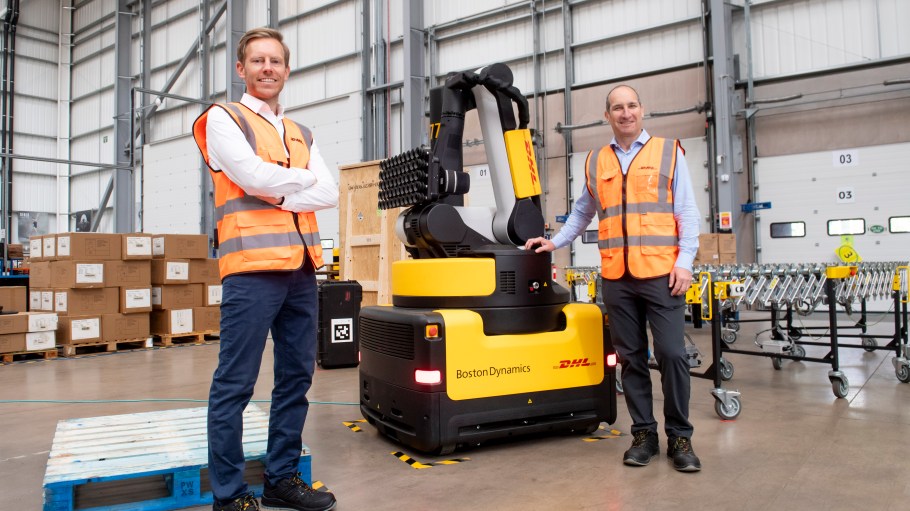
What’s more, DHL recently deployed its first Boston Dynamics Stretch Robot in the UK. Stretch assists human operators with unloading boxes weighing up to 50 pounds out of trucks and containers, a task which warehouse operators have long struggled to fully automate because of the crowded nature of transportation vessels hauling cargo and parcels, as well as the differing sizes of packages stowed in many trucks and containers. Stretch looks like a large-scale robotic arm that can glide around independently; instead of a hand, hook or grabber, it uses a suction panel to grasp and move goods autonomously and can grab boxes from the sides, not just from the top or bottom.
This particular robotic model can operate unattended because it uses computer vision to detect any boxes or cargo that shift around or fall in transit or during unloading, then uses that data to correct the issue. According to DHL, Stretch robots can unload as many as 700 boxes hourly; the idea is that, if Stretch is consistently unloading boxes and parcels, human warehouse workers will be exposed to lower levels of injury risk while also amping up warehouse efficiency. Other Stretch users include Gap and H&M, according to Boston Dynamics’ site.
As part of DHL’s newly announced investment, it plans to ramp up its partnerships with its robotic vendors. The idea is that, rather than simply purchasing or licensing pre-existing technology, the third-party logistics player will help develop, test and scale new technologies that could benefit the warehouse of the future.
Tim Tetzlaff, global head of digital transformation, DHL Supply Chain, said the technology will help redefine e-commerce as consumers know it.
“At DHL, we’re driving the next wave of automation, not as a one-size-fits-all approach but as a set of intelligent, adaptive technologies tailored to the specific needs of individual sectors,” Tetzlaff said in a statement. “For e-commerce, for example, where the market is evolving and demand is growing, we’re expanding our fulfillment capabilities to support that shift with automated solutions that significantly simplify high-volume operations.”