Automated apparel manufacturing firm CreateMe Technologies is prepping for its platform’s retail debut through a strategic partnership with Untuckit.
The direct-to-consumer label will be the first to sell apparel constructed using CreateMe’s digital bonding process, which swaps a needle and thread for adhesive that joins pieces of fabric together. Following years of development, CreateMe is now ready to release consumer-facing product to the market.
“We’ve been working with our partners to get the product really tight,” Cam Myers, founder and CEO of CreateMe, told Sourcing Journal. “And we feel that it’s in a really strong place in terms of the end product that the consumer will ultimately wear. That’s ultimately got to be the litmus for when it’s right to bring something commercially to market.”
Related Stories
The first product from this partnership will be a men’s T-shirt, slated to drop at retail in the second quarter for a pilot test. Starting in the third quarter, the partners have plans to scale up production, eventually reaching 50,000 pieces per year.
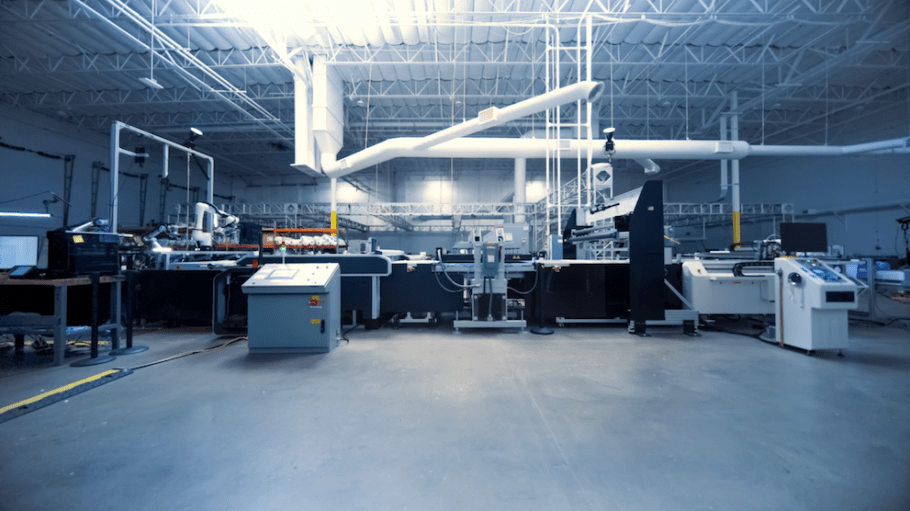
CreateMe’s MeRA platform—an acronym of Modular-engineering Robotic Assembly—leverages robotics to maneuver fabrics through the manufacturing process. Using a proprietary adhesive called Pixel and heat, textiles are bonded together. “Compared to other automation I’ve seen, this is as automated as you could possibly make a garment,” said Björn Bengtsson, chief product and supply chain officer at Untuckit.

According to Bengtsson, the resulting tee is indistinguishable from a sewn shirt, with no quality or durability trade-offs. Many of the mistakes or inconsistencies that happen in garment manufacturing stem from human error, which CreateMe circumvents. “There’s plenty of garments that lend themselves to automation, and with automation comes also precision and quality,” Bengtsson noted.
The CreateMe platform allows for adaptability and small batch runs, since the system adjusts production parameters through a CAD file rather than making physical machinery changes like a conventional factory, creating opportunities for responsive replenishment. Untuckit plans to use the shirt as a year-round staple and swap out colorways.
Per Myers, Untuckit’s business model made it a fit for CreateMe’s manufacturing model. For starters, the brand was founded on product innovation, with its raison d’etre centered on shirts that do not require tucking. Another synergy was its position as a DTC brand, a segment of the industry which Myers said tend to be more understanding of “dynamic supply chain sourcing models.”
For Untuckit, the partnership was a “no brainer,” with the ability to nearshore production at the top of the list of pluses. Untuckit has previously sought U.S. manufacturing relationships, such as its shirt production partnership with Garland Apparel Group in Garland, N.C., a former Brooks Brothers plant, which has since shuttered. “I always look for opportunities in United States, and right now, it’s more relevant than ever,” said Bengtsson, referencing the tariff-driven nudge toward nearshoring.
By leveraging American-grown Supima cotton, domestically sourced knit fabrics and CreateMe’s production hub in California, Untuckit has been able to build a fully made in the U.S. product. Via Supima’s traceability platform, Untuckit has full visibility from fiber to finished garment, and the brand intends to take this verification back to the farm level.
One of the hurdles in bringing production back to the States has been a lack of skilled sewing machine operators. Automation helps lower the skill bar required, and CreateMe’s static assembly system is an example of how robotics can open the door for new entrants to the field. “All that training that has to be found—the hand feel, flexing, moving fabrics, all those things that take years to develop—you don’t need that same skill set to assemble with our [platform],” Myers said. “So it’s actually very much widening the labor force, the labor pool that can come in and use our technology. That’s something that makes this whole equation that much more scalable.”
Although it leverages robotics, CreateMe’s Pixel and MeRA systems still require some human intervention. Each line—which has the capability to produce thousands of pieces a week today and is expected to reach a million-piece capacity next year—is currently staffed by 14 people. CreateMe intends to eventually reduce this worker count per line, as future generations of its system become capable of tasks like aligning fabric with the help of artificial intelligence and robotics, creating more cost efficiency.
Already, the cost of producing with CreateMe is on par with Untuckit’s existing manufacturing, leading to a “price competitive” product that is also domestically made.
“Quality of the needle is always a major objective for any company—they want their products to be well constructed,” said Buxton Midyette, vice president, marketing and promotions at Supima. “What CreateMe has developed is a way to, wherever the production location, have a needle of the highest quality, even though there’s no needle at all. That a product of this caliber can be made onshore is really exciting.”
The “sweet spot” for CreateMe’s solution are staple categories, like the basic tee, underwear and hoodies, and it plans to expand its production offerings from men’s to women’s T-shirts this year, tackling what is a more complex style compared to a fairly symmetrical men’s tee. It is also starting to prototype styles like polo shirts and V-necks, exploring expansion in the T-shirt category.
Following its scaling plans with Untuckit, CreateMe has its sights set on an even wider mass-manufacturing expansion in 2027. “This is the first of many bonded garments we’ll bring to market,” said Myers.