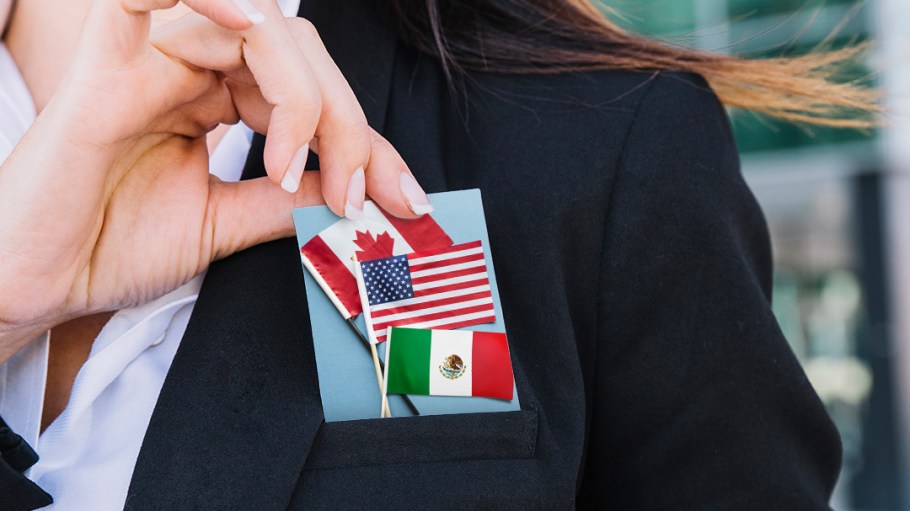
As trade dynamics continue to shift, global political tensions rise and logistical challenges intensify, Copen is repositioning itself to strengthen its support for the U.S.-Mexico-Canada Agreement (USMCA) and Central America-Dominican Republic Free Trade Agreement (CAFTA-DR) regions. At the same time, it is ensuring full compliance with all applicable Customs and Border Protection regulations, including those currently in flux.
The global supplier of pocketing, waistbands and linings has taken a strategic approach to Mexico over the past decade that has supported its continued success and expansion, with the addition of stock products and tactical locations that offer logistical advantages to key production hubs, according to Marc Shevrin, president of the Western Hemisphere at Copen United.
Related Stories

In 2019, 90 percent of Copen’s pocketing sales in Mexico were sourced from Asia. By 2024, that figure reversed, with 90 percent of sales coming from regionally produced, USMCA-compliant products—primarily manufactured in Mexico. This shift to local sourcing, ahead of changes to rules of origin, allowed Copen to improve delivery times and offer more competitive pricing, particularly as freight costs for U.S. production rose sharply.
The establishment of Copen Mexico in 2024 also opened opportunities to better serve the domestic Mexican market. While denim remains a core focus, Copen is expanding into the workwear sector, offering alternative products and meeting a broader range of quality standards.
“This move has enabled Copen to compete for business it previously could not access without a local presence,” Shevrin said. “Additionally, recent changes to USMCA rules of origin now allow Copen’s lining division to target regional opportunities, as suit linings no longer require regional yarn compliance to qualify.”
Alongside its existing pocketing operations in Torreón and Puebla, Copen has expanded its footprint in 2025 with the opening of a warehouse and factory in Aguascalientes. This facility supplies waistbands, pre-cut pockets, bindings and other products to the USMCA region.
As part of its broader efforts around sustainability, transparency and traceability, Copen is partnering with forensic and data science company Oritain to strengthen its documentation and origin claims. Oritain’s forensic process analyzes isotopes and trace markers on cotton to verify its origin, providing scientifically backed evidence in case of inquiries from authorities, brands or vendors.
While many controls and audits are conducted locally, Copen maintains a strong focus on traceability and transparency. In fact, the global manufacturers’ systems are designed to ensure a seamless process and provide customers with the confidence they need should material mapping be required by authorities during importation.
Copen sees the steps taken leading up to 2025 setting itself up for success amid market upheaval.
“We are optimistic that 2025 will be a positive year for Copen in this region. Sales have already improved year over year at this point in 2024. It looks like the trade war will not harm our business; in fact, in many cases, it may make Mexico more appealing for ‘nearshoring’ in these turbulent times,” Shevrin said. “As I always say, even when business may not be up in a region, if you’re gaining market share, you can still achieve a very positive result.”
To learn more about Copen United and its Mexico expansion plans, click here.