Byte-Sized AI is a bi-weekly column that covers all things artificial intelligence—from startup funding, to newly inked partnerships, to just-launched, AI-powered capabilities from major retailers, software providers and supply chain players.
Google and PayPal partner in preparation for agentic commerce
Google and PayPal want to “help advance the intelligent agent revolution” by making the next generation of digital commerce more accessible to a broad swath of consumers.
The two companies announced Wednesday that they had entered a multi-year partnership focused on upgrading consumers’ transaction experience for evolving AI systems. One of the goals of the partnership is to solidify the necessary cogs for future agentic commerce by leveraging PayPal’s data capturing, identity verification and payment solutions and using Google’s AI savviness. While the two companies have a vested interest in pushing agentic commerce forward, they also highlighted the need for reliable, safe transactions, particularly with AI’s involvement. The partnership announcement comes just one day after Google unveiled its Agent Payments Protocol, which is intended to foster trustworthy transactions led by agents.
Related Stories
Alex Chriss, president and CEO of PayPal, said the partnership will have far-reaching implications for the technology and e-commerce industries, if executed as planned.
“In this emerging world of agentic commerce, trust and innovation are key,” Chriss said in a statement. “Together with Google, we are leading the way for digital commerce, ensuring greater opportunities for merchants and users worldwide. We are bringing PayPal’s products and services to billions of Google users and redefining what’s possible at global scale.”
The move comes a few months after major payment providers Visa and Mastercard announced that they had teamed up with some of the world’s largest AI companies to enable agentic commerce securely and without sacrificing consumers’ sensitive information.
While the work stemming from those partnerships has not yet come to life at scale, the hope is that linking payment systems with existing AI shopping applications can allow for a truly autonomous experience that would see assistants purchasing items on consumers’ behalf based on a specific inquiry.
Uber Freight upgrades TMS with AI
Uber Freight announced at Deliver 2025, its annual conference, that it had upgraded the AI capabilities available on its platform in an effort to make logistics simpler and more efficient.
Uber Freight’s transportation management system (TMS) has been leveraging AI for some time, but this week, Uber announced that clients can now use the platform to track and handle the order-to-cash journey of shipments in full. That means that, where operators may previously have needed separate, disconnected systems, they can now leverage a single platform that helps them decision quicker and identify issues sooner.
Uber said the platform gives operators “greater control of freight spend and more accurate forecasting across the network.” The company’s hope is that clients use the TMS for real-time information, rather than treating it as a source for completed transactions and freight runs.
In addition to its spend upgrades, Uber has added more features to its procurement platform. The company said it can now automate the data-gathering and modeling behind bid awards. Rather than having a human spend days or weeks finding the information, requesting quotes and evaluating the options against one another, Uber Freight’s platform can generate a real-time comparison of costs, carriers, available services and more. What’s more, the system can project financial and performance metrics ahead of an operator choosing a specific carrier or plan.
The logistics player hopers that, in doing so, it can help clients cut costs and make faster decisions relying on data.
Steve Barber, vice president of product at Uber Freight, said it has already been leveraging agentic AI in its operations with customers, and noted that it expects to provide tangible improvements with these new capabilities.
“From procurement to payment, shippers face constant complexity across the freight lifecycle. Through continued investment in platform innovation, Uber Freight delivers the tools, automations and integrations that simplify the work and unlock meaningful outcomes such as faster decisions, smarter cost control, and more resilient supply chains,” Barber said in a statement.
Seattle-based startup secures pre-seed for in-store feedback
Seattle’s Ethosphere announced Tuesday that it has raised a $2.5 million pre-seed round. Point72 Ventures led the round, with additional participation from AI2 Incubator, Carya Ventures, Pack VC, Hike Ventures and J4 Ventures.
Ethosphere uses microphones to anonymously and securely capture real conversations between in-store retail associates and customers. It then parses through the key parts of the conversation, generates a transcript and passes feedback to both the employee and their manager.
Evan Smith, CEO and co-founder of Ethosphere, said the technology brings a unique use case for AI into companies’ stores and creates a proactive learning opportunity for employees as they go through their normal days.
For instance, Ethosphere might tell a manager that a particular associate is excellent at greeting and interacting with customers, but often shares incorrect product information about a newly stocked product line. The system may then recommend that the manager review the descriptions with that employee to ensure future accuracy.
“AI is bringing change to every industry, and retail is no exception, but there is a significant gap in how the technology can be applied in a useful, human-focused manner,” Smith said in a statement. “Ethosphere wants to bridge that gap by empowering retailers to invest in their people, recognizing that a well-supported and knowledgeable team is the key to building exceptional customer experiences. This human-centric approach not only enhances brick-and-mortar purchasing but also directly impacts a company’s bottom line by fostering loyalty and driving sales. We’re partnering with major brands to achieve this goal.”
The startup plans to use the funding to scale up the pilots it has already started with undisclosed “major retail brands.” Its site also shows that it’s hiring a senior software engineer, who would “lead a squad of two to four engineers” and build various systems to support the continued development of Ethosphere.
Ralph Lauren introduces Microsoft and OpenAI-powered shopping assistant
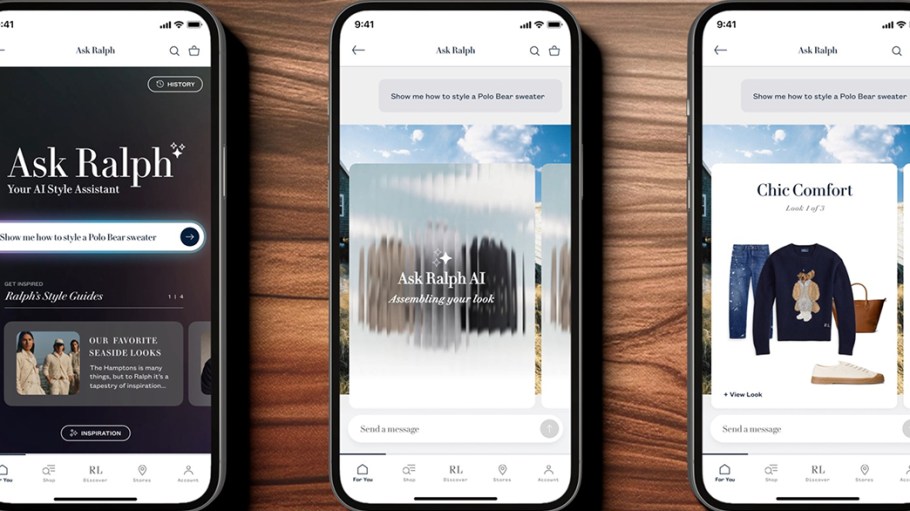
Ralph Lauren announced last week it had introduced a new, conversational AI chatbot it calls Ask Ralph.
Ask Ralph can handle consumer styling questions and provide recommendations on matching existing items, finding the right outfit for an occasion and more. For instance, a consumer might tell the chatbot that they need to attend an important business meeting and would like to purchase an outfit that matches their favorite navy blue blazer. For the brand, the idea is that consumers can work with the chatbot “just as they would with a stylist in a Ralph Lauren store.”
David Lauren, chief branding and innovation officer at Ralph Lauren, said allowing consumers to have richer e-commerce experiences will allow the brand to foster an even deeper connection with its shoppers.
“Whether getting ready for a first day of a new job, or creating the perfect look for a night out, Ask Ralph is about more than just discovery—it is about engaging consumers with what they love most about Ralph Lauren: our iconic, unique take on style, providing timeless head-to-toe looks that inspire them to step into our world,” Lauren said in a statement.
Ask Ralph is available only in Ralph Lauren’s app for U.S. users. The brand partnered with Microsoft to leverage its Azure OpenAI platform to enable the technology.
Shelley Bransten, corporate vice president of global industry solutions at Microsoft, said the partnership felt like a natural step for the brand and the technology provider, especially in a moment where consumers are changing their shopping and discovery habits.
“AI is transforming the way consumers get inspired, educated and purchase from fashion brands around the world,” Bransten said in a statement. “We’re proud to bring the combination of our trusted generative AI capabilities through Azure OpenAI together with Ralph Lauren’s iconic brand to pave the way for an entirely new conversational commerce experience.”
Inspectorio introduces intelligence layer Paramo
Supply chain intelligence firm Inspectorio announced Thursday it is introducing Paramo, which it calls “an AI-native ‘intelligence layer’ that is embedded across Inspectorio‘s entire supply chain platform.
Today, some AI solutions are deployed in pieces—for instance, a company might have one provider’s technology running to streamline inventory management and another platform leveraging different data to aid with insights on risks impacting their shipments. Because those two systems are not integrated with one another—that is to say, they don’t leverage the same data sources and don’t have the same baseline for external information—they cannot effectively interact one another, nor can they make parallel recommendations informed by context from the other.
But Inspectorio wants to change that with Paramo. The company said it has built a unified system that uses structured data from retailers and suppliers, with the intention of creating a single source of truth that underlays the recommendations an AI model provides to a user. That system then employs copilots and agentic AI to handle myriad tasks inside an organization. Inspectorio said it has trained the copilots to handle risk detection, document scanning and more. The agents, meanwhile, are meant to independently handle tasks that streamline brands and retailers’ sourcing, compliance and traceability strategies. If the system is deployed as designed, it could help the technology provider’s clients lower their technology and sourcing spends, upgrade compliance protocols and expedite sourcing.
Chirag Patel, CEO at Inspectorio, said supply chain management needs to be able to evolve effectively alongside technology.
“As retailers and brands navigate an increasingly complex supplier landscape, high-quality data and production chain visibility fuels more trustworthy outputs and decision making,” Patel said in a statement. “Organizations must evolve their operations by increasing agility and automation, and Paramo enables brands and retailers to transform this disruption into stability and growth. Embedded operational intelligence is the only way to future-proof operations. Paramo sets the industry standard for the future of supply chain management.”