
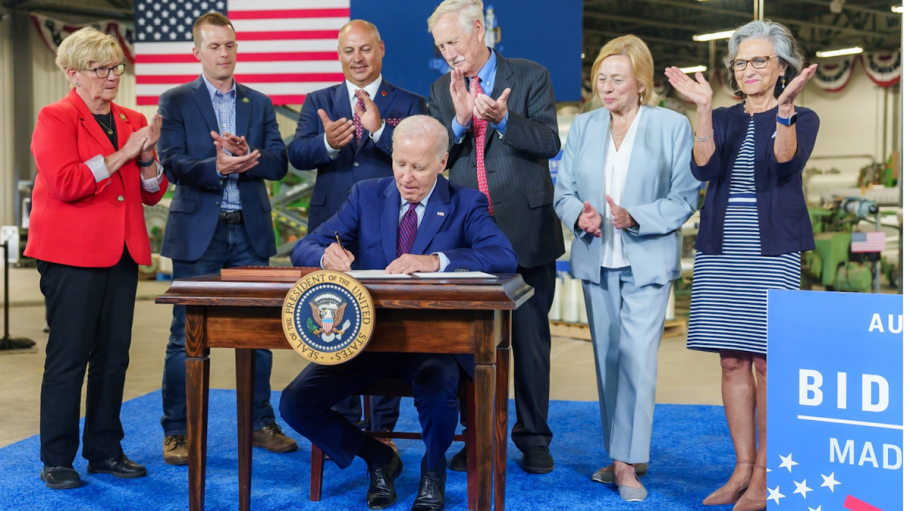
President Joe Biden took the floor at a Maine textile mill Friday to sign an executive order designed to streamline the process of getting funding for U.S. inventions, increase transparency in the approvals process, smooth the reporting process, and encourage agencies to consider domestically produced commodities.
The executive order also instructed the United States’ Department of Commerce to simplify and make more transparent the process used to approve waivers for manufacturing U.S. inventions outside the country.
Related Stories
“Invent it here, make it here,” was the theme at the signing which took place at Auburn Manufacturing, Inc. (AMI), makers of extreme heat protection textiles based in Auburn, Maine.
Surrounded by Maine elected officials, including Independent Sen. Angus King and Gov. Janet Mills, in addition to AMI founder and CEO Kathie Leonard, Biden reiterated his record for jobs creation, saying there are 13 million more jobs in the U.S. than there were before the pandemic, including 28,700 in Maine.
“800,000 new manufacturing jobs nationwide, that attracted half a trillion dollars in outside private investment to grow the economy because they know what’s available now,” he said. “That’s more jobs in two years than created by any president in a four year term.”
He also debunked the myth the Reagan-era trickle-down economics. “Not a whole lot ever trickled down on our kitchen table,” he said.
Biden came to office to move away from that theory of trickle down economics with a plan he said is working. Unemployment has been below 4 percent for the longest stretch in more than 50 years and workers are finding better jobs with better pay, he claimed. “People are coming off the sidelines.”
Auburn is a major supplier to the U.S. military, making products also used in the mining, petroleum, shipbuilding and glassmaking industries, among others. Founded in 1979 by Leonard and a partner, the woman-owned company got the attention of the U.S. Department of Commerce for taking on China when it started dumping inferior quality silica textiles, one of Auburn’s chief products, which was being sold at 30 percent cheaper than AMI’s.
AMI’s victory earlier this year means China will pay 200 to 300 percent tariff on the goods when they are imported into the U.S. Leonard has subsequently learned that the Chinese goods are being imported into the U.S. with false labels.
This particular episode dovetails with the growing anti-China trade sentiment over de minimis violations which soared to one billion last year from 150 million in 2016 when the law was changed to require the taxing of any item crossing the border that is valued at $800 or more, up from $200. It is also in line with the pending HOPR, or Homeland Procurement Act, which would further allow the Department of Homeland Security to purchase high-quality American-made PPE for front-line personnel.
Last year, the U.S. textile sector had 538,000 employees and an output of $65.8 billion.


