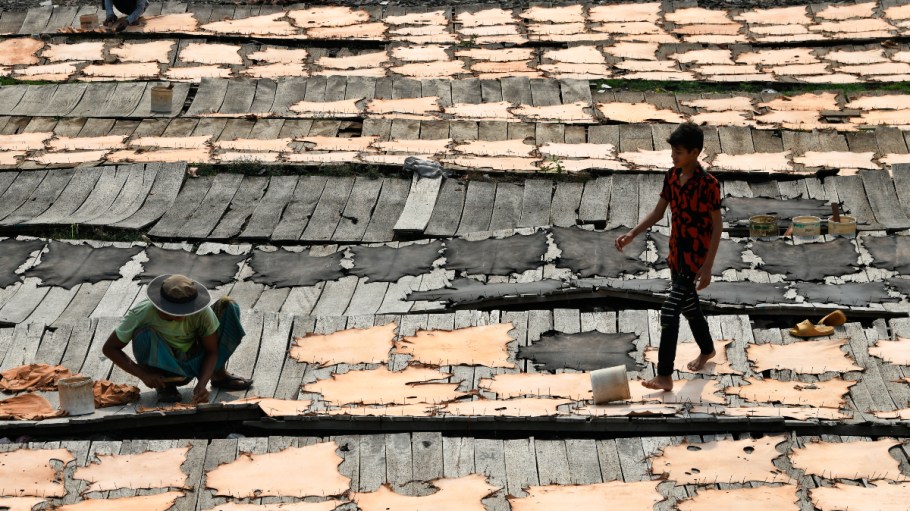
Bangladesh tanners are in a bind.
Though many big global brands will only work with suppliers certified to Leather Working Group standards, the lack of sufficient effluent management facilities means the nearly 200 Bangladesh tanneries that have moved to the Dhaka suburb of Savar in recent years struggle to compete with better equipped sectors in rival nations.
It’s a growing problem for the $1.2 billion Bangladesh leather export sector, the nation’s second-biggest export earner after the $47 billion apparel market, per the Export Promotion Bureau. Leather exports totaled just $224 million back in 2009.
Related Stories
Without sufficient effluent treatment systems, Bangladesh leather tanneries in Savar have little hope of achieving LWG certification, which applies to actors in the supply chain from rawhide to finished leather and covers micro-enterprises to large tanneries. This limits the sector’s export growth potential as well, given fashion’s growing focus on sustainability.
Because a central effluent treatment plant was supposed to be coordinated, tanneries haven’t invested in their own individual facilities.
The plan to shift the tanneries from Hazaribagh in Dhaka, where they were based for decades, to Savar’s Tannery Industrial Park in Hemayetpur began 20 years ago. But tanneries only starting moving in 2016, and the incomplete central effluent treatment plant (CETP) meant tanneries dump their waste into the Dhaleswari river.
Adding to the tanneries’ concerns is the call for a 25,000 taka ($227) minimum monthly wage, a steep increase from the current 13,000 taka ($118), which labor advocates say fails to factor in breakneck inflation and a higher cost of living. Workers have taken a 14-point list of demands to the wage board in recent months to fight for an increase that only happens once every five years.
Tannery owners and other leather industry stakeholders who met at the three-day Bangladesh Leather Footwear & Leather Goods International Sourcing Show (BLLISS) in Dhaka last week, spoke out about the need for measures to ensure facilities achieve the LWG certification and compete on a global scale.
Although the theme of the Oct. 12-14 conference was “Possible. In Bangladesh,” tanners still await a solution to the effluent problem.
At the event, Prime Minister Sheikh Hasina announced the formation of a leather industry development authority to enhance the sector’s growth. A seminar on “Linking Bangladesh to the global value chain” touched on reforms, tariff rationalization and increased participation with the Sustainable Leather Forum.
According to industry insiders, the existing plant can handle less than 60 percent of the waste, meaning the rest of the effluent pollutes the river nearby.
”In order to use domestic leather to manufacture exportable products, we need to ensure that Savar Leather is functioning properly as per the Central Effluent Treatment Plant (CETP) standards,” said Syed Nasim Manzur, president of the Leather Goods and Footwear Manufacturers and Exporters Association of Bangladesh (LFMEAB). He is also managing director of Apex Footwear Ltd, one of Bangladesh’s biggest footwear manufacturers which has its own effluent plant, a gold LWG certification and a tannery, covering 11,015 square meters within the factory grounds. According to industry sources, only three companies in Bangladesh hold the LWG certification.
Manzur added that a task force is working to select world-class, proven CETP technology suppliers from developed countries to evaluate and retrofit the CETP of Savar Leather Industrial City to achieve the LWG Gold Standard.
“Making the changes can help the industry exports to grow to $5 billion in five years,” he said.
Mohammed Mamun Or Rashid, a businessman who works with the leather industry, and CEO of Maxinary Tech International, said the effluent problems requires urgent attention.
“The area is getting more damaged each day,” he said. “It is becoming an issue of compliance on many fronts—whether it is to do with human health of occupational and safety hazard. More than 80 percent of the factories have no human resources department, no salary sheets. The area is like a desert with a very bad smell. The villages near by can no longer use the water of the Dhaleshwari river to wash or bathe in, it is too polluted.”
“Many people in the industry feel that Bangladesh Small and Cottage Industries Corporation (BSCIC) and Chinese contractors who were given the task of making the effluent plant are responsible for the situation. We need more experts to evaluate and find solutions,” he continued.
Monica Hartsell, deputy country program director, Solidarity Center Bangladesh, a worker rights organization, said that the labor outlook is bleak, partly because many workers don’t even earn the minimum wage.
“According to our research, more than 90 percent of workers say they don’t even have an appointment letter. This is a huge issue and even bigger issue since the shift from Hazaribagh to Savar. Many of the workers were appointed long time ago and there has been a shift to hiring temporary workers and using this to undermine workers. Tannery requires a high level of skills—many of the workers have worked for decades, [which is] different from garment sector where there is a quick turnover. So, the bigger issue for the workers has become job security,” she said, pointing to the industry’s “very dangerous” safety issues.
And although the leather sector has strong worker unions compared with the readymade garment industry, collective bargaining doesn’t seem to be helping much.
“In the garment industry workers [in] one union cannot be representative of the garment industry—it is factory by factory, you can’t negotiate an agreement across, but in tanneries the industry allows sectoral organizing and cluster bargaining. There is no question, it is TWU,” Hartsell said, using the acronym for the Tannery Workers Union, which has put a spotlight of the needs of workers, whom they say have neither job security, nor social justice.
TWU president Abul Kalam Azad said the shift from Hazaribagh to Savar had resulted in significant challenges for workers. Among the 14 worker demands is the full implementation of waste management and CETP to build an eco-friendly and modern leather city, and move towards achieving the Leather Working Group (LWG) certificate, strengthening the non-discrimination mechanism in the workplace, ensuring social compliance and a 50-bed hospital. Although the minimum wage board had stipulated the 13,000 taka minimum wage in 2018, many workers never received that pay, meaning greater transparency and a higher wage is now needed, he said.
Solidarity Center’s Hartsell said that even when there is an agreement in place, it is poorly implemented in the sector. “We’ve seen very few improvements in occupational safety,” she said. “You have the impact of the environment where workers are suffering from the effects of toxic chemicals like chromium and high risk of accidents, there is no personal protection equipment, and it is shocking to see workers walking around in waste water in their bare feet or in flip flops.
“Now they have moved, it’s a very desolate area—there is no hospital—they were promised [a] facility nearby, when they face a medical condition they have to go a long distance,” Hartsell said.
While labor advocates prepare negotiations before the wage board decision, all sides agree on the value of better communication. “Owners and tannery workers must work together,” said Abdul Malek, TWU general secretary.