The garment industry in Bangladesh faced a slew of problems in 2024. But one of its focuses for 2025 might be figuring out how to retain workers whose jobs have been negatively impacted by automation.
Joint research from the Bangladesh Labor Foundation (BLF), BRAC University and Solidaridad Network Asia shows that automation has started to slash garment worker jobs in Bangladesh’s factories.
The organizations said automation caused a 31 percent decline in Bangladesh’s total ready-made garment (RMG) sector workforce. The majority of those workers, the organizations said, were helpers. Helpers typically take on tasks requiring lower skill levels in factories.
Related Stories
The BLF said automation could continue to place negative pressure on jobs in the RMG sector.
“While automation has boosted economic growth and productivity in the sector, it has simultaneously created significant challenges for RMG workers—especially women, older employees, less literate individuals and those lacking skills or confidence,” the organization wrote in a Facebook post.
BLF highlighted that the study’s findings only exacerbate the “urgent need” to work on what it calls “Just Transition” issues. Through that program, the BLF works to help guide workers vulnerable to climate change, automation, economic inequality and other social issues through an economic transition.
According to LightCastle Partners, women are much more likely to be employed as helpers in Bangladeshi factories than their male counterparts.
So far, the hardest-hit subsectors of the industry have been sweater factories, which saw a 37 percent decline per production line, and woven factories which saw a 27 percent drop in their respective workforces.
Workers entrenched in the cutting stage of the garment manufacturing process were more likely to lose their jobs than those engaged in the sewing process. While the cutting function saw a 48 percent decrease in the number of workers employed, sewing’s decline came in at nearly 27 percent.
The insistence on automation in Bangladesh’s RMG sector doesn’t seem to be letting up soon.
Earlier this year, LightCastle Partners research showed that eight in 10 Bangladeshi factory owners have plans to invest in automation within the next two years.
The research further noted that, on average, factories like these employ about 2,250 workers, but only 500 of those workers will be directly involved in automation implementation processes.
Because factory owners have shown a keen interest in automated systems, helping workers avert job loss may require upskilling or reorganization of roles. Experts say that, when implemented thoughtfully, automation can enrich workers’ lives and foster business growth.
Figuring out to meld factories’ interest in automation with garment workers’ longstanding expertise could be a boon to Bangladesh in 2025. Vietnam’s garment manufacturing star has only continued to rise; projections show it may soon overtake Bangladesh‘s spot as the No. 2 apparel exporter in the world, coming in right behind China.
According to The Daily Star, a Bangladeshi media outlet, Syed Sultan Uddin Ahmed, the chairman of the Labor Reform Commission, said that, unless owners help workers to adapt to automation’s impacts, Bangladesh could become less competitive, as compared with peer countries competing for market share in garment exportation.
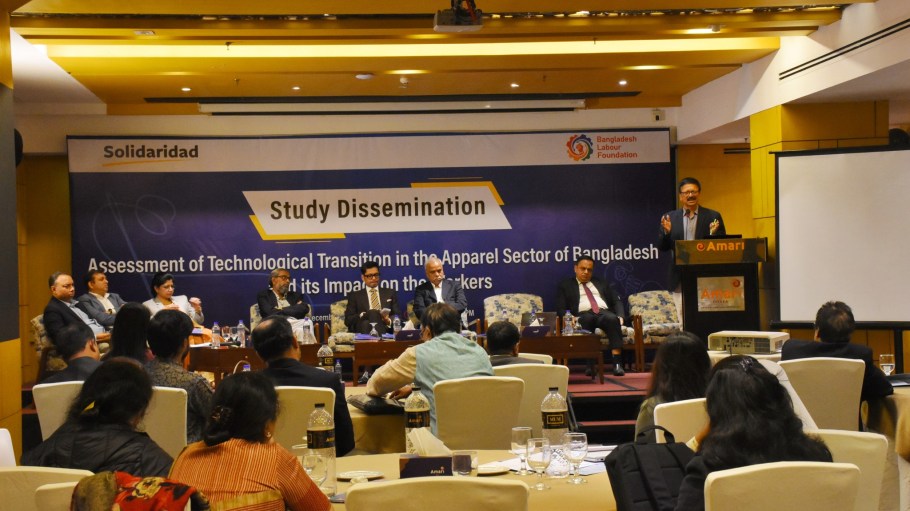
“It won’t be fair to say that our workers would not be able to cope with the arrival of the machines. Rather, we have to take preparations on how to utilize the existing workforce,” he said at an event highlighting the findings of the joint research.
The Daily Star reported that the government plans to launch an Employment Department, which may be able to help mitigate issues onslaught by hasty implementation of automation.