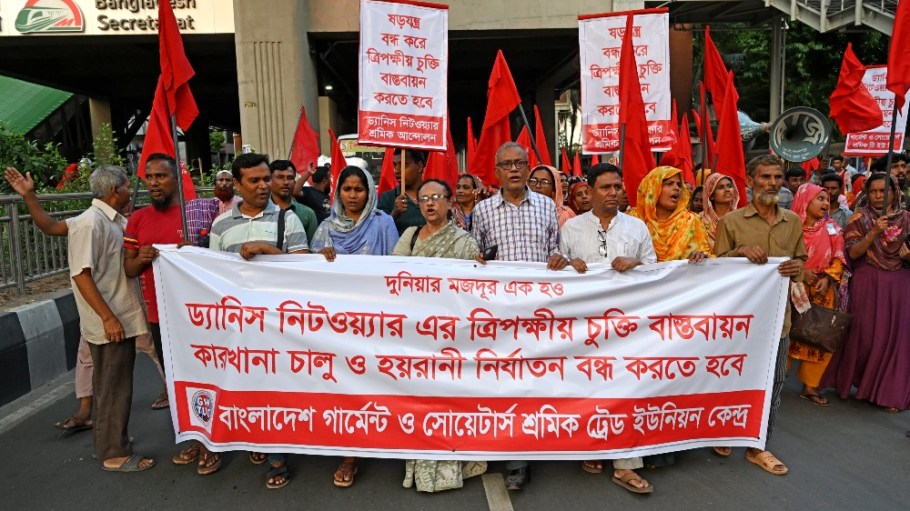
In the wake of ongoing protests, the Bangladesh government announced on Monday that it will add an additional 4 percent to the regular annual 5-percent wage increase for readymade garment (RMG) workers.
“RMG workers will receive a 9-percent salary increase starting this month,” Bangladesh Labour and Employment Ministry advisor M. Sakhawat Hussain said during a press briefing at the Bangladesh Secretariat. “Of the total increment, RMG workers will receive a 5-percent regular salary increase as prescribed by the Minimum Wage Board. Additionally, the owners and workers have agreed to an extra 4-percent increase.”
Related Stories
Sakhawat also noted that workers not eligible for the yearly raises will still receive the 4-percent bump in pay.
Though RMG business owners agreed to the additional increase, some expressed concern over how that additional expense will impact their businesses, particularly as they face other challenges.
“We feel trapped after investing heavily in this sector, especially as the previous government increased utility costs significantly,” an apparel exporter told The Business Standard on the condition of anonymity. “The government should conduct a comprehensive survey to assess the industry’s capacity and the workers’ needs.”
But labor organizations say the measure doesn’t go far enough, calling for a 15-percent increase due to current economic conditions.
“While the increase provides some relief to workers, it is insufficient given the rising commodity prices and inflation,” Bangladesh Garments and Industrial Workers Federation president Rafiqul Islam Sujan told the news outlet.
Unrest has plagued the garment industry in Bangladesh in recent years. In September, nearly 170 garment factories in Ashulia, Gazipur and Savar suspended production after vandalism and violence erupted. The Bangladesh Garment Manufacturers Association (BGMEA) said that workers aren’t behind the violence, pointing to outside parties “trying to create chaos.”
Sakhawat echoed BGMEA’s sentiments on the matter, saying “Conspiracies are being hatched both at home and abroad. Newspapers of different countries are reporting that now is the time to divert [apparel] buyers from Bangladesh. Many workers are protesting without understanding. Provocation is also coming from many places.”
On Monday, three RMG factories in Ashulia announced general holidays as workers went on strike, demanding a 15 percent annual raise and a minimum wage of 25,000 Bangladeshi taka ($209) per month due to the rise of the cost of living. Last year, the Labour and Employment Ministry raised the monthly minimum from 8,000 taka ($73) to 12,500 taka ($73).
The garment industry accounts for nearly 85 percent of Bangladesh’s annual $55 billion in exports. Unrest in the sector comes at a time when the country’s interim government has struggled to restore stability after former prime minister Sheikh Hasina fled the country in August amid a military takeover. And the country suffered through recent monsoon floods that disrupted activity at the country’s congested port, causing export delays.
Like it or not, Sakhawat said the 9 percent pay increase will remain in effect until Bangladesh’s next Minimum Wage Board is announced.