At least one man is dead after thousands of garment workers flocked to the streets of the Bangladeshi city of Gazipur on Monday in protest of the proposed minimum wage, which they say falls short of what they need to offset the rising cost of living.
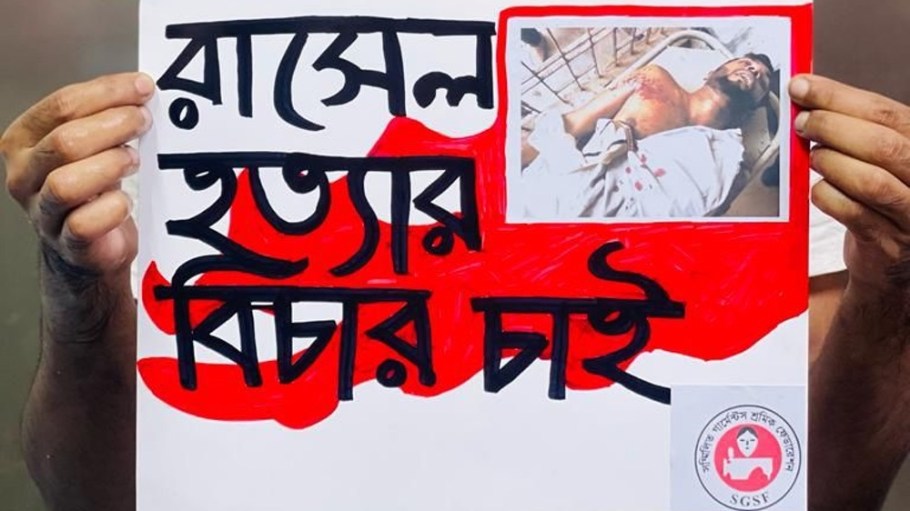
Md. Rasel Howlader, a 25-year-old maintenance machinist at the Design Express, had just finished closing up the factory as part of his job when police shot him, according to Nazma Akter, founder and president of Sommilito Garments Sramik Federation, an IndustriALL Global Union-affiliated union to which Howlader belonged. She said that he wasn’t part of the protests, but that by the time he exited the building, demonstrators were clashing with security forces over what police say was the vandalization of multiple factories, accusations the workers themselves denied.
Related Stories
“Rasel rushed to a nearby petrol station, fearing [for] his safety and was chased by police,” Akter told Sourcing Journal, describing a witness’s account. “He was begging for his life, but the police didn’t say anything and shot him. Rasel needs to get justice. Why should workers be killed when they’re asking for wages?”
She said Howlader was taken by the police to a nearby hospital, where he died. Now, his family is asking for the return of his body, which is in a morgue pending an autopsy.
The unrest comes after garment factory owners suggested raising the minimum wage from 8,000 Bangladeshi taka ($72.63) to 10,400 taka ($94.40), a figure far less than the 23,000 taka ($208.81) that trade unions are asking for and one that they say makes a “mockery of their demands.”
“Workers are reporting a caloric deficit; while profits have roared back workers aren’t even able to put food on the table,” Ayesha Barenblat, founder and CEO of fashion advocacy group Remake, told Sourcing Journal, calling the 23,000 taka number the “bare minimum” that workers are requesting. “And now being faced with such violence is unconscionable. And really, the wage board proposals were just disappointingly low. Hungry workers are not productive workers and this is not a way to run a business.”
Shelly Heald Han, chief of staff at the Fair Labor Association, whose roster includes Adidas, Patagonia and Uniqlo owner Fast Retailing, called Howlader’s death “such a tragedy, particularly as workers in Bangladesh struggle for higher wages.” The organization, together with fellow multi-stakeholder groups such as the Ethical Trading Initiative and the Fair Wear Foundation, had written to Bangladesh’s minimum wage board in August in support of a higher minimum wage.
“Wages for many in Bangladesh have not kept pace with the cost of living, but we are optimistic that the current minimum wage-setting process will help change that,” Han told Sourcing Journal. “We encourage the government of Bangladesh to foster an environment that respects workers’ collective bargaining rights and empowers them as essential stakeholders in this process.”
Because of a substantial drop in the value of the taka in relation to the U.S. dollar, brands have reduced their labor costs in Bangladesh by 38 percent “in real terms” since 2019, said Thulsi Narayanasamy, director of international advocacy at the Worker Rights Consortium, a Washington, D.C.-based think tank. At the start of 2019, the labor of a Bangladeshi garment worker, at the 2023 U.S. dollar value, cost $117 a month, or 56 cents per hour. Today, that same labor costs $73 a month, or 35 cents per hour.
“Murder and violence against people struggling to survive on poverty wages demonstrates the global fashion industry doesn’t just outsource clothes production to Bangladesh, it also benefits from vicious repression of workers when they stop work to speak out against their exploitation,” she told Sourcing Journal.
Howlader’s death comes just months after the June murder of trade unionist Shahidul Islam, who was negotiating the payment of unpaid wages at Prince Jacquard Sweater when he was fatally attacked by a group of assailants. And while more than a dozen brands, including Adidas, Gap Inc., Levi Strauss and Patagonia recently penned a letter to Prime Minister Sheikh Hasina asking that a revised minimum wage cover workers’ basic needs while leaving some discretionary income, only Patagonia has publicly come out in support of a 23,000 taka floor wage and none have responded with real commitments, Narayanasamy said.
“Brands say they want to pay a wage that workers can survive on, yet at this crucial moment where they need to support the call for a 23,000 taka wage alongside committing to increasing their prices to suppliers, the collective silence is deafening,” she added.
Sourcing Journal has reached out to the Gazipur police and the Bangladesh Garment Manufacturers and Exporters Association for comment.