
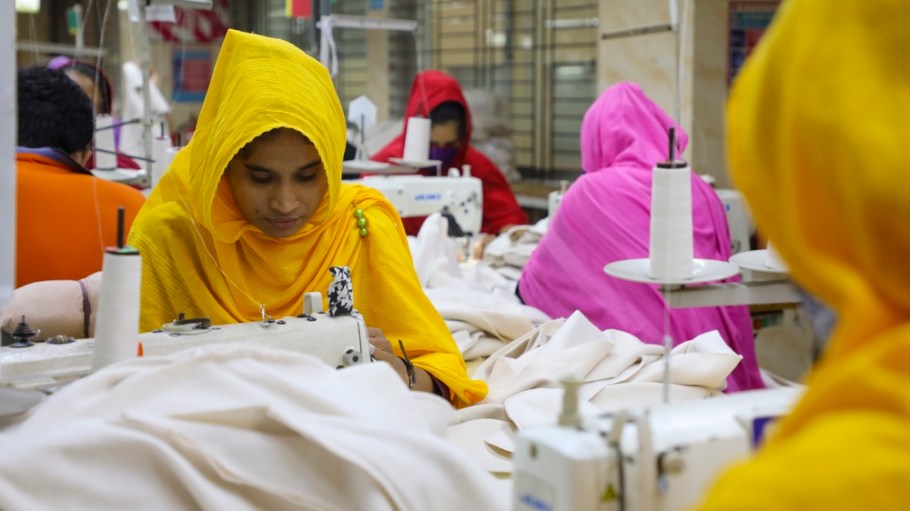
Factory workers from industrial zones around Dhaka have been thronging train stations and boat terminals as they head to their hometowns for voting day on Thursday for the national election.
The government declared a four-day holiday around the election period, from Feb. 10 to Feb. 14, prompting a mass departure from the capital and nearby manufacturing hubs.
Workers from industrial towns such as Gazipur, Ashulia and Tongi have faced traffic jams and a shortage of tickets. Several said they were also concerned about potential violence in Dhaka and felt that leaving early would help ensure their safety while allowing them to reach their polling stations on time. Media reports, citing mobile operators, said that more than 5 million mobile phone subscribers left the national capital over the past two days.
Related Stories
Although violence has often foreshadowed elections in Bangladesh, analysts say this vote is widely seen as especially volatile.
After 15 years of former Prime Minister Sheikh Hasina’s Awami League in power—a tenure that ended when she was toppled in 2024 by a student-led uprising—the political landscape has shifted dramatically. An interim government led by Professor Muhammad Yunus has since taken charge, and the contestants in this election have set a markedly different tone.
The election is also viewed as critical to the country’s economic outlook. Alongside the parliamentary vote, Bangladesh will hold a constitutional referendum on reforms aimed at reshaping political accountability and governance structures.
Muhammad Yunus, the chief adviser heading the interim government, said in an address on Wednesday, “This epoch-making referendum and national elections will be considered a unique and significant chapter in the political history of Bangladesh. This is not just an election or a constitutional process; rather, it is an important juncture that reflects the country’s future system of state, democratic trends and the sovereign will of the people.”
Analysts note that the Feb. 12 election differs from those of the past two decades, arguing that the results will determine whether the transformation envisioned after the 2024 upheaval can take hold or falter. Some have pointed to incidents of mob violence in December, including attacks on two media houses in Dhaka and on heritage cultural institutions, as signs of lingering instability.
Dr. M. Masrur Reaz, chairman and chief executive officer of Policy Exchange Bangladesh, told Sourcing Journal that “Bangladesh is undergoing a triple transition—deepening democracy, restoring governance across institutions and reconstructing the economy.”
He added that this process requires comprehensive, time-bound and integrated reforms at a moment when fiscal and external pressures are intensifying.
The composition of contestants in this election is itself markedly different. With the Awami League banned from contesting, the Bangladesh Nationalist Party appears to be the frontrunner. Although the BNP has long been a major political force and has governed the country for several terms, it is now led by Tarique Rahman following the death of his mother and former party chief, Khaleda Zia, on Dec. 30. Rahman returned to Bangladesh in December after more than 17 years in exile. Several forecasts suggest that the BNP, possibly in alliance with smaller parties, is well positioned to win.
At the same time, an 11-party coalition led by Jamaat-e-Islami—itself barred from contesting in previous elections—has emerged as a significant force. Its resurgence has raised concerns among minorities and women workers who fear a potential curtailment of women’s rights if conservative elements gain influence. Civil society observers have expressed unease about the growing prominence of Islamist politics. Analysts note that even if the coalition does not secure victory, it could form a powerful opposition bloc in parliament.
For the business community, the stakes are high, particularly for the apparel sector.
A director at the Bangladesh Garment Manufacturers and Exporters Association (BGMEA), speaking on condition of anonymity, told Sourcing Journal, “Apparel exports account for more than 4 million workers, and 80 percent of these are women. We are hoping there will be no downslide of civil liberties, as this will cripple the sector.”
The ready-made garment industry accounts for more than 81.5 percent of Bangladesh’s total exports and remains vital to an economy that secured a $4.7 billion loan from the International Monetary Fund (IMF) in 2023. The IMF program, disbursed in tranches, is tied to tighter fiscal and monetary policies aimed at stabilizing the economy.
Factory owners say 2025 was marked by deep uncertainty as orders plummeted. BGMEA too elected new leadership on June 16, 2025, after months of internal uncertainty.
Although Bangladesh remains the world’s second-largest apparel exporter after China, and factory safety has improved significantly over the past decade with substantial investment, manufacturers reported mounting challenges and declining orders, particularly in the second half of the year. A Bangladesh Knitwear Manufacturers and Exporters Association (BKMEA) official told Sourcing Journal that more than 250 factories shut down in 2025. He said that with shifting geopolitics and consumer demand, manufacturers were hard pressed to keep factories running without any surety on orders.
Global trade turbulence has compounded these pressures.
Tariffs introduced by President Trump rattled exporters, and shifting political and economic conditions at home unsettled global buyers as well as causing factory owners palpitations.
However, a trade agreement signed Monday with the U.S. reducing the reciprocal tariff from 20 percent to 19 percent and granting exemptions for some textiles and garments made using U.S. cotton has offered a measure of hope.
Industry leaders say the deal gives Bangladesh a competitive advantage over other sourcing countries, and that this may well be the silver lining they have been hoping for to change the tough outlook of the previous year. Sharing the news, commerce adviser Sheikh Bashir Uddin told reporters that under the new agreement, negotiated over nine months, apparel produced in Bangladesh using cotton fiber imported from the U.S. would enjoy duty-free access to the U.S. market.
Even as work goes on pause, and the country gears for elections on Thursday, with 299 constituencies going to the polls from 7:30 a.m. to 4:30 p.m., anticipation is rife; results are expected by Friday morning although the election commissioner has cautioned that delays are possible.
For many of the workers who have spent the past several days rushing home, secure jobs and fair wages are clearly high on their wish list from the changing government. “We want stable work and regular orders,” said a garment worker waiting at Gazipur bus terminal on Wednesday. “Whoever forms the government, we hope they will ensure that we have jobs, and the freedom of association.”


