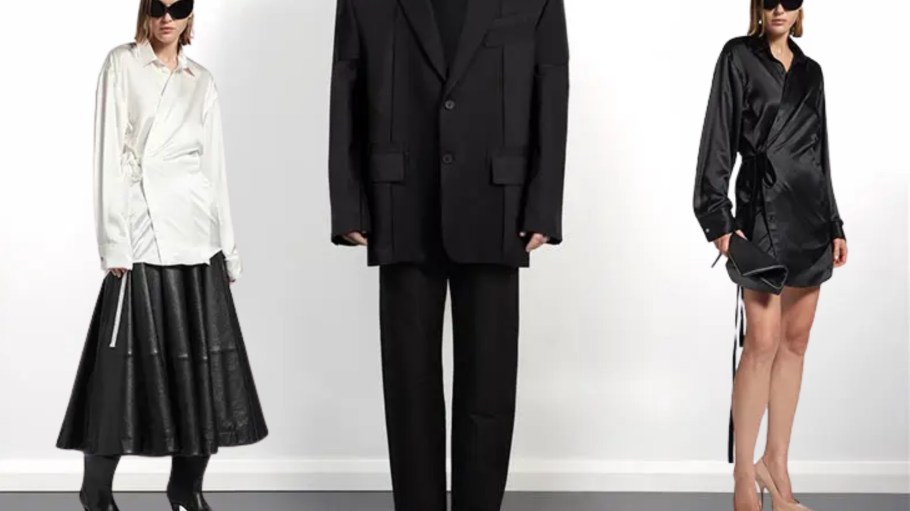
Balenciaga has a few tricks up its sleeve for Spring 2026.
The luxury Spanish house has introduced dual innovations and an artificially-intelligent partnership for its next collection.
With the support of Kering’s Material Innovation Lab, Balenciaga continues pushing lab‑grown materials and low‑waste construction—not to mention leveraging agentic frameworks—into commercial luxury endeavors; beyond experimental capsules, the couture conglomerate said.
Materially speaking, Balenciaga will drop spider-inspired bioengineered silk from the world’s first industrial supplier of vegan silk biopolymers, AMSilk, alongside 3D woven tailoring with Weffan, a UK-based startup shortening production cycles with advanced 3D weaving technology.
“At the heart of the Spring 26 collection is Balenciaga’s debut use of 3D weaving, a software-driven textile process developed in collaboration with Weffan, a startup founded in 2020 by award-winning textile designer Graysha Audren,” a press release from Kering reads.
Rather than assembling them later, the collaboration applies 3D weaving to suiting, building seams, pockets and sleeves directly into the fabric. The companies said this approach cuts fabric offcuts and shortens production time by reducing the number of pattern pieces and construction steps. With that in mind, Balenciaga framed the technique as a scalable solution and next-gen alternative to conventional tailoring—one aimed at eliminating waste and inefficiency before the first sample is even made.
On that note, Balenciaga’s advanced bioengineered silk alternative, developed with AMSilk, debuts in a fluid warp shirt and shirtdress within the Spring 26 ready-to-wear collection.
The “innovation of AMSilk” lies within “DNA editing and protein engineering,” per Balenciaga, one developed by scientists from a spider’s genome as a blueprint to engineer microorganisms in a bioreactor. Its production uses roughly 97 percent less water and emits 81 percent less carbon dioxide than conventional silk manufacturing, according to the Munich-based manufacturer. The resulting material is certified Product Class I and microplastic-free by the Hohenstein Textile Testing Institute and as bacteriostatic by Microbial Testing Competence.
“These microorganisms produce lab-grown proteins that are transformed into polymers, spun into ultrafine yarns and woven into a silk-like textile that can be tailored like any natural fiber,” Balenciaga said in a statement. In tandem, AMSilk said the luxury collaboration is a defining moment for the Technical University of Munich spin-off.
“This application shows that bioengineered materials are no longer experimental,” said Ulrich Scherbel, chief executive officer of AMSilk. “They are ready for demanding industrial environments and real market adoption. It reflects years of technological progress and demonstrates how innovation at material level can enable both performance and more resilient production systems.”
Both the Balenciaga Weffan jacket and trousers, alongside the AMSilk shirt and shirtdress, are available in select Balenciaga stores worldwide and online. Aside from materials, the brand nicknamed “Balenci” has also updated its internal operations.
The Kering company also unveiled an agentic artificial intelligence collaboration with the Plano, Tex.-based startup, Intelo.ai, to overhaul Balenciaga’s global retail operations for the age of AI. The strategic partnership centers on integrating Intelo.ai’s Collaborative Intelligence Agent Network, which the developer called a suite of specialized AI agents designed to “augment human decision-making” and “master the complexities of modern luxury retail.”
“In the luxury sector, having the right product in the right place at the precise moment of desire is paramount,” said Vasilis Dimitropoulos, co-founder and managing director EMEA for Intelo.ai. “Our agents don’t just manage stock; they provide the cognitive scale necessary to ensure a brand’s craftsmanship reaches the clients who want it most, effectively turning dormant inventory back into active revenue.”
While Intelo.ai declined to share specifics on the partnership’s scope, co-CEO Jeff Fish shared on social media that the collaboration will “redefine the boundaries of retail merchandising and planning” for the luxury label.
How? Collaborative Intelligence: what Intelo.ai defined as a model where AI agents act as “digital teammates” versus static tools. These virtual agents are designed to handle high-frequency tasks, allowing human planners to focus on efforts such as sophisticated stratagem and creative direction.
“In today’s global market, ‘trapped capital’—inventory stuck in the wrong location while in high demand elsewhere—is a silent growth killer,” Fish posted to his LinkedIn profile. “We are empowering planners to move away from manual spreadsheets and toward high-level strategic decision-making.”