Back-to-school (BTS) season is in full swing, and it’s poised to yield mostly favorable results for retail, with experts seeing sales trending upward from 2022. But shopping behavior continues to reflect the economic concerns that remain top of mind for most consumers.
“While inflation—how quickly prices are rising—has slowed in the last year, prices are still higher comparatively,” Michael Zdinak, director of U.S. consumer markets service at S&P Global Market Intelligence, told Sourcing Journal, noting that “part of the slowdown in inflation reflects softer demand.” Last BTS season, consumer prices rose more than 8 percent across the board, “but, in S&P Global Market Intelligence’s forecast, the consumer price index (CPI) is expected to rise just 4.1 percent this year,” Zdinak said. That increase is driven by the rising cost of rents and services, and has actually led to a slowdown in increases in retail prices.
Related Stories
“Consumer sentiment has risen this year, boosted by a labor market that remains historically tight,” he added. The University of Michigan Consumer Sentiment Index surged in July, reaching its highest level since October 2021, and recording one of the largest monthly increases since 1980. Sentiment has recovered nearly half of its pre-pandemic level after falling to an all-time low in June 2022. Survey respondents cited slowing inflation, as well as strong labor markets, as reasons for optimism, Zdinak said. “In our forecast, sentiment continues to advance this year with income gains being the key driver.”
“Initial results around back-to-school spending remain mixed,” Ernst & Young (EY) Americas retail lead Isaac Krakovsky said, noting that parents are still “looking for ways to cut costs, on everything from electronics to clothing.”
EY insights from June showed a 0.2 percent gain in BTS spending, “as consumers cut back on essentials to spend more on discretionary items.” As parents look for ways to “rein in their spending, they continue to focus on affordability,” and part of that includes trading down. “We’re seeing some brand erosion with increased prioritization of private labels in search of more affordable options.”
“Amid ongoing recessionary concerns, the biggest priority for parents this BTS season is how to get the most products for the least amount of money,” Krakovsky added.
EY’s Future Consumer Index revealed that in the US, 33 percent of parents shopping for their kids are exploring new brands in a bid to cut costs, and 36 percent view private labels as a palatable option. More than half of those surveyed by EY (55 percent) went as far as saying brands are “no longer important,” and 50 percent said they’d look into private labels for apparel, footwear and accessories. “Affordability first is a top priority for U.S. consumers as they struggle to stretch their finances,” the consultant said. “This shift to an affordability first mindset has led to the demise of the ‘brand is king’ mentality.”
“In our forecast, consumers prioritize the must-haves for a new school year, backpacks, books, and school supplies, and cut back a bit on the bigger ticket items they likely bought last year, new furniture, and personal computers,” S&P Global’s Zdinak said.
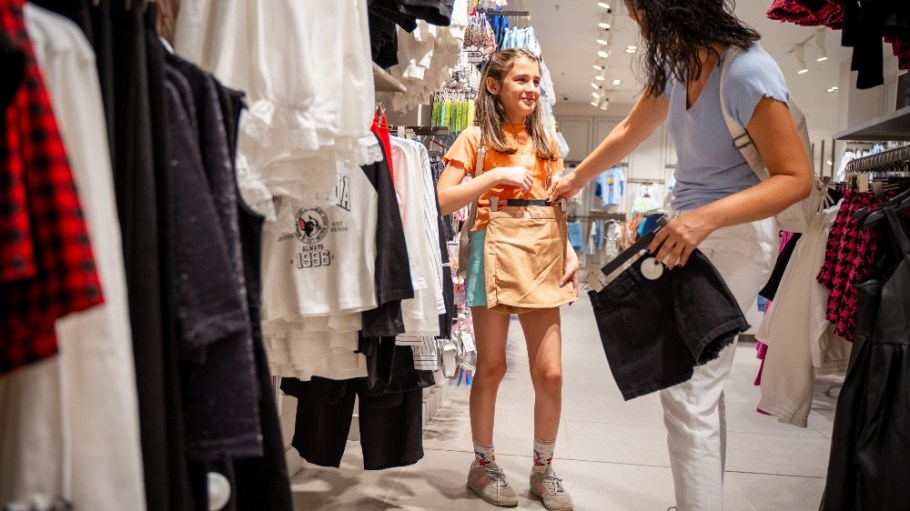
Despite their price sensitivity, BTS spending will increase over last summer and early fall—”and some of that increase will be driven by in-store purchases,” Krakovsky said. In-store promotions and tax-free weekends are proving to be a “major draw” for parents. “These campaigns are a win-win for consumers and retailers,” he added. “Deals, sales and special promotions incentivize shoppers to leave stores with more than they bargained for.” A July Numerator study of more than 1,000 shoppers revealed that 69 percent plan to make BTS purchases in-store. Nearly half (45 percent) said they would shop sales, while 35 percent plan to use coupons.
“Most retailers have indicated that they intend to reduce their inventories further, and may need to use extra promotions to do so,” S&P Global head of supply chain research Chris Rogers added.
Retailers that can provide a convenient one-stop shopping experience will also have an advantage. Numerator data showed that 80 percent plan to purchase BTS supplies and more at multi-category mass retail like Target and Walmart, while 20 percent plan to shop at dollar stores and 15 percent plan to shop at club stores like Costco. Malls, too, will benefit from the increased retail footfall, according to Placer.Ai. The retail data intelligence firm’s July data showed that indoor malls, open-air shopping centers and outlet malls saw month-over-month increases in traffic from June, representing three consecutive months of growth. Not surprisingly, outlet malls saw the largest uptick, with 17.8 percent more shoppers visiting in July than in June, followed by indoor malls (6.6 percent) and open-air shopping centers (6.4 percent).
Mall-based retailers and department stores have helped drive the trend with targeted television advertising, according to Entertainment Data Oracle (EDO), a platform that measures ad effectiveness across cable and streaming. While overall advertising spend has decreased by 26 percent year over year, likely due to economic factors, overall ad effectiveness increased by 6 percent during the same period.
BTS advertising has also garnered better results than standard advertising for many retailers. Since July 1, BTS ads have been 11 percent more effective than non-BTS ads; for Kohl’s, the differential was 8 percent, and for Macy’s, it was 17 percent. JCPenney and Target both spent markedly less in BTS television and streaming ads year on year, with the department store slashing its spend by 78 percent and the big box retailer cutting 65 percent of its budget. Remarkably, the effectiveness of each firm’s BTS ads grew, with JCPenney seeing 26 percent more engagement and Target saw 10 percent growth from 2022.
Online shopping will remain important this BTS season, but consumers will likely turn to e-commerce to supplement their in-store purchases, whether they find a better deal on the web or a product that isn’t available at physical retail, EY’s Krakovsky added. About 17 percent of shoppers plan to use e-commerce for BTS purchases, and 9 percent will use buy online, pick up in store (BOPIS) for fulfillment, according to Numerator.
Leonard Marano, president of the Americas division of technology and equipment company Lectra, said brands and retailers’ responses to changes in consumer demand will be key to their success or failure this BTS season. “Retailers must realize that accurate forecasting and competitive brand analysis will be key to building winning product assortments that meet the desires of customers and ultimately reduce waste.”
The firm’s product lifecycle management (PLM) tool, Kubix Link, facilitates inventory management, among other functions. “Retailers can ensure that they are producing on trend products at the right time for the right price,” Marano said, and “a higher focus on inventory management will help ensure that your assortment will sell and leave you with less stock that will ultimately never make it off the shelves.”
In addition to optimizing their apparel inventory management process in order to create an accurately sized collection of styles, “retailers can benefit from competitive analysis platforms that can accurately track competitor pricing and assortments to make sure they are pricing their objects in line with competition,” the executive added. That’s key to ensuring “that they will get their fair share of the market.”