Senators voted 99-1 on Tuesday morning to strike a provision related to states’ lawmaking powers on AI from Republicans’ megabill.
The so-called AI moratorium would have prevented state lawmakers from creating and enforcing state-specific AI regulations for 10 years, and it was initially proposed with the idea that it could foster innovation for large U.S. technology players competing to propel the U.S. forward.
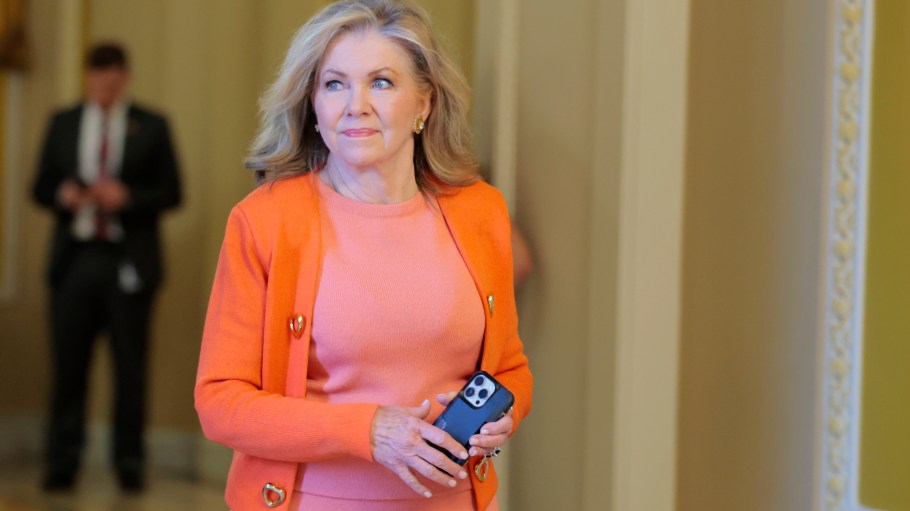
The widely contested moratorium lost momentum Monday night when Senator Marsha Blackburn (R-Tenn.) struck up a deal with Senator Maria Cantwell (D-Wash.) that saw the two introducing an amendment to axe the provision from Republicans’ megabill. Blackburn had previously entertained a compromise with Senator Ted Cruz (R-Texas) on the AI moratorium, but ultimately abandoned the partnership, citing “frustration” over Congress’ inaction on important legislative considerations.
Related Stories
“This body has proven that they cannot legislate on emerging technology. It is frustrating,” Blackburn said. “There are all of these pieces of legislation dealing with AI that we haven’t passed. But you know who has passed it? It is our states.”
Cruz had tried to broker a last-minute compromise with Blackburn, but ultimately withdrew that amendment and voted in favor of striking the AI moratorium. Senator Thom Tillis (R-N.C.) was the lone vote against getting rid of the provision.
Cantwell said removing the moratorium marks a win for consumers throughout the U.S., who will continue to be protected by existing state AI laws and those that are yet to come.
“The Senate came together [Tuesday] to say that we can’t just run over good state consumer protection laws. States can fight robocalls, deepfakes and provide safe autonomous vehicle laws,” Cantwell said. “This also allows us to work together nationally to provide a new federal framework on artificial intelligence that accelerates U.S. leadership in AI while still protecting consumers.”
The “big, beautiful bill” passed the Senate on Tuesday afternoon, without the AI provision.
Sean O’Brien, general president of the International Brotherhood of Teamsters, voiced his dismay for the moratorium last week in a letter to the Senate. He contended that the provision would have harmed blue-collar workers looking to stave off job replacement caused by automation.
“If adopted, this provision extinguishes local control in favor of giving tech companies free reign to act without regard to the cost and impact on local communities,” O’Brien wrote last week. “Pure and simple, it is a give-away to Big Tech companies who reap economic value by continuing to operate in an unregulated void where their decisions and behavior are accountable to no one.”
Politicians from both sides of the aisle had previously expressed serious hesitations about the proposed ban on state regulation, as well; attorneys general from 40 states called on Congress to strip the provision from the bill in May, and Republican governors from 17 states echoed the call late last month.
Marc Frankel, co-founder and CEO of cybersecurity company Manifest, said striking the moratorium could be “an inconvenience” to Big Tech companies but noted that, with their exponential growth in recent years because of AI, they have the tools to handle regulatory compliance needs.
“Having to boost their compliance efforts with state regulations isn’t going to kick the legs out from under their businesses,” he told Sourcing Journal.
In line with what experts projected at the outset of 2025, Congress has yet to pass any sweeping, AI-related legislation; instead, states are at the helm when it comes to regulating the technology, which has created what some call a patchwork effect. Some states have worked toward laws that mandate human operators in autonomous vehicles; others have fought against the proliferation of deepfakes flooding the internet; some have taken on data privacy and more.
Frankel said he anticipates federal legislators may soon put guardrails into place for government agencies that have adopted AI and that, beyond that type of sweeping regulation, U.S. residents may simply see federal legislation that’s “more arcane or technologically specific.”
That projection tracks against what other experts told Sourcing Journal earlier this year; they expected that federal regulators would act on technology issues they hear most about from their constituents. Those issues include deepfakes, children’s safety and more.