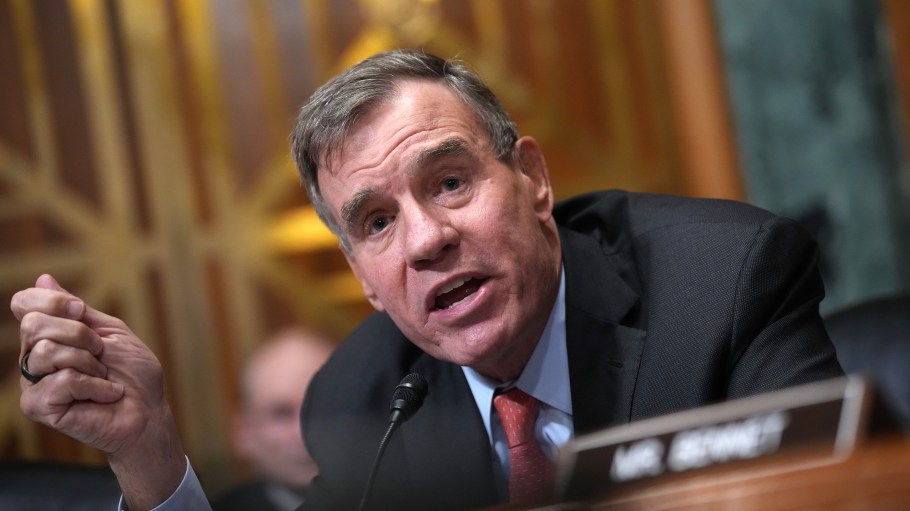
Senators Josh Hawley (R-Mo.) and Mark Warner (R-Va.) proposed a bill this month that would require many major employers to more clearly disclose the impact of artificial intelligence on American jobs.
The bill, called the AI-Related Job Impacts Clarity Act, would compel public companies and government agencies to file quarterly reports on several considerations related to AI in the workforce.
Within 30 days of a quarter’s end, entities would be required to disclose how many workers they had laid off in the U.S. “substantially due to the replacement or automation by artificial intelligence of the functions performed by such individuals;” divulge how many people the entity hired “that are substantially due to the incorporation of artificial intelligence;” share whether the entity decided not to backfill empty jobs because they were replaced with automation or AI and note how many employees the company or agency “is retraining, or assisting in retraining, based on a reason that is substantially due to artificial intelligence.”
Related Stories
The lawmakers noted in the bill’s draft that private entities that are large employers could eventually be impacted by these same rules, if the bill goes through.
Once the required entities have submitted their information to the Department of Labor, the agency’s secretary would need to work with the Director of the Office of Management and Budget and the Director of the Office of Professional Management to prepare a quarterly and annual report that summarizes the impact of AI on the workforce based on the data. That report would be published and submitted to Congress for review.
That Hawley and Warner are working together on the bill could be a signal that, despite President Donald Trump’s continued efforts to clear a path for the proliferation of the technology in the U.S. to compete with other nations, lawmakers have concerns about how the technology could influence Americans’ everyday lives.
Hawley said the bill, if passed, could give Americans a more robust picture of the realities of AI and its impact on the workforce.
“Artificial intelligence is already replacing American workers, and experts project AI could drive unemployment up to 10-20 percent in the next five years,” Hawley said in a statement. “The American people need to have an accurate understanding of how AI is affecting our workforce, so we can ensure that AI works for the people, not the other way around.”
The unemployment figure Hawley cited comes from a projection Dario Amodei, CEO of AI company Anthropic, made in May in an interview with Axios. He expressed that while, today, many AI models are used to augment human labor, that will only creep further toward full automation in the years to come. He said lawmakers and executives inside major companies have, in some ways, turned a blind eye toward the ways AI could impact labor and the economy in the near term.
Amodei is far from the first to make a statement that rings alarm bells for Americans when it comes to replacement or displacement because of AI. He also wasn’t the last.
Amazon CEO Andy Jassy said in an internal memo in June that AI will decrease the number of roles in the company’s corporate workforce—and recently, Amazon axed 14,000 roles. Reports also show that Amazon has floated documents internally suggesting that, because of its prowess in robotics and automation, it might choose not to hire people for roles it otherwise would’ve needed to. The company has said it continues to upskill humans alongside technology and noted that the memo came from one team and may not represent the views of the at-large organization.
Walmart CEO Doug McMillon has said that all Walmart employees’ roles will change, regardless of what they handle, because of AI—and the company expects to work with Sam Altman’s OpenAI in 2026 to further train workers on AI and its impacts.
Shopify CEO Tobi Lütke said this year that, if Shopify employees wanted to add more human heads to their teams, they would first be required to prove AI couldn’t handle the job.
The list of high-powered executives prognosticating on how technology could touch their companies goes on. But how those outlooks manifest has, in many ways, remained unclear to Americans. Warner said he hopes that this bill can change that—and that, if carried out effectively, it could influence further legislation in the space.
“Good policy starts with good data. This bipartisan legislation will finally give us a clear picture of AI’s impact on the workforce—what jobs are being eliminated, which workers are being retrained and where new opportunities are emerging. Armed with this information, we can make sure AI drives opportunity instead of leaving workers behind, ” Warner said in a statement.