Byte-Sized AI is a bi-weekly column that covers all things artificial intelligence—from startup funding, to newly inked partnerships, to just-launched, AI-powered capabilities from major retailers, software providers and supply chain players.
Manhattan Associates drops new supply chain and logistics agents
Manhattan Associates announced at its annual conference, Momentum, last week that, beginning in the fall, it will launch agents designed to handle specific supply chain and logistics tasks. Agentic AI continues to surface to the top of conversations about emerging technology—agents are meant to autonomously deal with certain functions inside of organizations to free up users who would have otherwise had to tackle the same tasks manually.
Related Stories
Manhattan said, to start out, it will drop an agent aimed at optimizing labor, a store management agent, an inventory research agent, an agent that can parse through data with context and more. It anticipates these upgrades will drive efficiencies for customers, because the agents will have access to clients’ own data embedded in Manhattan’s systems, making real-time decisioning and adjustments easier.
Manhattan is far from the only company trying to bring agents to life across multiple functions; SAP announced at its conference, Sapphire, last week that it plans to unleash 40 agents with different functions by the end of the year.
Both Manhattan and SAP will also allow users to configure their own agents; that is to say, if the providers lack an agent with a specific function, users can build one to meet the task. In Manhattan’s case, that capability will be housed under a program called Manhattan Agent Foundry. It stated that customers will be able to “create specialized agents tailored to their unique processes and preferences, drastically reducing time-to-value, increasing automation scalability, enhancing productivity and delivering tangible business value.”
Sanjeev Siotia, chief technology officer at Manhattan, said offering clients the chance to solve their own inefficiencies with technology directly will help them get ahead as they embrace emerging technology.
“Agentic AI isn’t just another feature; it’s a transformative innovation capability tailored to redefine the future of supply chain commerce,” Siotia said in a statement. “By opening up Agent Foundry to our customers and partners, we’re ensuring that AI agent creation will not be constrained by vendor development cycles. This is part of Manhattan’s ongoing commitment to path-breaking technology that heightens efficiency and resiliency. Our best-in-class customer base now has the power to create thousands of digital agents, limited only by their imagination.”
Salesforce spends $8 billion on Informatica acquisition, with agentic in mind
It’s all eyes on agentic for Salesforce. The technology giant announced this week it had agreed to acquire Informatica, a cloud data management company, for $8 billion as part of its quest to better enable the build-out of AI agents for its customers.
Salesforce has put a great deal of resources into Agentforce, a platform of AI agents designed to autonomously handle tasks for companies. Saks has integrated Agentforce and uses it to handle processes like order inquiries and personalization.
Salesforce executives said they expect the acquisition of Informatica, which is slated to close in early 2027, to allow the company to have a more trustworthy, well-governed data foundation on which to build agents with additional functions.
“Truly autonomous, trustworthy AI agents need the most comprehensive understanding of their data. The combination of Informatica’s advanced catalog and metadata capabilities with our Agentforce platform delivers exactly this,” said Steve Fisher, president and chief technology officer at Salesforce, in a statement. “Imagine an AI agent that goes beyond simply seeing data points to understand their full context—origin, transformation, quality and governance. This clarity, from a unified Salesforce and Informatica solution, will allow all types of businesses to automate more complex processes and make more reliable AI-driven decisions.”
Salesforce also plans to use Informatica’s data capabilities to upgrade other systems, like its customer data cloud, to help unify organizations’ data, allowing for faster, better-informed decision making inside organizations.
Amit Walia, CEO of Informatica, said the acquisition marks a turning point for the business and its ability to bring forth game-changing technologies at scale.
“Joining forces with Salesforce represents a significant leap forward in our journey to bring data and AI to life by empowering businesses with the transformative power of their most critical asset — their data,” Walia said in a statement. “We have a shared vision for how we can help organizations harness the full value of their data in the AI era.”
Veho and Rivr team on AI-powered delivery robots
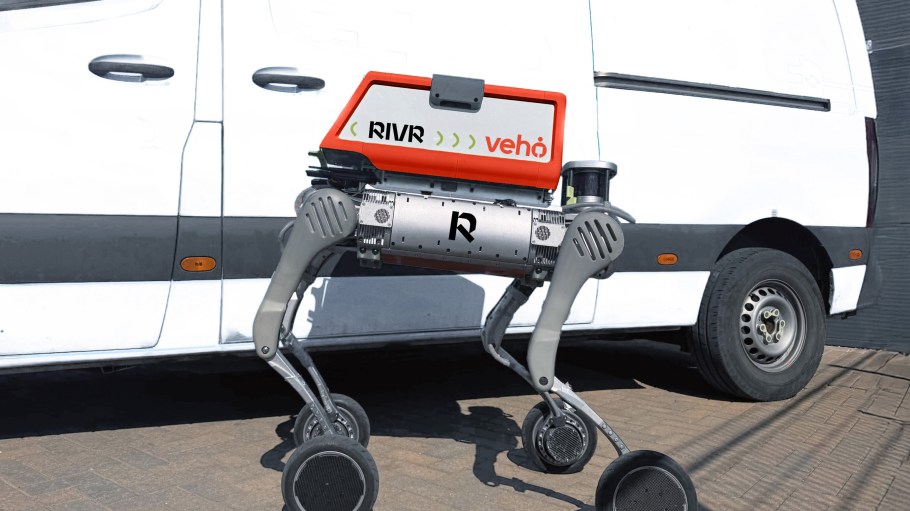
Last-mile delivery company Veho and AI-enabled robotics company Rivr announced this week that they are collaborating on a pilot to use delivery robots alongside human delivery employees in Austin, Tex. If the deployment goes smoothly, the companies plan to expand it to other cities in the United States later this year.
A human Veho delivery driver brings the Rivr robot along with them on their route, and while they deliver one parcel, the robot delivers another in immediate proximity. The robots are retrofitted with cameras, allowing them to snap photos of the delivered parcel to share with consumers. They also have been trained to follow customers’ delivery instructions—for instance, if a customer requests that Veho leave the parcel in front of the garage rather than on the porch, the robot can handle such a request.
Both companies contend that the idea is not to replace human operators, but rather to allow them to deliver more parcels in less time.
Throughout the first phase of the pilot, a Rivr employee will accompany robots on their delivery routes to understand how well it handles requests and operations.
Marko Bjelonic, CEO of Rivr, said the partnership is a step forward in matching consumers’ expectations for fast delivery, particularly in areas where addresses are packed together tightly.
“With the exponential rise in e-commerce, the last mile has become the most critical—and complex—link in the logistics chain. At RIVR, our mission is to put one million delivery robots into the field, leveraging General Physical AI to scale urban robotics to where it’s needed most,” Bjelonic said in a statement. “Our partnership with Veho is a major milestone on that journey to bring our technology to the U.S. As a leading parcel delivery platform in the U.S., Veho offers the ideal environment for deploying at scale—helping us deliver not just faster and more cost-effective service, but a smarter, more human-centered model for robotics in logistics.”
Pallet gets its Series B, led by General Catalyst
Pallet announced this week that it had secured a $27 million Series B round, led by General Catalyst, with additional support from Activant Capital, Bessemer Venture Partners and individual angel investors. The round brings the company’s total funding to $50 million.
The California-based startup promises to help automate key moments in logistics workflows through its primary offering, known as CoPallet. The system uses various agents to complete repeat, manual tasks done by logistics operators today. It can ingest data from shipping documents, create freight quotes, track shipments in real-time with data from other platforms and more. The company contends its solutions can guide workflows 10 times faster than current capabilities while simultaneously cutting costs in half.
Sushanth Raman, Pallet’s CEO and founder, said the company has seen demand increase because of uncertainties associated with President Donald Trump’s tariff strategy.
“This wasn’t a story about hype, it was a story about math,” Raman said in a statement. “Customers ran the numbers. A midsized carrier was able to reallocate 25 employees who were doing repetitive order entry, saving millions. With tariffs driving up costs across the board, the ROI was obvious and our biggest challenge became keeping up with demand.”
Pallet plans to use the funding to expand its engineering team and further build out the agentic AI models handling the workflows for logistics operators. The company serves brokers, third-party logistics players, forwarders and more, so broadening its capabilities remains important to its future value proposition.
But investors already see the promise of the technology, Marc Bhargava, managing director at General Catalyst said.
“General Catalyst believes the next wave of iconic companies will come from applied AI—purpose-built systems that solve real, high-friction problems in massive industries,” Bhargava said in a statement. “Pallet is doing exactly that for logistics, and we believe has the potential to be a multi-billion dollar opportunity.”