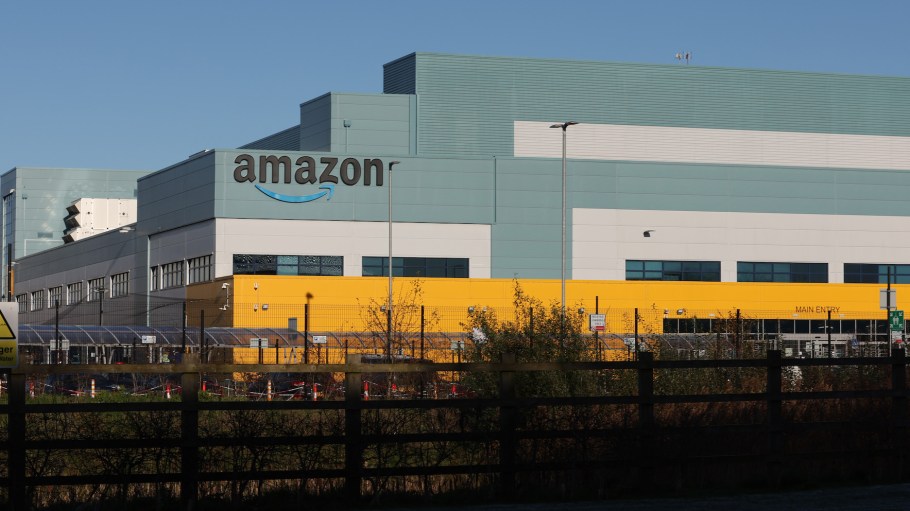
The Washington State Department of Labor & Industries (L&I) fined Amazon another $85,800 for knowingly putting workers at risk of injury at a Spokane fulfillment center.
This is the fifth such citation across four warehouses the state agency has levied against the e-commerce giant since 2021. Because it has cited Amazon for similar violations at other Washington facilities in Sumner, Kent and DuPont, L&I issued a “willful” citation with a higher penalty for the Spokane facility.
Related Stories
In the three years since the warehouse opened, laborers have filed more than 400 workers’ compensation claims for work-related musculoskeletal disorders, the term encompassing strains, sprains and tears often caused by repetitive motions. The Spokane warehouse has the highest injury rates for all Amazon fulfillment centers in the state, L&I said.
The fulfillment center was also cited for three serious and one general violation for noise levels that were too high when workers are not wearing appropriate hearing protection.
As of Wednesday, Amazon has 15 business days to appeal the citation. The e-commerce giant said it plans to appeal.
Amazon is appealing the prior four citations in Washington State in a case that could set the tone for how state and federal officials tackle workplace safety concerns at the company’s warehouses.
During the trial expected to last through September, a judge from the Board of Industrial Insurance Appeals (BIIA) will determine if Amazon has violated state law by failing to create a safe working environment.
If the judge rules in favor of L&I, Amazon would have to amend its warehouse operations, following suggestions from the department.
The L&I, which administers and oversees individual statewide workplace safety and health programs approved by the federal Occupational Safety and Health Administration (OSHA), slapped Amazon with $7,000 fines for each of the first three citations in Sumner and DuPont. But the agency approved a $60,000 fine for the latest incident, claiming that the company was aware of workplace hazards at its Kent facility, but didn’t make necessary changes to improve safety.
An Amazon spokesperson said the company disputes the agency’s claims.
“We disagree with the allegations, and especially with the ‘willful’ characterization. Once again, L&I is relying on prior citations we have challenged—and that are being challenged in court right now—as a basis for alleging that we willfully exposed employees to ergonomic hazards. That is categorically false,” Amazon spokesperson Maureen Lynch Vogel told Sourcing Journal.
The company also takes issue with L&I’s characterizations of the alleged noise hazards.
“We look forward to a full and fair hearing on the citations we’ve already challenged, because the fact is, we’re making measurable progress and have improved recordable incident rates in the U.S. by 23 percent since 2019,” Vogel said. “We will continue to prioritize the health and safety of all of our employees.”
Amazon has long clashed with OSHA over how it handles injury reporting data.
According to data cited by the Strategic Organizing Center (SOC), a coalition of labor unions critical of Amazon’s injury rates, the serious injury rate at Amazon warehouses in 2022 was 6.6 per 100 workers—more than double the rate at non-Amazon warehouses (3.2).
Although the SOC often notes that Amazon reports this data directly to OSHA, the e-commerce giant has maintained that the stats are provided with improper context since the federal agency doesn’t officially measure a “serious injury” metric.
Amazon also says that since OSHA’s reporting requirements don’t mandate that retailers categorize where injuries take place, the company’s warehouse-related injury totals are often skewed to appear larger than its physical retail counterparts.
The Seattle firm invested $300 million in safety improvements in 2021, including $66.5 million to create technology that would help prevent collisions of forklifts and other types of industrial vehicles. But it might have to pay even more if it loses the appeal.
“Perhaps more than any other company, Amazon has the means and the know-how to invest in solutions that keep their workers safe,” said Craig Blackwood, assistant director for L&I’s Division of Occupational Safety and Health (DOSH), in a statement.
In an effort to reduce warehouse worker injuries, effective July 1, 2024, Washington state law will require large distribution centers to disclose any production quotas workers are expected to meet. The law also requires quotas to factor in time for rest and meal breaks, time to use the restroom, and time to access tools and safety equipment needed to perform the job.
Injury reporting and ergonomic violations at national Amazon warehouses has led to many citations from OSHA. The safety concerns got the attention of Independent Vermont Senator Bernie Sanders, who chairs the Senate committee that launched an investigation into what he called “dangerous and illegal” conditions at Amazon warehouses.