The International Brotherhood of Teamsters says Amazon illegally fired 150 third-party drivers working out of a warehouse based in Queens, New York. The e-tail giant begs to differ.
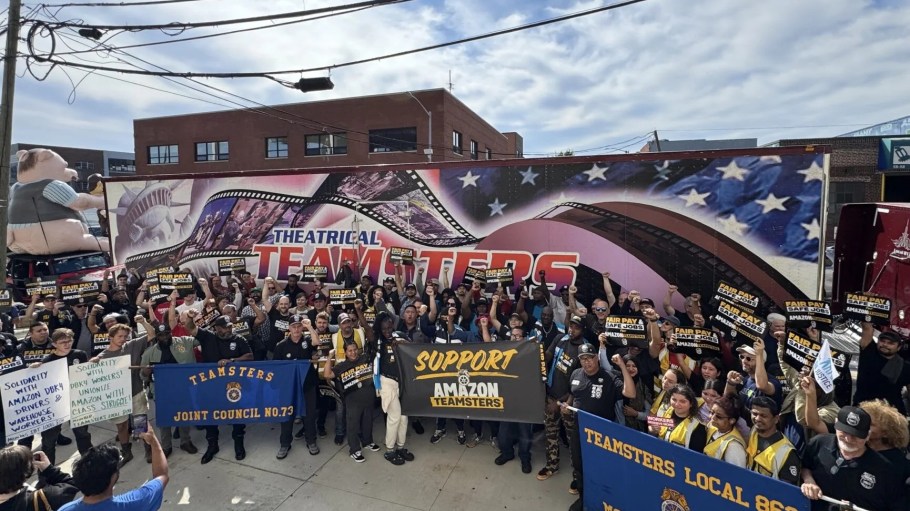
The Teamsters said Amazon, in cutting contracts with delivery services partner (DSP) Cornucopia, axed union-protected jobs, and held a Monday rally against the company’s alleged wrongdoings. The union said impacted employees had joined the Teamsters in September 2024 and called Amazon’s choice to cut the contract resulting in the firings “sudden and illegal.”
Related Stories
According to the Teamsters, the DSPs that joined the organization last year had a majority of drivers sign authorization cards to unionize under the Teamsters, then delivered the demand to Amazon. The drivers working to organize were hoping to garner “better pay and working conditions from Amazon,” they said at the time, promising to “fight like hell with the Teamsters to get what we deserve.”
To date, though, Amazon has not voluntarily recognized the organization efforts coming out of DBK4, nor have the DSPs held a formal election overseen by the National Labor Relations Board (NLRB). An Amazon spokesperson said it has not been legally compelled to work with the Teamsters in Queens.
The Teamsters have long said that DSP employees should be recognized by Amazon, even though they are formally employed by Amazon subcontractors. Most recently, the union called Amazon’s DSP strategy “a phony shell game.”
“Drivers wear Amazon uniforms, follow Amazon rules and work off Amazon’s routing software. Amazon calls the shots. They are the employer and everyone knows it,” the Teamsters for a Democratic Union wrote in a blog post Monday.
Amazon spokesperson Eileen Hards denied the Teamsters’ claims about illegal firings and dismissed them as bogus.
“These claims are false and this is just another example of the Teamsters deliberately spreading misinformation to advance their own agenda. The truth is that no Amazon employees or delivery partners have ever chosen the Teamsters as their representative in an NLRB election, and the NLRB has never directed Amazon to bargain with the Teamsters,” Hards said in an emailed statement.
The Teamsters said the company is acting in retaliation against the DSPs that joined the union in September 2024; a spokesperson for the union told Sourcing Journal the firings violated the National Labor Relations Act (NLRA) and the Worker Adjustment and Retraining Notifications (WARN) Act.
For its part, Amazon noted that it consistently reviews and updates the DSPs it works with to support both employees and customers.
The Teamsters cited a regional determination by an NLRB director in Region 31 that said that Amazon is a joint employer of DSP drivers in a Palmdale, Calif., warehouse. That determination, however, applies only to the workers in Palmdale and has not been formally ruled upon, said labor and employment attorney David Wimmer, partner at Swerdlow Florence Sanchez Swerdlow & Wimmer.
“There’s been no ruling on that [determination] by an administrative law judge. There’s been no ruling on that by the National Labor Relations Board, nor by any court. That is merely an allegation that was issued as part of a complaint by Region 31 in response to a series of unfair labor practices filed by the Teamsters against Amazon,” Wimmer explained.
Amazon said the Teamsters’ messaging about the status of the NLRB determinations has misled the public and confused DSP drivers about its impact on their employment.
Because the case has not yet been decided, Wimmer said the Teamsters “appear to be overstating the case greatly for their public relations benefit.”
Wimmer further said that he believes the union is “trying to exploit the complaint issued in Region 31…because if they’re successful in the challenge in [California], then they have a foot in the door to try to replicate that challenge nationally.”
Camron Dowlatshahi, partner at MSD Lawyers, said that while precedential law doesn’t yet find that Amazon is considered a joint employer, he believes it’s only a matter of time. He noted that the Region 31 determination is “setting up the case for a hearing or for a trial,” which he said Amazon might struggle to win.
“I would expect, over the next several months to a year, for there to be decisions against Amazon, in favor of joint employer liability, at least in the state of California,” Dowlatshahi said.
A regional NLRB director in Georgia has filed a complaint that includes a joint employer allegation similar to the one filed in California.
Dowlatshahi said that the Teamsters’ efforts and statements about the workers in Queens seem to be aligned with the idea that Amazon may, in the future, be named as a joint employer for DSPs.
“I wouldn’t take it as they are misrepresenting anything; I think they are definitely characterizing it correctly,” Dowlatshahi said. “The NLRB’s [determination] is not precedential for any court, but it’s certainly persuasive.”
As Wimmer said, if Amazon is formally ruled a joint employer in California, the Teamsters could try to use precedent to make the same case in other states or regions. The union has already started to set up DSP strongholds in New York and Illinois, which Dowlatshahi said are traditionally considered to house less conservative courts.
“That’s a typical strategy, whether you’re a plaintiff or a defendant—you want to be in the best forum possible,” he said.
And the Teamsters aren’t shying away from a fight with the e-tail giant. Randy Korgan, director of the Teamsters Amazon Division, said the union will do everything in its power to protect the livelihoods of the displaced workers from DBK4.
“When normal people break the law, they go to jail. When Amazon executives do it, they get rewarded,” Korgan said. “Amazon’s crime spree has gone on long enough. The Teamsters are fully prepared to put these crooks in their place if they don’t reinstate our brothers and sisters at DBK4.”
Dowlatshahi said future complaints alleging that Amazon should be labeled a joint employer for DSPs could change the way employees are treated—and their capability to report illegal activities. He noted that, already, he has seen a trend toward governments keen to label large companies as joint employers; for instance, the Ritz-Carlton Hotel Company received a citation and a fine of more than $2 million from the California Labor Commissioner’s Office for “misclassifying 155 janitors as independent contractors” at one of its hotels.
Dowlatshahi said he expects to see that trend continue, and that categorizing major companies as joint employers when they use subcontractors as full-time employees helps protect workers’ rights.
“These companies are trying to…disclaim any sort of liability for any sort of employment malfeasance,” he said. “If this is ignored, and the trend is reversed and joint employer liabilities are not a thing anymore, then you have a dangerous situation where the only recourse is to go after a DSP or some contractor that has very minimal resources and oftentimes is a lawsuit away from declaring bankruptcy.”