Some of the biggest players in logistics are bullish on robots—especially those that are integrated with artificial intelligence systems.
Earlier this month, Amazon cut the ribbon on an AI-enabled, first-mile logistics facility in Charlton, Mass., that employs hundreds of robots alongside more than 1,000 humans.
Amazon broke ground on the facility, which opened in November but was formally recognized this month, in March 2022. It has more than 30 million items in stock, and Amazon invested more than $300 million in building and staffing the 2.8 million-square-foot facility.
Related Stories
Massachusetts Governor Maura Healey said she believes the facility will prove a positive addition for Charlton, a rural community the U.S. Census Bureau estimates to have a population of about 13,000 people. Census Bureau shows that Worcester County, where Charlton is located, has a population of more than 862,000.
“Amazon’s Charlton robotics fulfillment center will bring economic activity and growth to Worcester County and our rural communities,” Healey said. “Massachusetts continues to be a leader in innovation and technology, and it’s great to see these opportunities expanding all across our state.”
That it is partly powered by AI-powered robots seems to be on par with Amazon’s future-facing strategy. The company has built some of its own warehouse robots, and in other cases, has partnered with outside firms to bring the technology in.
The first-mile facility is responsible for picking and packing products, then teeing them up for transport to middle-mile facilities and eventually reaching last-mile delivery centers. The robots that the facility is equipped with have the ability to lift up to 1,500 pounds each, and they’re meant to help human workers with orders that come through the fulfillment center.
Amazon has repeatedly contended that it plans to use AI, robotics and other emerging technologies to aid workers, both in fulfillment centers and in corporate offices. But on Wednesday, Andy Jassy, the company’s CEO, said Amazon would be likely to shed jobs because of the continued rise of agentic and generative AI systems. While he was, in specific, referring to corporate roles at Amazon, the company has laid off tens of thousands of people since 2022, some of them warehouse and fulfillment center workers.
Still, the company remains committed to upskilling some of its workers on robotics and engineering, having committed at least $1.2 billion to doing so since 2020.
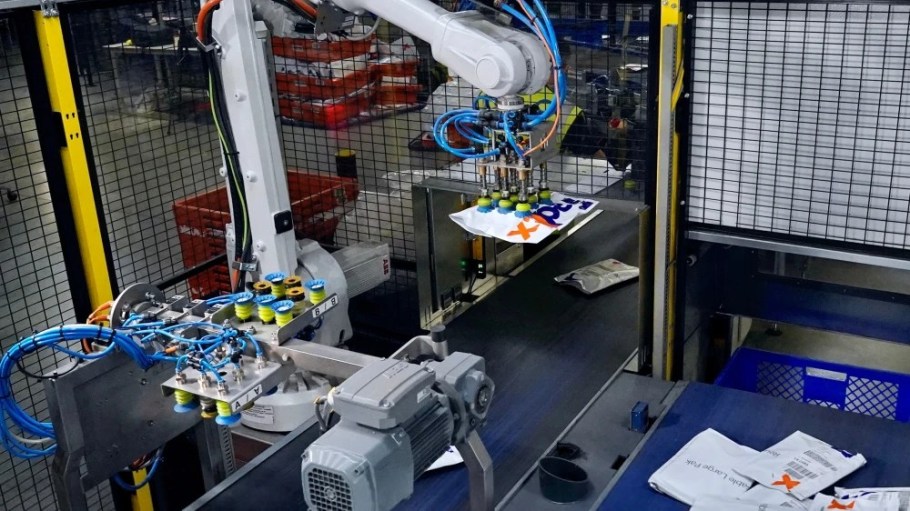
Other companies are also stepping up their robotics acumen for logistics. Third-party logistics giant FedEx announced late last week that it had introduced AI-powered robotic arms for sortation at its air network facility in Cologne, Germany.
The location employs more than 900 team members, and the robotic arm will help sort small parcels; according to FedEx, the arm is manufactured by Hellebrekers B.V. and can sort as many as 1,000 units per hour. The company contends that allowing a robot to handle intake for some of the smallest parcels entering the facility frees human workers up to handle more complex tasks.
Already, the company has integrated similar technology into facilities in Tennessee, New York, Las Vegas and Ohio. It uses robots to sort and identify parcels in 17 of its U.S. sites, and also uses sortation robots in its Guangzhou, China, and Singapore hubs. The use of the arm in Cologne is the first time the technology has broadened into FedEx’s hub in Europe.
Boris Stoffer, managing director network operations Germany at FedEx, said the impacts of the robot will be felt not only by employees but also by clients.
“AI-supported technologies like this help us manage shipments more effectively, enhance customer experience, and boost our competitive edge as e-commerce continues to drive growth in the market,” Stoffer said in a statement. “These technologies are also supporting our employees by reducing physical [stress] by taking over repetitive, high-volume tasks.”