
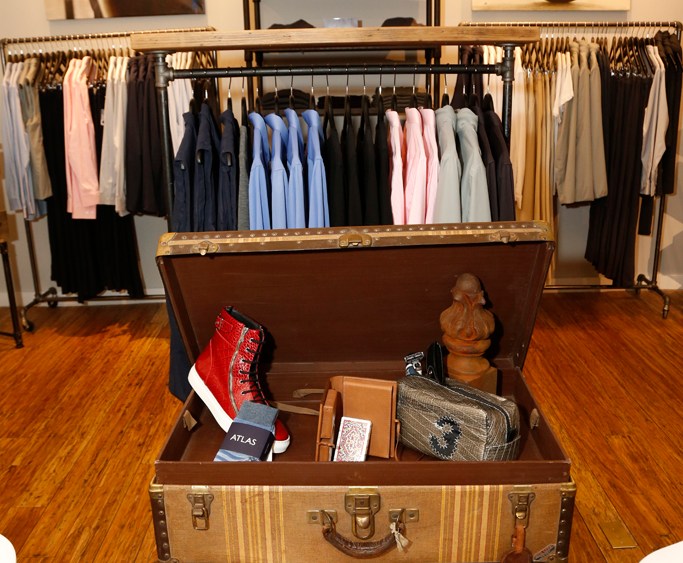
NEW YORK — In the shadow of Lord & Taylor on West 38th Street here, the Bene Rialto town house makes a curious statement. It blends a retail experience with a showroom format and targets consumers and store buyers seeking new and less-widely distributed labels.
“We see ourselves as a destination for brand-building rather than a retailer,” said Caryn Neary, the founder, owner and chief executive of Bene Rialto. “We’re a marketplace concept for retailers that’s constantly evolving. It’s about connecting them with emerging brands and providing a critical look at the direction of the industry and upcoming trends.”
Retailers generally aren’t welcoming of other retailers checking out their assortments and wooing the same vendors. But Neary says the Bene Rialto philosophy is different, encouraging retailers to visit and place orders directly with the brands that the store brings under its wings, so the brands can grow. The brands pay Bene Rialto a participation fee of $500 and upward, and turn over 25 percent of their sales revenues for the exposure on the selling floor as well as for consulting services. Most brands maintain a dedicated presence at Bene Rialto for three to six months before making way for other vendors, while roughly 10 percent would stay longer. The rotation of brands helps Bene Rialto convey fashion newness and share a changing fashion trove with retailers. Bene Rialto does not own the inventory.
Related Articles
Its launch comes at a time of mounting urgency that stores across the board lack merchandise innovation and design inspiration and need to get consumers excited about shopping for fashion again. Yet some are taking action. Bergdorf Goodman is developing a fashion lab on its sixth floor for emerging talent, and last fall, Lord & Taylor opened two concept shops — Birdcage and Brand Assembly. The Council of Fashion Designers of America supports emerging talent though its CFDA Fashion Incubator program, and Macy’s has its Designers-in-Residence of the Fashion Incubators program in a handful of cities.
You May Also Like
At Bene Rialto, the first three floors of the five-story, 5,000-square-foot, early 20th-century town house are the retail store. It presents a mix of smallish brands and designers offering men’s and women’s wear, footwear, accessories, jewelry and gifts. The upper levels house an art gallery, a lounge, and the Bene Rialto Collective, a by-appointment designer showroom that launched during the last Fashion Week and had a three-week run. The next Collective will be in April coinciding with Coterie.
Since beginning operations last November, Bene Rialto, according to its executives, has contacted and attracted such retailers as Saks Fifth Avenue, Shopbop, Holt Renfrew, Rent the Runway and The Doneger Group. Sometimes retailers show up without prior notice. “We can tell who the retailers are by the questions they ask,” said Glen Lagerstrom, who handles the Collective. He said they typically ask, ‘How did you find your brands? How do you select the brands? Where are they based? Where else are they carried? How long have they been in business?’”
In a crowded, competitive city, Bene Rialto’s hybrid character is a differentiator though passersby don’t always immediately get what it is, being a new kid on a block not generally associated with shopping. Foot traffic is increasing due to a few recent hotel openings on 38th Street including the Refinery and the Archer, which houses David Burke’s Fabrick restaurant. Next year, a Starwood hotel is expected to open at 25 West 38th Street.
Bene Rialto, formerly a store that sold buttons and trim primarily to the trade, was completely renovated by Neary. She spent 12 years at Saks, last working as vice president of merchandising for Saks Direct, then becoming a consultant, working with emerging brands and creating pop-up shops. She decided two years ago to start Bene Rialto, which is Italian for “good marketplace.” Neary has a silent partner, and two former Saks merchants, Jo Polanco and David Teeter, working with her as merchandisers. After Saks, Polanco worked at Lane Crawford and Walin & Wolff, and Teeter worked at Holt Renfrew. There’s also a general manager, Timothy Burger, a former manager at Kate Spade and Henri Bendel.
The store carries brands such as Ministry of Supply, a men’s sportswear collection with $98 men’s shirts that incorporate heat-mapping technology and technical fabrics to help the body breathe better, developed by MIT engineering graduates. There is also $200 athletic-inspired footwear from Johan Cruyff, a former Dutch soccer player, for which Bene Rialto is the first point of distribution in the U.S. For Nha Khanh’s $800 to $1,000 evening dresses, Bene Rialto is the only point of distribution in New York.
Also sold is Nesh, a New York-based yoga-inspired sportswear line produced in the garment center; dresses from Philadelphia designer Paula Hian; Slightly Alabama, a handcrafted, hand-stitched, leather goods line made in New York City, and Smart Glass Art jewelry and glassware handcrafted from recycled bottles.
The assortment — accessories, footwear and apparel — ranges from socks priced at $25, to $2,000 advanced contemporary dresses, with the bulk of the merchandise priced from $100 to $300. Men’s and women’s items are intermixed on the selling floors. The Bene Rialto team shops trade shows, stores around the world, and showrooms, and has open calls for designers to introduce their lines. There is also a Web site for e-commerce.
“There’s lot of flexibility for change and moving and morphing,” Neary said. “We have 50 brands. We could go to 90. We are exceeding our sales plan by 10 percent and by year end, we’ll be profitable.”