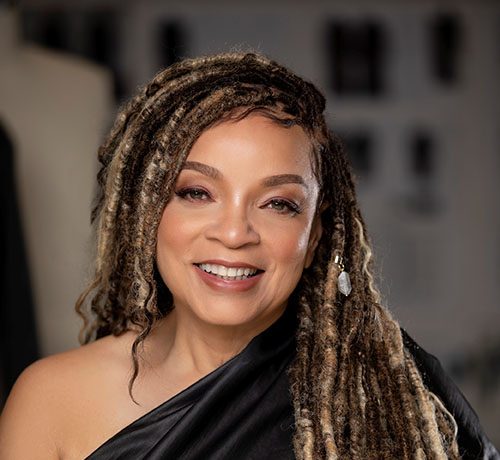
“It was out of this world, otherworldly. It was God saying ‘You’re fulfilling your purpose girl and the people who support and love you are here to applaud your efforts, your hard work and your sacrifice,’” Ruth Carter told WWD regarding the Oscar she won in 2019, making history as the first Black woman to win for Best Costume Design.

The famed costume designer has been the brains behind the fashion for some of the most legendary films, including “Do the Right Thing” (1989), “Malcom X” (1992), Marvel’s “Black Panther” (2018) and its sequel (2023). After a three-decade-long career, Carter is gearing up to release her first book: “The Art of Ruth E. Carter: Costuming Black History and the Afrofuture, From Do the Right Thing to Black Panther,” on Tuesday.
Related Articles
“We wanted it to come out way before it did. It just so happens that it came out after my Oscar win, which nobody could predict,” Carter said regarding the book and her second Oscar win this March for Best Costume Design, which solidified her as the first Black woman to win two Oscars.
You May Also Like
The upcoming title is slated to be a read that deviates from the normal “how-to” format that comes to mind when one thinks of costume design, simply because Carter’s approach to the subject is much more elaborate than that.
“I thought that wouldn’t be as interesting as telling the stories about meeting with historians, digging deep to get the period or culture right and those obstacles that I faced: going to Egypt and working with Denzel, being the only one that they actually sent from the United States and having a crew of people that didn’t speak the language,” she shared.
“I felt like those stories about being a costume designer were more inspiring than me saying ‘take all of your colors and put them together and how does it make you feel?’ I think there’s space for that kind of a book also, but the first book I wanted to write was the one about my journey and hopefully that will inspire people to understand me better as a costume designer, not a fashion designer.”
For her role as a dynamic costume designer, Carter not only creates outfits for characters, but curates fashion in such a way that it becomes a catalyst to the larger story of the film. It’s a highly collaborative project that involves producers, writers and actors.
“When the actors come into my fitting room, I’m ready for them. I have research on the walls, I have their sketches on an easel, I have clothing that’s been custom built and at a stage where it’s ready for a fitting, so it may not be completely finished yet. I have a plethora of footwear, because a lot of times they are in action or they have to move and pivot, so it’s not just about beauty, sometimes it’s also about functionality. When I get together with the actor, we’re first telling the story.”
Carter even recalls a moment when Oprah Winfrey, who she has worked with on “Selma” (2014) and “The Butler” (2013) detailed what it was like working with her in an interview. “She said, ‘I have been dressed by some of the biggest designers in the world. You go into Ruth’s fitting room and she’s like, ‘Oh yeah, well, we won’t be having any of that. Here’s what you have,'” Carter shared humorously, adding “We’re trying to journey together to create a character.”
The costume designer knows a thing or two about creating iconic characters, with her most recent work on the “Black Panther” sequel “Black Panther: Wakanda Forever.” Directed by Ryan Coogler, the film introduced the new underwater seaworld Talokan and its king Namor, which Carter said was inspired by the Mayans and Mesoamerica.
“I started learning about Jade, the Spondylus shells, how the Mayans used the rubber plant and created a ball game, they had sheer fabrics,” Carter said about preparing for the new underwater setting. “Then, I knew we were underwater, so I looked at fish and fish fins. What could we use? We talked to oceanographers, we asked them ‘what’s in the bottom of the ocean that we could use?’ and they said ‘lots of bones’ and we were like ‘great, bones!'”
But the preparation for the film came to a temporary unanimous halt in August 2020, when actor Chadwick Boseman, who played the iconic Black Panther, King T’Challa, died at 43 years old after a private battle with colon cancer.
“Nothing prepared you for the loss of your hero, your lead, your friend, your collaborator, your brother, your loved one,” Carter said about the actor’s death, later adding, “We saw that we were all going to be telling a story about grief and we could use this medium. Lucky for us, we could use art to channel some of our emotions.”
So, following Boseman’s untimely passing, while grieving, Coogler and fellow writer Joe Robert Cole rewrote the script, and Carter forged on, using fashion to tell the story of loss.
“We went to some historians on African culture and found that in many African societies, they all wear white at the funerals. So Ryan said, ‘All white, pure white, not cream, white, white.’ African artistry, whether it be beadwork, carve fabric or Ndebele, it’s colorful. I had to figure out how to make these tribes distinctive, and all in white,” Carter told WWD.
Eventually, she did find a way to dress each Wakandan tribe in white, while still preserving their individuality. She saw her work fully come to life during the film’s procession, where each tribe was lined up in all-white gear.
“I’d see a cluster of Zulu and they’d have their white fur and their shields that we did with the cow, then I saw the Tuareg and they were all together, the women and the men with the wraps, then I went to the Ndebele and we had the neck rings,” she shared adding, “I saw the procession coming through and each tribe was marching. I was emotional. It was like Africa unified.”
Carter wrote the book while working on “Black Panther: Wakanda Forever,” and said she had to become comfortable with the idea of editing and tweaking her story.
“Telling your story once is like, ‘OK, I got it out.’ I told them that adventure. But then I had to go over and groom it. It just felt like a lot. It was a lot and I wasn’t off. If I had not been working, maybe it wouldn’t have felt as hard as it was,” Carter said.
But with Carter working on more than 40 films throughout her career and making history twice in the span of five years, it seems like it was well worth it. “I don’t know if anyone could have this kind of experience like I’ve had in my career,” Carter said.
“The Art of Ruth E. Carter: Costuming Black History and the Afrofuture, From Do the Right Thing to Black Panther” will be available for purchase online Tuesday at Barnes and Noble, Book Shop, Amazon and Chronicle Books.