
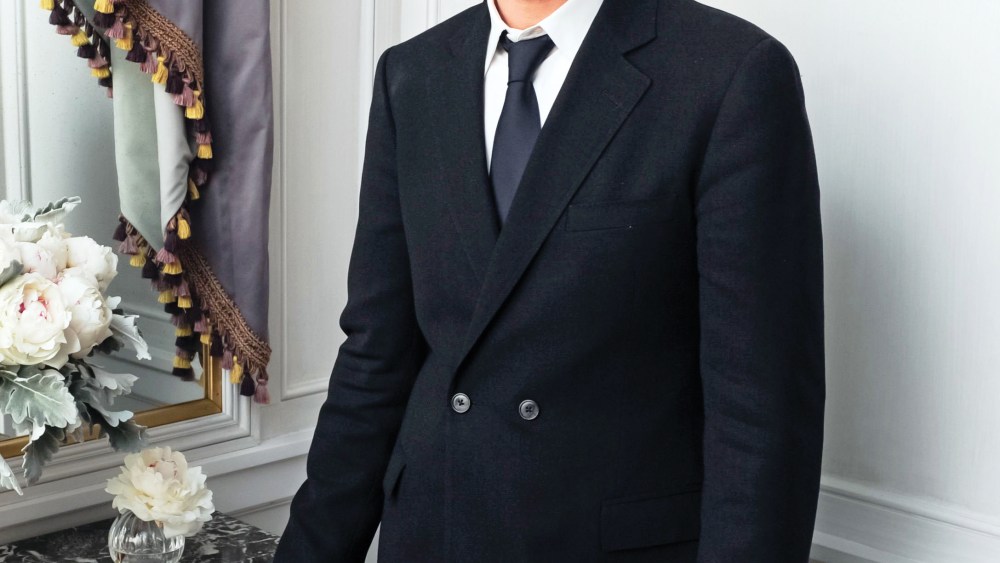
No stranger to Pitti Uomo, Raf Simons will return to the Florentine trade fair for a special presentation on June 16. The Antwerp-based designer staged an exhibition there in 2003, marked the 10th anniversary of his signature men’s brand in 2005 and staged a Jil Sander show in 2010 when he was creative director of the Milan-based house. With speculation widespread that Simons is heading to Calvin Klein as the company’s overall creative director, he remains mum on that subject. He also is keeping a tight lid on particulars about his spring 2017 collection and the “Florence Calling: Raf Simons” spectacle he’s concocting. But the designer spoke freely about the evolution of the fashion industry, his love of men’s wear and his stature — after more than two decades — as one of its most enduring innovators.
Related Articles
You May Also Like
How does it feel to be back at Pitti?
It’s nice to go back because I know the people, and the collaboration is very warm and very professional and very nice. I don’t know why it’s so different from showing in Paris, but you get this kind of emotional connection to it.
Can you tell us what to expect?
The only thing I can say is that people are invited to the fashion show, just like every other fashion show I have done in the past 20 years, but I have added things. I can’t really say what it is because it’s so specific and I think it will be so much nicer for everybody if it’s a surprise. The one thing that I can say is that the actual collection itself is again a collaboration with an artist.
Now that you’ve left Dior, has that given you more time to devote to this event?
It’s going to be quite different from a normal runway show, I think. It’s also something that I could not have done if I had not been in the situation that I am in now. I am fascinated with the questions that are hanging over fashion right now. What is the future of the fashion show? What is the future of product? What is the relationship between product, audience, selling and previewing? I think the whole environment is very structured….I think there are a lot of things in danger, particularly smaller, more daring ventures that don’t seem to fit the mentality of a bigger house with a bigger amount of product. I think that’s a pity because that’s not how fashion used to be.
Why is that?
You know, there’s lots of money involved. I think it’s really interesting how younger brands or more niche brands can take a different kind of position. The system can be good, but I think the way it is evolving is ridiculous: the amount of product, the amount of deliveries, the delivery schedules, the amount of presentations, the scale of presentations, the number of looks on the runway, bags, all that kind of stuff. I see it not only happening in my own situation, but I see it everywhere. And I’m not sure that it’s going to hold up any longer.
Youth culture and streetwear seem to be having a real moment now. Why?
The designers that are coming now are definitely going very, very much toward the teenage kind of thing. I think about things like Demna Gvasalia of Vetements and I am happy that something like that is welcomed. I like very much that there is somebody coming in with an attitude that I recognize. But maybe I would prefer if I saw somebody coming in with an attitude that I don’t recognize and that has impact.
Looking back at your career, what are some recurring things?
The beautiful part of the Raf Simons brand is that it literally says or does what it wants to do. It’s very, very freeing. It’s never really been a big brand in terms of product, but it has always marked its independence. Right now it’s actually strong and growing. In men’s wear, there is not yet an over-offering of brands and products that are really different. So, for me, men’s is still very interesting and very, very much something to focus on.
Indeed, men’s wear seems to be having a creative and commercial renaissance.
Our society has definitely evolved and I think therefore, it’s much easier for men to buy high fashion. I think that fashion became a very normal thing. Fashion became very pop. It’s not the way it was when I started almost 20 years ago. I remember that in the early Nineties, people would be ashamed to go to fashion academies. Now everybody wants their kids to do something within fashion. At the same time, I think that way too many people are tapping into fashion and they don’t have that much to say or share. I think there are a lot of people that can make nice clothes, but I don’t think there are a lot of people who can make a difference in fashion, which I think is something that is necessary.
You’ve always been daring with men’s wear.
I think that men’s fashion has not been daring at all for a long time. I find it a pity because I would almost say that men deserve to be treated like women. There’s so much variety and so many options in women’s brands. I don’t think that’s happening in men’s wear at all. Sometimes you can see something very exciting on the stage, but it doesn’t get to the stores very often.
What are the next steps for your label?
Just to continue in the way of being totally independent. Of course, I would also be really interested in opening stores.
You’ve had women in men’s clothes on your runway. Could a women’s wear launch be in your future?
I enjoy working on women’s very much. For me, there’s no difference. Having women on the runway was something that was very eye-opening: none of the garments were made for a woman. It’s about scale and size and attitude. I have no plans to launch women’s wear. It might come at one point, but not now. It doesn’t feel like something I have to do now, it doesn’t feel like something I want now and it doesn’t feel like something that would make me happy if I did it now. For me, it’s satisfying knowing that a woman can buy what I am doing even if it’s presented on men.