
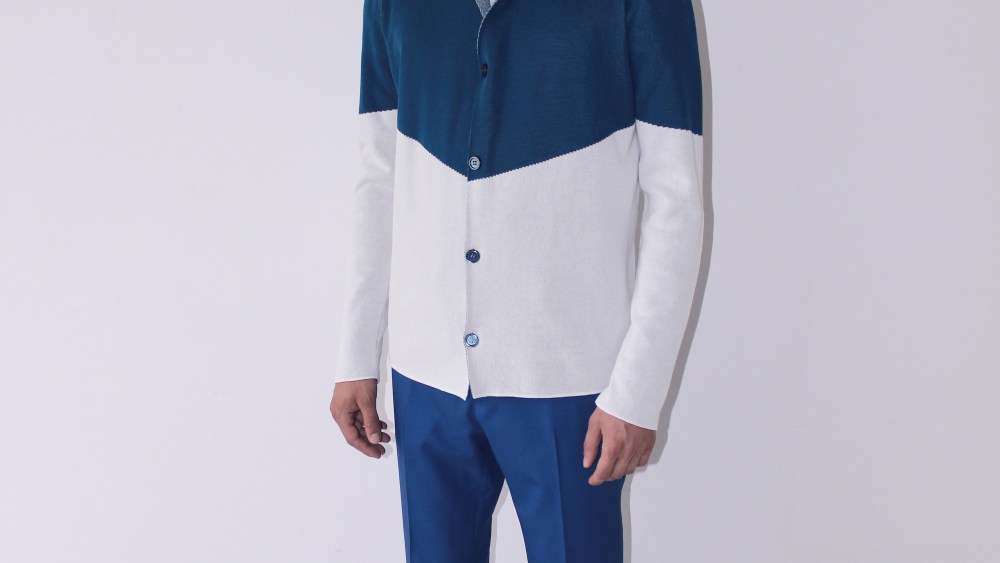
Ones to Watch: some hot brands to check out in Paris during the men’s shows.
Essius
Classic tailoring usually doesn’t rhyme with fun. But in the case of Essius, it’s part of the picture.
Hailing from Switzerland, the brand — now in its second season — takes cues from Dadaism, and much like the cheeky art movement founded in Zurich in 1916, it twists existing codes to produce a fresh new look. Cue dandyish suits that come in reversible materials, upped with playful but subtle prints as well as the label’s now trademark curvy lapels inspired by the form of Le Corbusier’s famous LC4 chair.
“I have spent a lot of time in shareholders’ meetings, but the dress options were always the same,” said Essius’ founder Adel Najah, an investor and former chief executive officer at Each Other. “Either I go for a handmade Italian suit, which lasts, thanks to its high quality but ultimately is a very conservative, uniform option, or I take a suit from a fashion label that frankly lacks the same quality and comes with a higher price tag. I want something edgy but not too fashion-y, and at a price level that feels right.”
Related Articles
Through a friend, Najah teamed with Youn Chong Bak, who for 16 years cut her teeth at Francesco Smalto, most recently as the Parisian tailor’s creative director. It was the master herself who taught her the craft. “Mr. Smalto always said there is no man you cannot suit. It’s all in the construction,” she said. “He worked a lot on the movement, so that in the end a guy could be elegant and still drive a car or perform some other activity.”
You May Also Like
Much like her mentor, Bak adopted the full-canvas option for the inside of Essius jackets, which help them keep their handsome form. “Usually, brands fuse or thermo-bond the inside, which is cheaper and doesn’t require much know-how, but the thing is: a suit evolves based on temperature and weather conditions, and we want it to stay in a guy’s closet,” she said.
The brand’s playful character also comes through its choice of fabrics, which include cashmere next to waterproof materials from Loro Piana, as well as typical women’s textiles such as silk and see-through qualities, an idea Bak again adopted from the master tailor.
Targeting a younger customer, a two-piece suit from Essius produced in Italy starts at 1,290 euro, or $1,450 at current exchange. A shirt sells for 250 euro, or $281, while coats retail at 1,390, or $1,563.
For spring, the collection takes cues from Le Corbusier’s Heidi Weber museum in Zurich, mixing yellow and white with electric blue and black.
While so far the line has only been available in made-to-measure, a trunk show is slated for fall in Paris as well as in Zurich during the city’s film festival. An e-shop is to launch in September.
Icosae
Icosae, founded in 2014, is the brainchild of brothers Valentin and Florentin Glemarec, great-grandchildren of a French tailor from Brittany, who instilled in them a formal sense of aesthetic. But mixed with the boys’ contemporary penchant for youth subcultures, the label channels a playful mix of high-and-low-brow dressing. Asymmetries and exaggerated volumes take cues from streetwear while deconstructed, open-seam constructions hail from tailoring.
“Icosae is influenced by street, because this is what we see. But there are already a lot of streetwear labels and we didn’t feel like doing just sweaters,’” said Valentin, who is also freelancing as a graphic and video artist for Givenchy. “And since we are very much into tailoring because of our family, we decided to give it an artisanal touch.”
The brothers admit they were too young to exchange trade secrets with their great-grandfather, but they raided his archives instead, which explains a run of hybrids such as a baggy pair of heavily pleated raw denim pants and a four-arm trenchcoat that has already emerged as the label’s trademark.
“Our starting point is always the cut,” said Florentin, who is also a model and has walked down the runway for brands including Dior Homme, Kolor, Ann Demeulemeester and Antonio Marras, “and then we add on details such as prints.” The brothers, who studied drawing and painting at the Ecole du Louvre in Paris, execute those prints by hand.
For spring, the prints are inspired by the artwork of Francis Bacon, while overall the collection harkens back to the Japanese Bosozoku subculture, associated with customized motorcycles. Their motto — “Live fast, die hard and leave a good-looking corpse” — has become the collection’s title. “In previous seasons we used a lot of rough and rigid fabrics, but now we have balanced it out with silk and virgin wool, so delicate you can see through it,” said Florentin.
Produced in France and Belgium by the same manufacturers that handle orders for Givenchy, Raf Simons and Dries Van Noten, the pieces retail between 250 euro, or $281, for a printed and embroidered T-shirt, and 1,500 euro, or $1,687, for a big coat.
Icosae, which takes its name from the icosahedron, a solid 3-D figure with 20 faces, is currently sold at five doors, including The Cartel in Dubai and Nubian in Tokyo.
Sean Suen
Having been introduced to the Western Hemisphere by GQ China during London Collection: Men, where he showed last January, Sean Suen is taking a leap across the Channel, where he is scheduled to stage a runway show as part of Paris men’s official calendar this week.
“London has made me develop a lot. But Paris is definitely a dream come true and it will just be a beginning,” said the self-taught Beijing-based designer, who originally studied graphic design at the Sichuan Fine Arts Institute.
He said: “After I graduated from university, I entered a company and began with a nine-to-five job that required little creativity [although the position was for a so-called ‘graphic designer’]. Soon enough I realized that it was not the ideal work for me, so I resigned. That is basically how I started my fashion design career,” he recalled.
Suen is aware of the challenges that lie ahead. While Europe is “a mature market with consumers who know what they want,” he acknowledged, “China, on the contrary, is a fresh one and people are more likely to follow blindly.”
His aesthetic is athletic, but not without a good dose of tailoring. Suen said he likes to play with opposites, mixing different fabrics and textures to unexpected visual effects, such as a combination of leather and silk that has been a recurring theme in his collections.
For spring, he employed cuts from traditional Asian costumes, while also experimenting with denim and silk for the first time.
“While I am increasingly interested in wearability, I am always hoping to express something more than fashion itself,” he said, adding that “the experience from learning painting in my youth has a natural impact on my aesthetic as well as my design. My target customers are simply those who appreciate my design.”
Currently available through eight doors, including Galeries Lafayette in Beijing and Harvey Nichols in Hong Kong, the collection sells between 150 euro, or $168, for a T-shirt and about 1,000 euro, or $1,123, for a coat.